On this page
Between 1979 and 1983, India learned two different things in space. With the Bhaskara satellites it learned to look at Earth from orbit. With Rohini and the SLV-3 rocket it learned to get there on its own. Here is what each did and how to check its orbit with school physics.
What were the Bhaskara satellites?
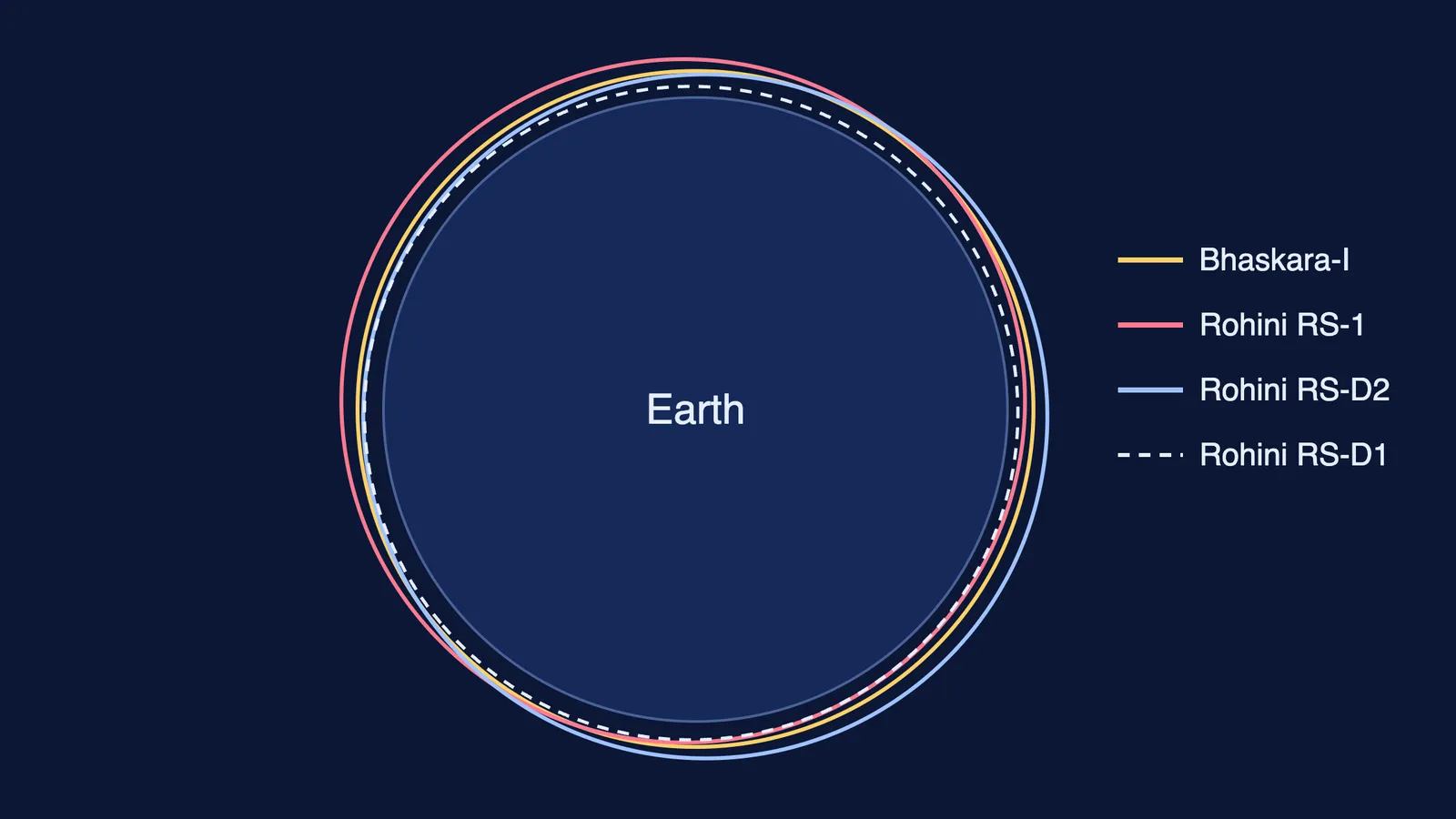
ISRO describes Bhaskara-I as "the first experimental remote sensing satellite built in India". It was launched on 7 June 1979 on a Soviet C-1 Intercosmos rocket, weighed 442 kg and circled Earth in a 519 x 541 km orbit inclined at 50.6 degrees.
It carried TV cameras and a three-band microwave radiometer called SAMIR. ISRO's page says the camera images were used in hydrology and forestry. The mission was planned to last one year, and the satellite stayed in orbit for about ten years before re-entering in 1989.
A second craft, Bhaskara-II, followed on 20 November 1981. It weighed 444 kg and flew in a 541 x 557 km orbit. ISRO records that one of its two cameras ran into a problem, yet it still sent more than two thousand images.
What was the Rohini satellite and the SLV-3?
Rohini was a family of small satellites built to ride India's first launch vehicle. ISRO describes SLV-3 as an all-solid, four-stage rocket 22 m tall, weighing 17 tonnes and able to place 40 kg class payloads in low Earth orbit.
The first flight, SLV-3 E1 on 10 August 1979, carried a Rohini Technology Payload and was "only partially successful", in ISRO's words.
The second flight worked. On 18 July 1980, SLV-3 E2 lifted off from SHAR, Sriharikota, and placed the Rohini satellite RS-1 in orbit. ISRO says this made India the sixth member of an exclusive club of space-faring nations.
Rohini RS-1 weighed 35 kg and reached a 305 x 919 km orbit inclined at 44.7 degrees. Its payload was a set of launch vehicle monitoring instruments: during the launch it sent all the readings from SLV-3's fourth stage to ground stations. It also carried a digital sun sensor and a magnetometer.
The team that designed SLV-3 was led by A. P. J. Abdul Kalam, according to his official biography released by PIB in 2002.
Why did one Rohini fall back after nine days?
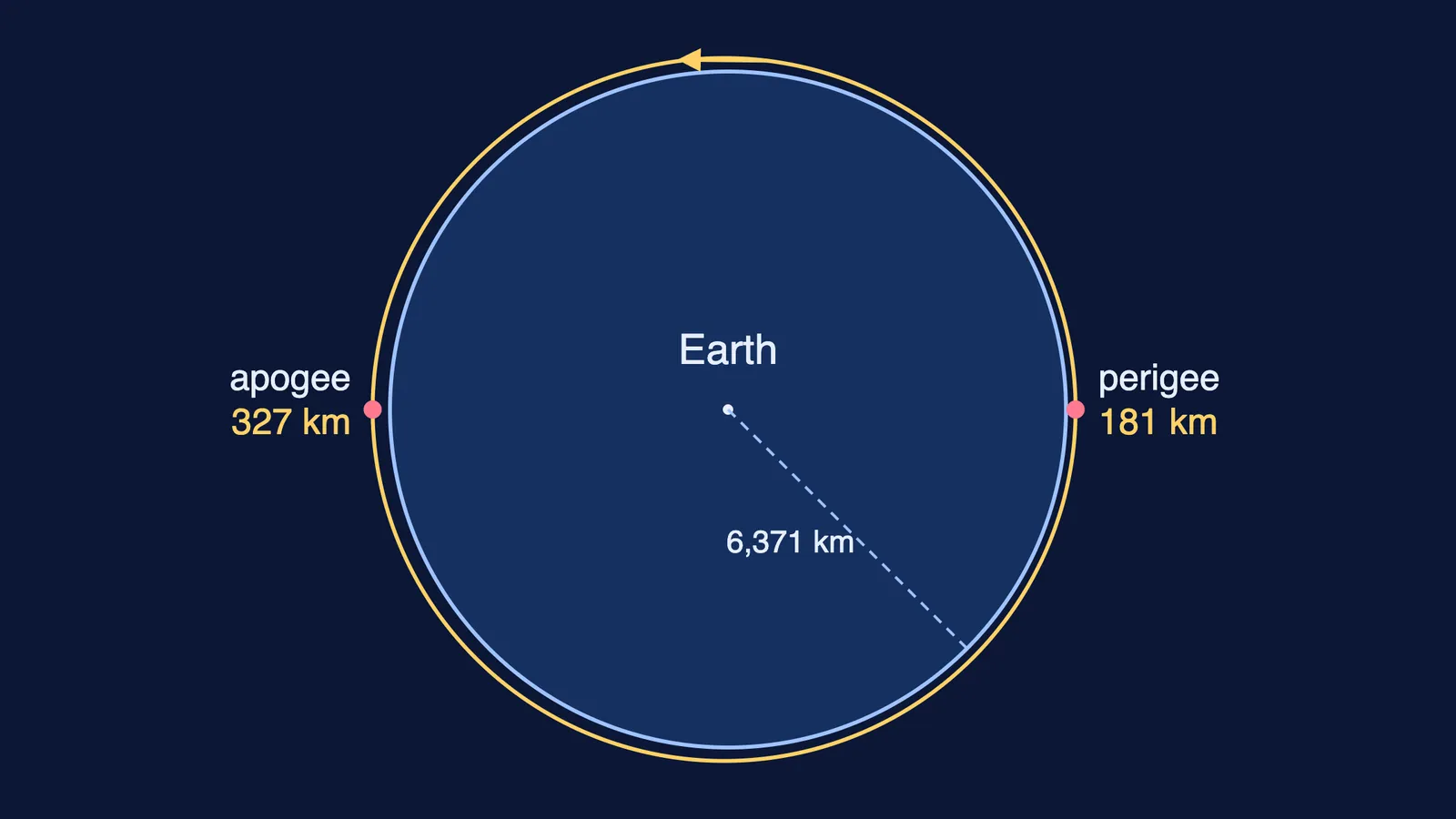
Rohini RS-D1, launched on 31 May 1981, reached only a 186 x 418 km orbit. ISRO records that the satellite "did not reach the intended height and thus it stayed in orbit for only 9 days". At such a low height, thin upper air still drags on a satellite and its orbit shrinks quickly.
Rohini RS-D2 went up on 17 April 1983 into a 371 x 861 km orbit. Its main payload was a Smart Sensor camera, and ISRO says it sent more than 5000 picture frames in visible and infrared bands. It stayed in orbit for seven years and re-entered on 19 April 1990.
How long did Rohini RS-1 take to circle Earth?
You can work this out from ISRO's orbit numbers for RS-1 with Kepler's third law from school gravitation. You need two constants from NASA's Earth fact sheet: Earth's mean radius is 6371 km, and GM for Earth is 398,600 km^3/s^2.
Change heights into distances from Earth's centre: perigee 6371 + 305 = 6676 km, apogee 6371 + 919 = 7290 km.
The semi-major axis is the average: a = (6676 + 7290) / 2 = 6983 km.
Use T = 2π √(a^3 / GM). a^3 is about 3.405 x 10^11 km^3. Dividing by GM gives about 854,300 s^2. The square root is about 924 s.
Multiply by 2π: T is about 5810 s, or roughly 97 minutes.
Try it yourself for Bhaskara-I. With a = 6371 + 530 = 6901 km, you should get about 95 minutes, and an orbital speed of about 7.6 km/s from v = √(GM / r). Notice that the satellite's mass never enters the sum: a 35 kg Rohini and a 442 kg Bhaskara at the same height take the same time. We explain why in why a satellite's period does not depend on its mass.
If ellipses and perigees are hard to picture, the Fermi Simulation Lab has interactive simulations for ideas that are easier to see than to read. For more practice, the Fermi Problem Library has worked problems with a step-by-step solver that explains the reasoning.
What can you take from 1979 to 1983?
Partial failures were part of the path: SLV-3 E1 in 1979 was only partly successful and D1 in 1981 fell short of its intended height, but E2 in 1980 and D2 in 1983 both put working satellites in orbit.
A first rocket carried small satellites: RS-1 weighed 35 kg against Bhaskara-I's 442 kg, because SLV-3 was built for 40 kg class payloads.
Textbook physics explains these flights: Kepler's third law sets how long each orbit takes, and orbit height, through air drag, decided how long each satellite stayed up.
To see why SLV-3 needed four stages to reach orbit, read why rockets have multiple stages.