On this page
Bertha Lutz spent her working life in two places that rarely meet: the frog collections of Brazil's National Museum in Rio de Janeiro, and the campaign that won Brazilian women the vote. Here is what she studied, which animals carry her name, and how to read those names like a zoologist.
Who was Bertha Lutz?
She was born in São Paulo on 2 August 1894 and died in Rio de Janeiro on 16 September 1976; her father was the physician and epidemiologist Adolfo Lutz (Wikipedia biography). Brazil's Chamber of Deputies records that she studied botany, natural sciences, zoology, embryology, chemistry and biology at the Faculty of Sciences of the University of Paris, finishing in 1918.
Back in Brazil, she sat a public competitive exam for a post at the National Museum and passed. According to the Chamber of Deputies, that made her only the second woman to enter Brazil's public service.
What did Bertha Lutz study at Brazil's National Museum?
Frogs. Lutz specialised in amphibians, especially poison dart frogs and the tree frogs of the family Hylidae (Wikipedia). Her work was taxonomy: deciding which frogs are separate species, describing new ones and recording where they live.
Three pieces you can still check:
In 1958 she and A. Carvalho described *Paratelmatobius lutzii*, a small frog of the Mantiqueira Mountains, and named it after her father. The IUCN now lists it as critically endangered and possibly extinct, with no record since 1979 (species page).
In 1972 she published "Geographical and Ecological Notes on Cisandine to Platine Frogs" in the *Journal of Herpetology* (Crossref record).
In 1973 the University of Texas Press published her book *Brazilian Species of Hyla*, 260 pages with illustrations by Gualter A. Lutz (Internet Archive catalogue).
Much of the physical record is gone. Her collections at the museum were destroyed when fire swept through it in September 2018 (Wikipedia). The Art Newspaper reported that one of the museum's archivists said Lutz's papers "gave the impression that she never slept."
Which frogs are named after Bertha Lutz?
Four frogs and two lizards honour her: the frogs *Pristimantis lutzae*, *Dendropsophus berthalutzae*, *Megaelosia lutzae* and *Scinax berthae*, and the lizards *Liolaemus lutzae* and *Phyllopezus lutzae* (Wikipedia).
*Dendropsophus berthalutzae*, Bertha's treefrog, was described by Werner Bokermann in 1962. It lives in south-eastern Brazil, and males are only 18–21 mm long (species page).
*Liolaemus lutzae*, a lizard from Rio de Janeiro, was named by Robert Mertens in 1938. The Reptile Database says it honours "a zoologist and pioneering feminist who founded the Brazilian Federation for Feminine Progress (1922)."
How do you read a species name like lutzae?
Every species name has two parts, a genus and a species name, and the ending of the second part often tells you who it honours. The rule is written into Article 31.1.2 of the International Code of Zoological Nomenclature: a name formed from a modern person's name adds -i for a man, -ae for a woman, -orum for men (or a mixed group) and -arum for women.
Worked example with *Dendropsophus berthalutzae*:
Split the name. *Dendropsophus* is the genus; *berthalutzae* is the species name.
Find the person. Strip the ending and you get bertha + lutz.
Read the ending. -ae means the person is a woman.
Confirm in the source. An ending tells you sex and number, not which person, so check the original description or a database entry before you claim who is honoured.
Now try *Paratelmatobius lutzii*. The ending is -i, so it honours a man: Adolfo Lutz, as step 4 confirms. Why the doubled i? Article 31.1.3 keeps an original spelling unless it is incorrect, and the Code's own example accepts both *cuvierii* and *cuvieri*.
If two-part names and classification still feel shaky, the Fermi Concept Library gives every concept in biology its own lesson and its place in the map, so you can see how genus, species and family fit together.
How did Bertha Lutz win the vote for Brazilian women?
In 1922 she founded the Brazilian Federation for the Advancement of Women and led it until 1942 (Chamber of Deputies).
The breakthrough came with Decree 21,076 of 24 February 1932, Brazil's new Electoral Code. Its Article 2 defines a voter as a citizen over 21 "sem distinção de sexo", without distinction of sex (decree text, Chamber of Deputies).
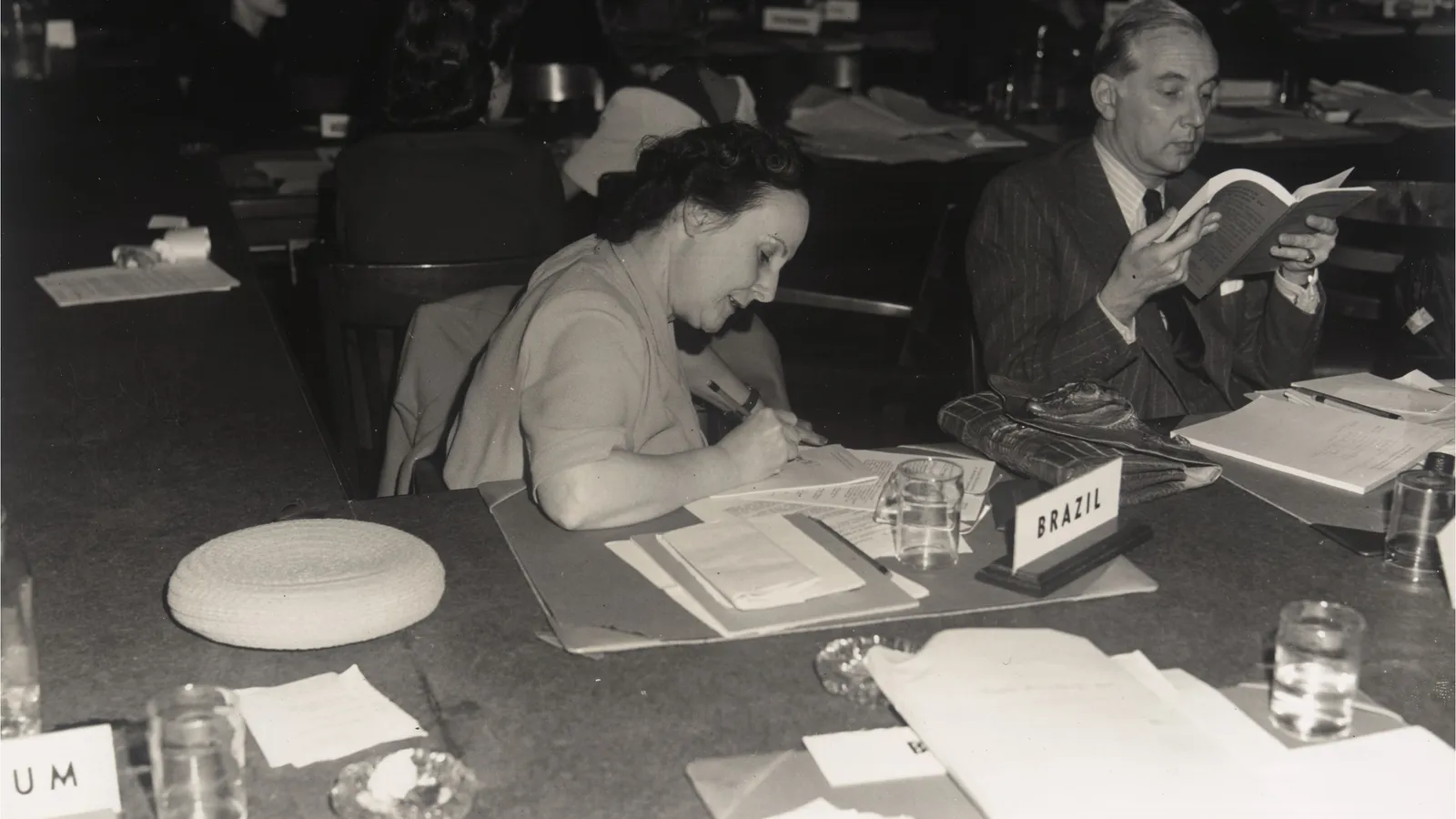
She stood in the October 1934 election, finished as first substitute, and took a seat in the Chamber of Deputies in July 1936, after the sitting deputy died (Chamber of Deputies). In 1945 she was one of only four women delegates at the San Francisco Conference who signed the United Nations Charter (UN in Brazil).
What can a student take from her?
That careful science and caring about your society can share one life. For more scientists who worked from Brazil and beyond, read how Vital Brazil showed that snake antivenom must match the species, how Maria Sibylla Merian painted insect metamorphosis in Surinam, and how Elizabeth Garrett Anderson became Britain's first woman doctor.