On this page
In the mid-nineteenth century, medical schools in Britain did not admit female students. Elizabeth Garrett Anderson wanted to be a physician, but universities across the country rejected her applications. Instead of giving up, she found an alternative route to qualification, changing the course of medical history in the UK.
Her story is a masterclass in independent study, perseverance, and creating opportunities when none seem to exist.
How did Elizabeth Garrett Anderson become a doctor?
After being turned away by medical schools in Oxford, Cambridge, and Edinburgh, Garrett Anderson discovered a legal loophole. She applied to the Worshipful Society of Apothecaries, whose charter did not explicitly state that females were banned from taking their examinations.
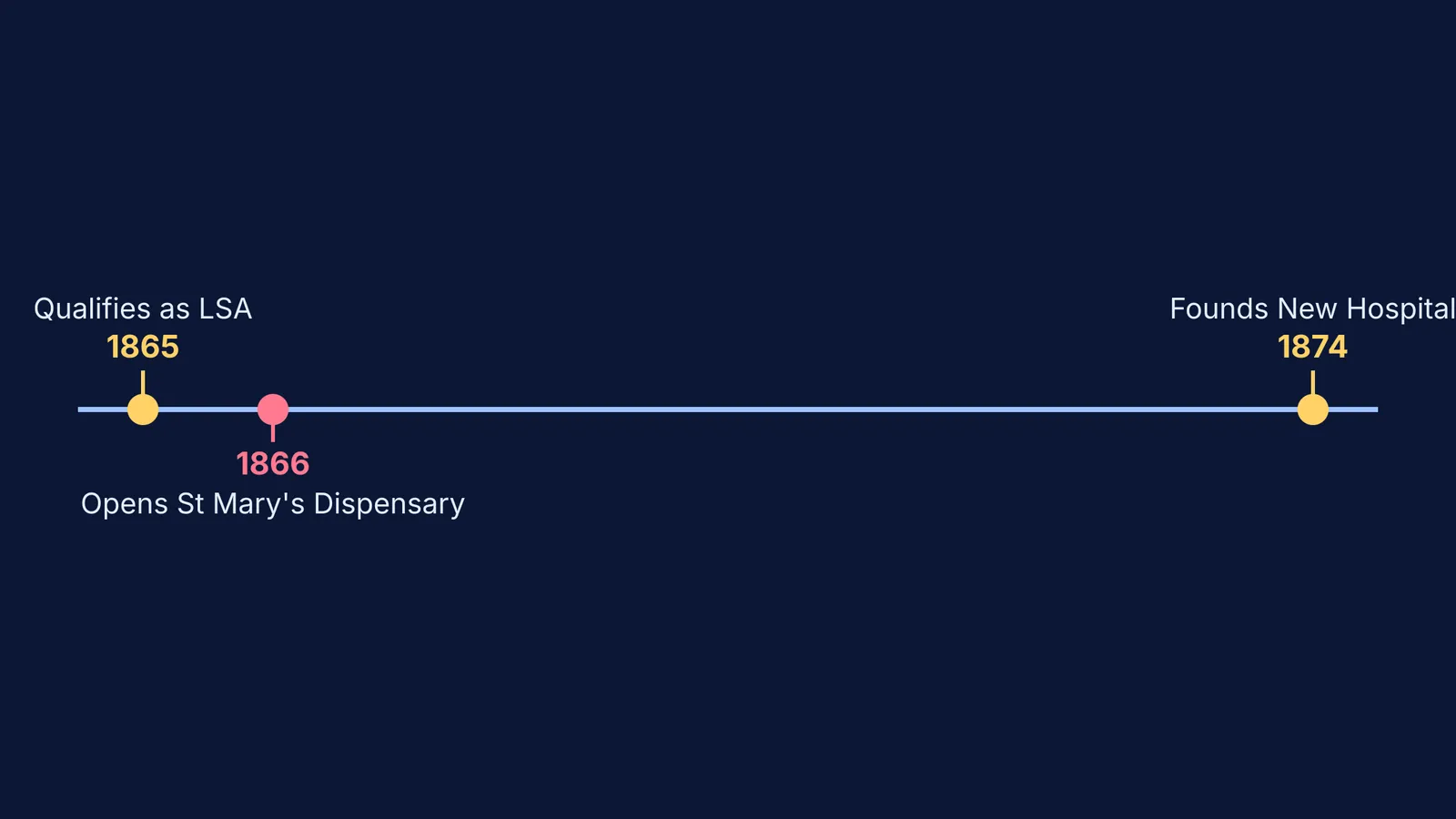
Because she could not attend a medical school, she obtained a certificate in anatomy and physiology by studying privately. She hired tutors and worked with professors at the London Hospital Medical School and the University of St Andrews. On 28 September 1865, she sat the Society's exam. Out of the seven candidates tested that day, only three passed, and Garrett Anderson scored the highest marks.
Upon passing, she became a Licentiate of the Society of Apothecaries (LSA), making her the first woman to qualify openly to practice medicine in Britain.
What hospitals did she found?
Although she was now a qualified doctor, Garrett Anderson still faced resistance from the medical establishment. Unable to secure a post in an existing hospital, she decided to build her own.
In June 1866, she opened the St Mary's Dispensary for Women and Children in London. She wanted to provide medical care for poor women, delivered by female practitioners. The dispensary was a success, and it eventually expanded to admit in-patients in 1871.
By 1874, the practice had evolved into the New Hospital for Women. It was the first hospital in Britain to be staffed entirely by women, proving that female doctors could manage and run a major medical institution. In 1918, a year after her death, the hospital was renamed the Elizabeth Garrett Anderson Hospital in her honour.
What can we learn from her study habits?
Garrett Anderson's success relied heavily on self-directed learning. When formal classes were closed to her, she mapped out the syllabus, found mentors, and prepared for the exam on her own terms.
If you are preparing for competitive exams, you might also face times when you have to learn complex topics without a teacher's direct help. You can apply a similar independent approach:
Define the exact requirement: Garrett Anderson knew exactly what the Society of Apothecaries required for its exam and gathered the necessary certificates.
Test yourself often: When studying independently, it is easy to assume you know a topic. Practising with past papers or using the Fermi Problem Library to work through step-by-step solutions can help you check your reasoning.
Build a study plan: Without a school timetable, you need your own structure. Fermi's AI tutor can work out what you already know and build a plan for your session, keeping you on track.
Find a peer group: While Garrett Anderson studied privately at first, she later co-founded the London School of Medicine for Women to ensure other students had a community to learn with.
Her legacy shows that a closed door is rarely the end of the road. With the right strategy and a willingness to learn independently, you can pass the exams that stand between you and your career.
Read more on How to stay motivated through two years of JEE preparation or check Am I ready for the exam? A four-signal readiness checklist.