

On this page
Most students answer "Am I ready?" with a feeling, and feelings are a poor guide. In four studies by Justin Kruger and David Dunning, people in the bottom quarter on tests of grammar, logic and humour scored around the 12th percentile but placed themselves around the 62nd (Kruger and Dunning, 1999). Those were college students, not exam aspirants, but the lesson carries: your gaps are often the ones you can't see.
Rereading can make this worse. In a survey of 177 college students, most repeatedly reread notes or textbooks and relatively few tested themselves, and the researchers proposed that many students experience illusions of competence while studying (Karpicke, Butler and Roediger, 2009).
So judge readiness by timed tests instead. A 2017 meta-analysis found that practice tests helped learning more than restudying and every other comparison condition it examined (Adesope, Trevisan and Sundararajan, 2017).
How do I know if I am ready for the exam?
Take your last three full-length mocks, sat under real exam timing (see how to use NTA's official mock tests), and check four signals:
Score trend. The average of your last three mocks is at your target or within about 5 percentage points of it, and the line is flat or rising.
Chapter coverage. Every chapter on the syllabus has appeared in at least one timed test, and you can name your weak chapters instead of hoping they won't come.
Timing. You finish with time left to check, and no section regularly eats into another's time.
Error rate. Most of the marks you lost in those three mocks came from slips, not from questions you had no idea how to start.
These thresholds are our rules of thumb, not research findings; adjust them with a teacher who knows your exam.
What does a readiness check look like in practice?
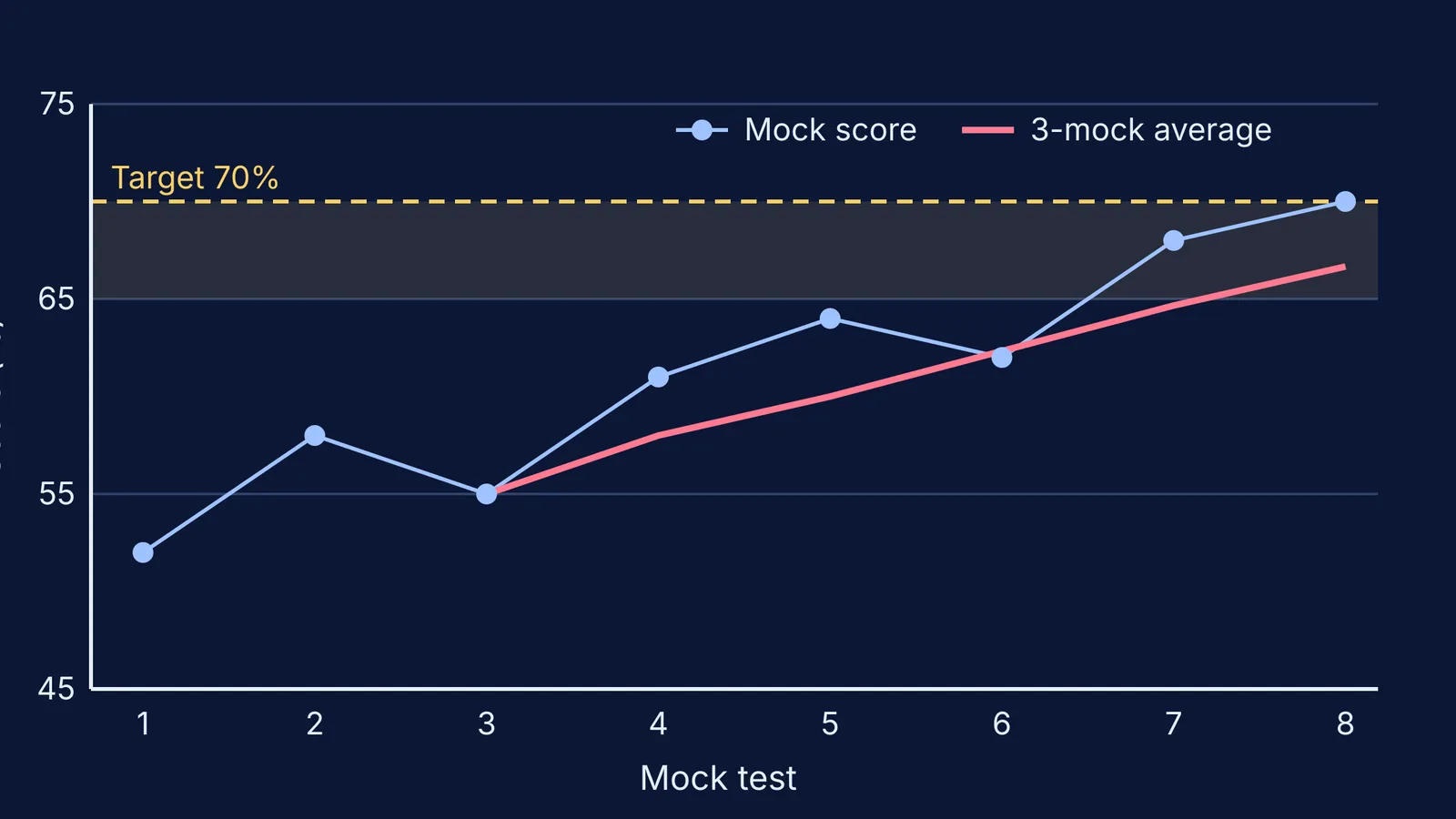
Take a hypothetical student, Riya, aiming for 70% on a full-length paper. Riya's eight mocks scored 52, 58, 55, 61, 64, 62, 68 and 70%.
Trend: the last three average 66.7%, which is 3.3 points short of the target, and rising. Pass.
Coverage: two chapters, rotational motion and electrochemistry, never appeared in a timed sectional. Fail.
Timing: Riya finished the last two mocks with about ten minutes to spare. Pass.
Errors: in mock 8, Riya lost 30 percentage points: 12 to questions Riya couldn't start, 10 to a wrong method and 8 to careless slips. Fail.
Verdict: almost ready. The concept gaps came mostly from those same two chapters, so Riya's next fortnight is those chapters, a sectional test on each, then one more full mock.
How should I sort my mistakes after a mock?
Give every lost question one of four labels; each points to a different fix.
Concept gap (you couldn't start): relearn the idea, then do ten questions on it. The Fermi Concept Library gives every concept in physics, chemistry, biology and mathematics its own lesson, so you can return to exactly the missing idea.
Wrong method (you started down the wrong path): redo the question and write why your first approach failed. The Fermi Problem Library has worked problems with a step-by-step solver that explains the reasoning rather than printing an answer.
Careless slip (sign, unit, misread option): build a short checking routine for the last minutes of the paper.
Out of time: practise two passes, easy questions first, then return to the hard ones.
If one mock went badly, our 60-minute review after a bad test walks through this calmly.
What should I do if I'm not ready yet?
How much time you have left decides the plan.
More than six weeks: work through concept-gap chapters one at a time, ending each with a timed sectional test. If many chapters are behind, use this triage plan to clear a chapter backlog.
Two to six weeks: fix the chapters that cost you the most marks, keep a full mock every week, and spend the next day on the error log.
Under two weeks: start no brand-new chapters. Take mocks, fix slips and timing, and revise from your error log.
Spread the work out. A review of ten learning techniques gave practice testing and distributed practice its only high-utility ratings (Dunlosky and colleagues, 2013). In a survey of 324 undergraduates, self-testing was linked to higher grades (so, in that survey, was rereading), while low performers studied late at night more often than high performers (Hartwig and Dunlosky, 2012).
How can parents ask about readiness without adding pressure?
"Are you ready?" invites a yes or a fight. Try: "What did your last three mocks say, and which chapter is costing you the most?" Then ask what help would be useful, such as a quiet room for a timed mock.
If worry about the exam stops your child sleeping, eating or functioning for days, talk to a doctor or counsellor. Tele MANAS is a free, 24x7 national mental-health helpline on 14416 or 1800-891-4416 (IIT Kanpur counselling service).
Run the four-signal check after your next mock, write down the one signal that fails, and make that next week's job.


