

On this page
Snakebite envenoming is a massive global health challenge that disproportionately affects rural and agricultural communities. According to the World Health Organization, approximately 5.4 million people are bitten by snakes each year across the globe. Of those bites, roughly half lead to clinical illness, resulting in 81,410 to 137,880 deaths annually and leaving hundreds of thousands more with permanent disabilities. The only effective medical treatment for these emergencies is antivenom, a life-saving biological tool born from a fierce scientific debate at the turn of the 20th century.
Who was Vital Brazil?
Vital Brazil (1865–1950) was a pioneering Brazilian physician, researcher, and immunologist who completely transformed the global medical understanding of toxinology. In the late 1800s, the science of immunology was still in its infancy, and researchers were rushing to find cures for infectious diseases and animal toxins.
The prominent French scientist Albert Calmette, working at the Pasteur Institute, developed the first therapeutic antivenom in 1894. He did this by immunizing animals against the venom of the Indian cobra (*Naja naja*), as detailed in a historical review in *Toxicon* (Squaiella-Baptistão et al., 2018). Because all snake venoms caused similar terrifying symptoms—such as paralysis and tissue damage—Calmette made a bold, logical leap. He claimed that his anti-cobra serum was a universal cure for all venomous snakebites worldwide, assuming all snake venoms shared a single toxic principle.
When this supposedly universal serum arrived in South America, Vital Brazil rigorously tested it against the venoms of highly dangerous local vipers, such as the jararaca (*Bothrops jararaca*) and the South American rattlesnake (*Crotalus durissus*). The serum failed completely. The animals in his experiments were not protected from the venom, proving beyond doubt that Calmette's universal cure was dangerously flawed.
Why must snake antivenom match the species?
Through his careful experiments, Vital Brazil discovered the foundational principle of antivenom specificity. He realised that venom is not a single, uniform poison. Instead, it is a highly complex biological mixture of proteins, peptides, and enzymes that varies drastically between different snake families, and even between closely related species.
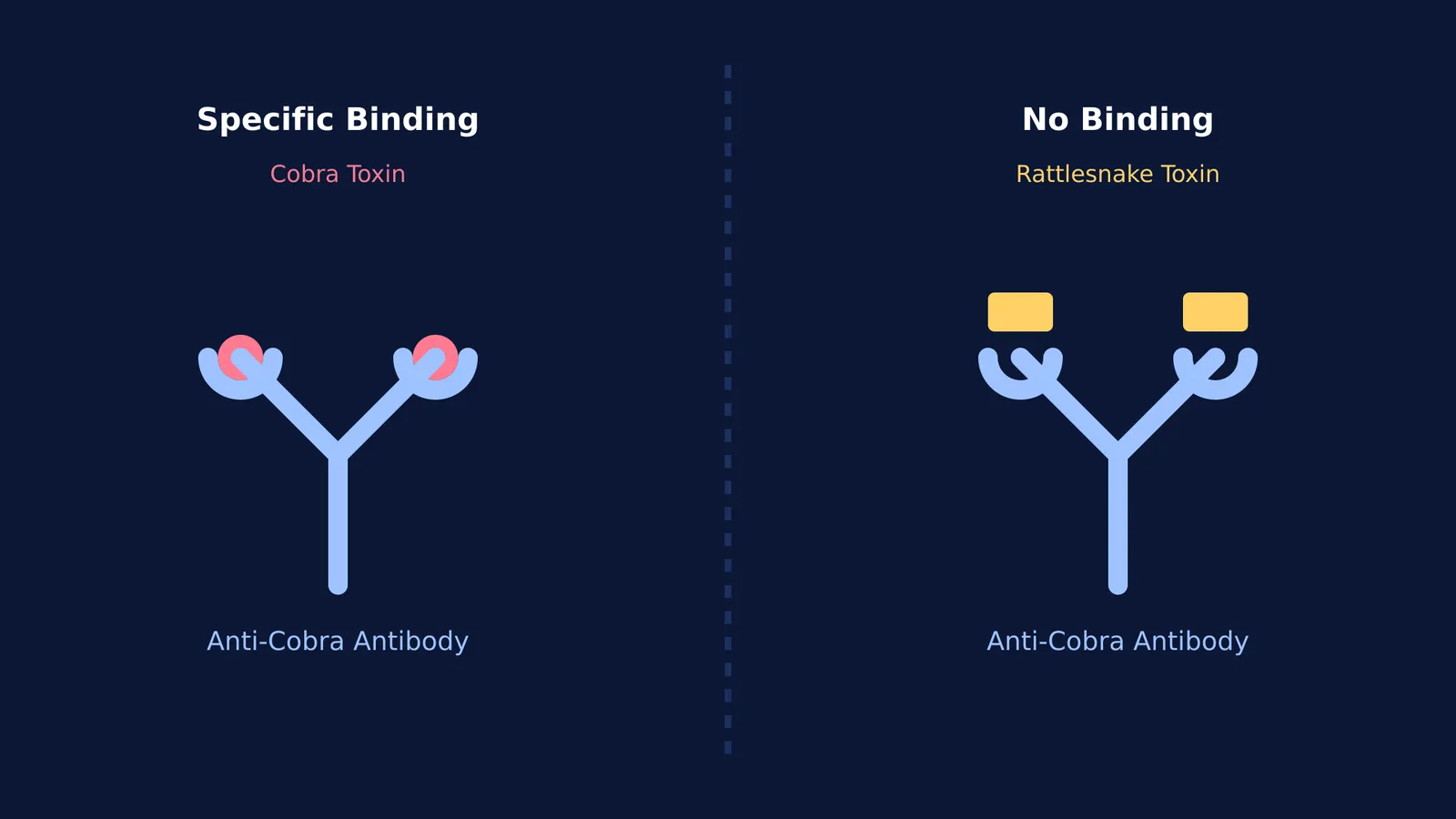
To neutralize a toxin, the host's immune system produces antibodies (immunoglobulins) that bind directly to the venom molecules. This interaction works exactly like a physical key fitting into a highly specific lock. Because a rattlesnake's venom proteins have a completely different three-dimensional shape than a cobra's proteins, the antibodies raised against a cobra will simply bounce off the rattlesnake's toxins, leaving the patient unprotected. Brazil published his findings between 1897 and 1901, proving that an antivenom is only effective if it is raised against the venom of the specific snake that caused the bite (Hawgood, 199290851-U)).
Understanding exactly how antibodies bind to specific antigens is a foundational idea in immunology. The Fermi Concept Library has a lesson for every concept in biology, helping you visualise this lock-and-key mechanism rather than just memorising textbook definitions.
How did the Butantan Institute change snakebite treatment?
To solve the immediate problem of local snakebites in his home country, Vital Brazil founded the Instituto Butantan in São Paulo in 1901. Under his leadership, the facility developed the world's first monovalent antivenoms, which were highly purified treatments targeted at a single, known species of snake.
To support the massive scale of serum production needed, Brazil set up an ingenious exchange system. Rural farmers sent live snakes to the institute via the railway network, ensuring a steady, reliable supply of venom. In return, the institute sent the farmers wooden boxes containing vials of fresh antivenom and clean glass syringes. This practical public health loop saved countless lives across the continent and quickly turned the Butantan Institute into one of the world's leading toxinology research centres.
Concept checklist: The biology of antivenoms
For students tackling immunology, the story of Vital Brazil perfectly maps to the vocabulary of the human immune response. Here is a checklist of the key terms at play during a snakebite:
Antigen: The foreign biological substance—in this case, the highly toxic proteins contained in the snake venom.
Antibody: The Y-shaped defensive proteins produced by the host to physically bind and neutralize the invading antigen.
Epitope: The highly specific surface region on the venom toxin where the antibody precisely attaches.
Specificity: The inviolable biological rule Vital Brazil proved. A *Bothrops* antibody cannot bind to a *Crotalus* epitope because their physical shapes do not match.
To see how these defensive cells operate inside the human body, read our guide to the Formed elements of blood: RBCs, WBC types and platelets for NEET or explore Jacques Miller and the role of the thymus in immunity.


