On this page
A copper wire's resistance rises by roughly 0.4% for every degree it warms up. A nichrome heater coil changes about ten times less, according to the HyperPhysics resistivity table. The reason goes back to a London chemist, Augustus Matthiessen, and it is simple: two kinds of resistivity just add up.
Who was Augustus Matthiessen?
Matthiessen (1831 to 1870) was a British chemist and physicist who lectured on chemistry at St Mary's and St Bartholomew's hospitals in London, was elected a Fellow of the Royal Society in 1861 and received its Royal Medal in 1869 for his work on metals and alloys, according to his Wikipedia biography.
With August Christoph Carl Vogt he published "On the influence of temperature on the electric conducting-power of alloys" in the Philosophical Transactions of the Royal Society in 1864 (DOI 10.1098/rstl.1864.0004). The paper's abstract says they set out to "discover the law which regulates this property", and one of its four parts is "a method by which the conducting-power of a pure metal may be deduced from that of the impure one." That method rests on the idea now called Matthiessen's rule, which Wikipedia's article on the rule says developed from his 1864 work.
Why do impurities increase the resistance of a metal?
Current in a metal is free electrons drifting through a lattice of ions. Anything that breaks the regular pattern scatters them.
Heat: ions vibrate more as temperature rises, so electrons collide more often. This part grows with temperature.
Impurities and defects: a foreign atom, a vacancy or a grain boundary is a fixed bump in the pattern. This part hardly depends on temperature.
LibreTexts/09:_Electronic_Properties_of_Materials_-_Superconductors_and_Semiconductors/9.05:_Resistivity) explains that at low enough temperatures the thermal vibrations are not yet active, so what is left, the residual resistivity, comes from impurities and defects.
What is Matthiessen's rule?
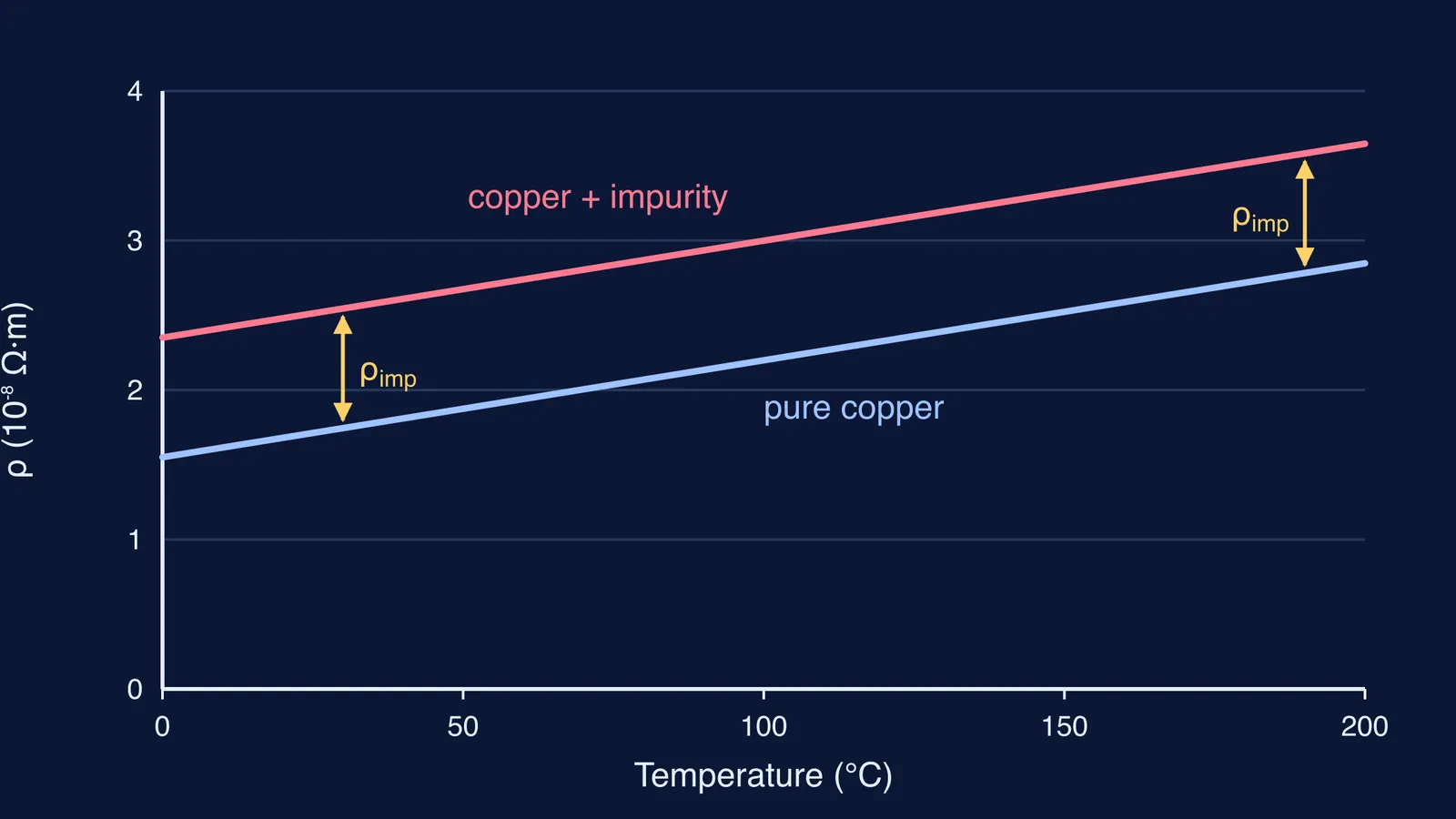
Matthiessen's rule says the total resistivity of a metal is the sum of a thermal part and a part from impurities and defects: ρ = ρ_thermal + ρ_impurity + ρ_defect (LibreTexts/09:_Electronic_Properties_of_Materials_-_Superconductors_and_Semiconductors/9.05:_Resistivity)).
On a graph of resistivity against temperature, an impurity lifts the whole line by a constant amount without changing its slope, as in the picture at the top.
It is an approximation. Wikipedia notes that it fails when the scattering mechanisms are not independent of each other, so treat it as a very good first model, not an exact law.
Why does nichrome's resistance barely change with temperature?
The temperature coefficient α is the fractional change in resistance per degree. Here are the values from HyperPhysics at 20 °C:
Copper: resistivity 1.68 × 10⁻⁸ Ω·m, α = 0.00386 per °C.
Nichrome: resistivity 100 × 10⁻⁸ Ω·m, α = 0.0004 per °C.
Manganin: resistivity 48.2 × 10⁻⁸ Ω·m, α = 0.000002 per °C.
The common A-grade nichrome is 80% nickel and 20% chromium by mass, though other mixes exist (Wikipedia). Every chromium atom in the nickel lattice is a permanent bump, so the fixed part is huge: nichrome's resistivity is about 60 times copper's in the HyperPhysics table. The thermal part still exists, but as a percentage of the total it is small.
That steadiness is one reason heaters use nichrome; see why tungsten goes in bulbs and nichrome in heaters. For the general reason alloys resist more than pure metals, see why alloys have higher resistivity.
How much does a hot coil's resistance change?
Take two coils, each 10 Ω at 20 °C, one copper and one nichrome, and heat both to 120 °C. Use R = R₀(1 + αΔT) with ΔT = 100 °C and the HyperPhysics values above.
Copper: R = 10 × (1 + 0.00386 × 100) = 13.86 Ω, a rise of about 39%.
Nichrome: R = 10 × (1 + 0.0004 × 100) = 10.4 Ω, a rise of 4%.
Now try a made-up dilute alloy. Suppose an impurity adds a fixed 0.8 × 10⁻⁸ Ω·m to copper. The thermal slope stays at about 1.68 × 10⁻⁸ × 0.00386 ≈ 0.0065 × 10⁻⁸ Ω·m per °C, but the total at 20 °C is now 2.48 × 10⁻⁸ Ω·m. So α ≈ 0.0065 ÷ 2.48 ≈ 0.0026 per °C. Same slope, bigger base, smaller coefficient.
How do you write this in an exam answer?
When a CBSE board or JEE Main question asks why heaters and standard resistors use alloys, write four steps:
Resistivity comes from electron scattering by lattice vibrations and by impurities.
By Matthiessen's rule these add: ρ = ρ_thermal + ρ_impurity.
In an alloy the impurity term is large and nearly independent of temperature.
So the fractional change with temperature, α, is small, and the resistance stays steady.
For step 4, remember that α is the slope divided by the total, not the slope itself. The Fermi Concept Library has a lesson for every concept in physics, and the Fermi Problem Library has worked problems with a step-by-step solver that explains the reasoning rather than printing an answer.
Near absolute zero, some metals lose even their residual resistance: read about Heike Kamerlingh Onnes and the discovery of superconductivity next.