

On this page
You have probably met this line in a textbook question: alloys have higher resistivity than the pure metals they are made from. It is why heater coils are made of nichrome and house wiring is made of copper. It comes down to how regular the atoms are, and how often a drifting electron gets knocked off course.
Why do alloys have higher resistivity than pure metals?
Start with the free-electron (Drude) model, which gives conductivity as σ = ne²τ/m, where τ is the average time between an electron's collisions (Drude model). Resistivity is the reciprocal, ρ = m/(ne²τ), so anything that shortens τ raises resistivity.
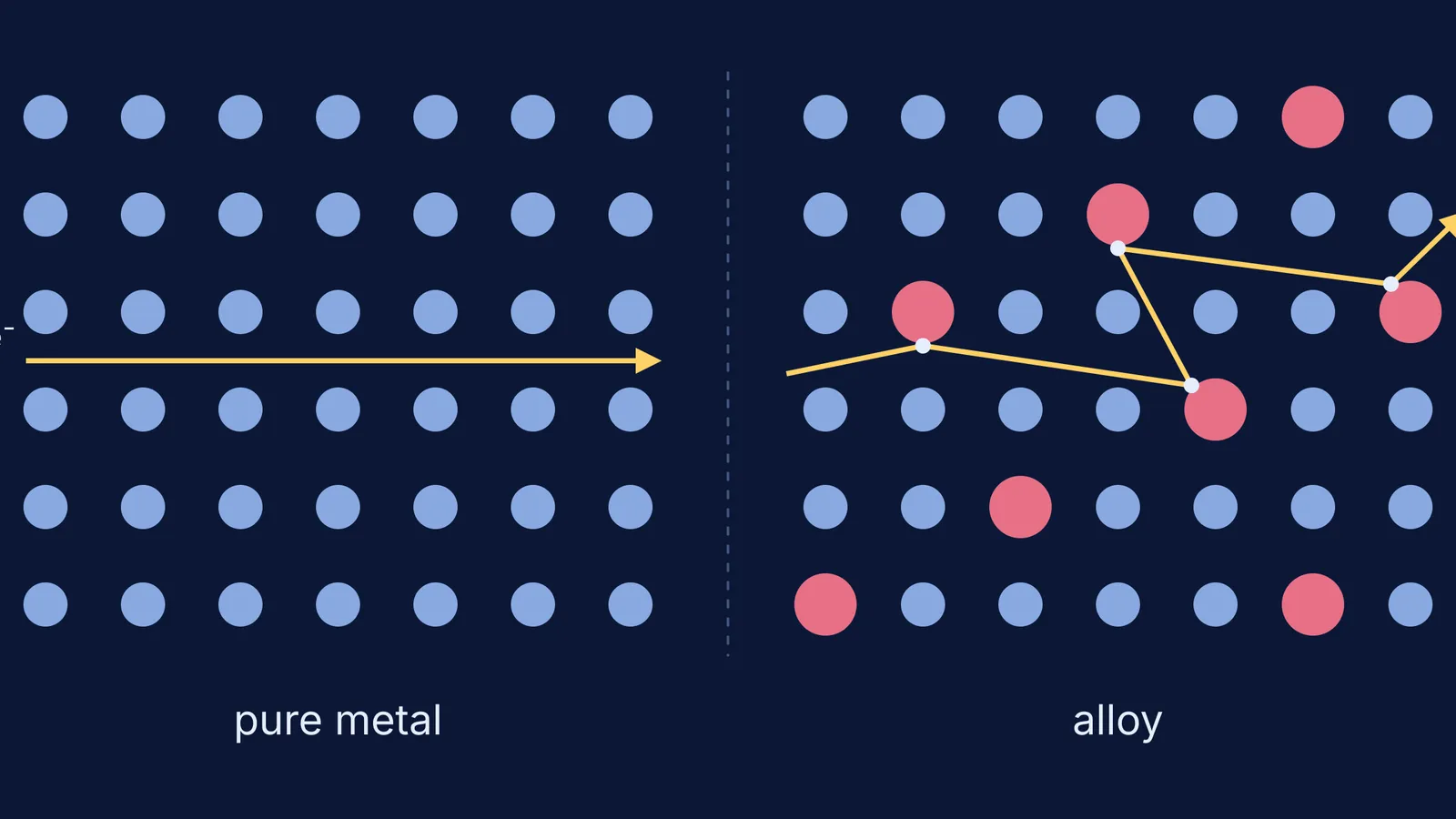
In a pure metal, the ions sit in a repeating pattern, and "the more regular the lattice is, the less disturbance happens and thus the less resistance" (Electrical resistivity and conductivity). The same article names the second cause of resistance: a mixture of different ions is itself an irregularity.
In an alloy such as nichrome (nickel, chromium and iron), atoms of different sizes are placed at random through the lattice. Each misfit atom disturbs the pattern, so electrons are deflected far more often, τ falls and ρ rises. One chemistry course puts it simply: an alloy can be viewed as a metal with a large number of impurities, which means many more scattering sites (LibreTexts, Resistivity/09:_Electronic_Properties_of_Materials_-_Superconductors_and_Semiconductors/9.05:_Resistivity)).
At 20 °C, copper's resistivity is 1.68 × 10⁻⁸ Ω·m and nichrome's is 100 × 10⁻⁸ Ω·m, about 60 times higher (HyperPhysics resistivity table).
Why does an alloy's resistivity barely change with temperature?
Matthiessen's rule, first stated by Augustus Matthiessen in the 1860s, says the resistivity from different scattering sources can be approximately added together (Electrical resistivity and conductivity). Written out, ρ = ρ(thermal) + ρ(impurities) + ρ(defects) (LibreTexts, Resistivity/09:_Electronic_Properties_of_Materials_-_Superconductors_and_Semiconductors/9.05:_Resistivity)). The thermal part grows as the lattice vibrates harder. The disorder part is there even when the metal is cold. Our explainer on relaxation time and why hot metals resist more covers the thermal part in detail.
In copper, the thermal part dominates, so heating copper raises its resistance noticeably. In an alloy, the disorder part is already large, so extra thermal scattering adds only a little. HyperPhysics lists temperature coefficients of 0.00386 per °C for copper, 0.0004 per °C for nichrome and 0.000002 per °C for manganin (HyperPhysics resistivity table). That stability is why manganin and constantan are used in standard resistors.
A July 2026 preprint by Kenji Yamaguchi, not yet peer reviewed, reports from first-principles calculations on dilute alloys of copper with 3d transition metals at room temperature that resistivity tracks how much disorder broadens electron states, which is tied to the scattering rate (arXiv:2607.13419).
Worked example: copper or nichrome for the same wire?
Take two wires, each 1 m long with a cross-section of 1 mm² (1 × 10⁻⁶ m²). Use R = ρL/A with the HyperPhysics values for 20 °C (resistivity table).
Copper: R = (1.68 × 10⁻⁸ × 1) / (1 × 10⁻⁶) = 0.0168 Ω.
Nichrome: R = (100 × 10⁻⁸ × 1) / (1 × 10⁻⁶) = 1.0 Ω, about 60 times more.
Now heat both to 100 °C. Use R = R₀(1 + αΔT) with ΔT = 80 °C.
Copper: 0.0168 × (1 + 0.00386 × 80) ≈ 0.0220 Ω, a rise of about 31%.
Nichrome: 1.0 × (1 + 0.0004 × 80) = 1.032 Ω, a rise of about 3%.
Now a design question. A heating element needs R = V²/P. For a 1000 W element on a 230 V supply, R = 230²/1000 ≈ 52.9 Ω. With wire of cross-section 0.1 mm² and the 20 °C values, nichrome needs L = RA/ρ ≈ 5.3 m. Copper would need about 315 m, which will not fit inside a heater. Our post on why tungsten is used in bulbs and nichrome in heaters covers the other properties that matter.
How should you write this in an exam answer?
A model answer:
"In an alloy, atoms of different elements are arranged irregularly in the crystal lattice. These irregularities scatter conduction electrons more often, so the relaxation time τ is smaller. Since ρ = m/(ne²τ), an alloy has a higher resistivity than its constituent metals. Because this disorder scattering hardly depends on temperature, alloys also have a low temperature coefficient of resistivity, which makes them useful for heating elements and standard resistors."
Mistakes to avoid:
Explaining it as alloys having "fewer free electrons". The standard textbook answer is about scattering and τ.
Mixing up resistance and resistivity.
Stopping at "higher resistivity" when the question also asks why alloys are useful.
If ρ = m/(ne²τ) still feels like a formula you memorised rather than understood, the Fermi Concept Library has a lesson for every concept in physics. To practise R = ρL/A and temperature-coefficient numericals, the Fermi Problem Library has worked problems with a step-by-step solver that explains the reasoning rather than printing an answer.
Next time you see a glowing heater coil, picture electrons bouncing off misfit atoms: that is the whole answer.


