

On this page
Most students meet hydrogen's spectrum as five names to memorise: Lyman, Balmer, Paschen, Brackett, Pfund. The last is the easiest to forget. Every line in it ends on the same level, n = 5, and every line is invisible to your eyes.
Who discovered the Pfund series?
August Herman Pfund, an American physicist, reported the series in 1924 in a paper titled "The Emission of Nitrogen and Hydrogen in the Infrared", published in the Journal of the Optical Society of America, volume 9, issue 3, starting on page 193 (Crossref record).
Pfund was born in Madison, Wisconsin, in 1879, earned his PhD at Johns Hopkins University in 1906, and spent the rest of his career there, later chairing its physics department (Wikipedia biography). He also invented the Pfund sky compass, which grew out of his 1944 studies of polarised skylight and helped transpolar flights find the Sun's direction at twilight. He served as president of the Optical Society of America in 1943-44 and died in 1949.
His was the fifth of hydrogen's named series to be found. Frederick Brackett had found the n = 4 series only two years earlier, in 1922, and the sixth, ending on n = 6, waited until Curtis Humphreys reported it in 1953 (hydrogen spectral series overview).
What are the wavelengths of the Pfund series?
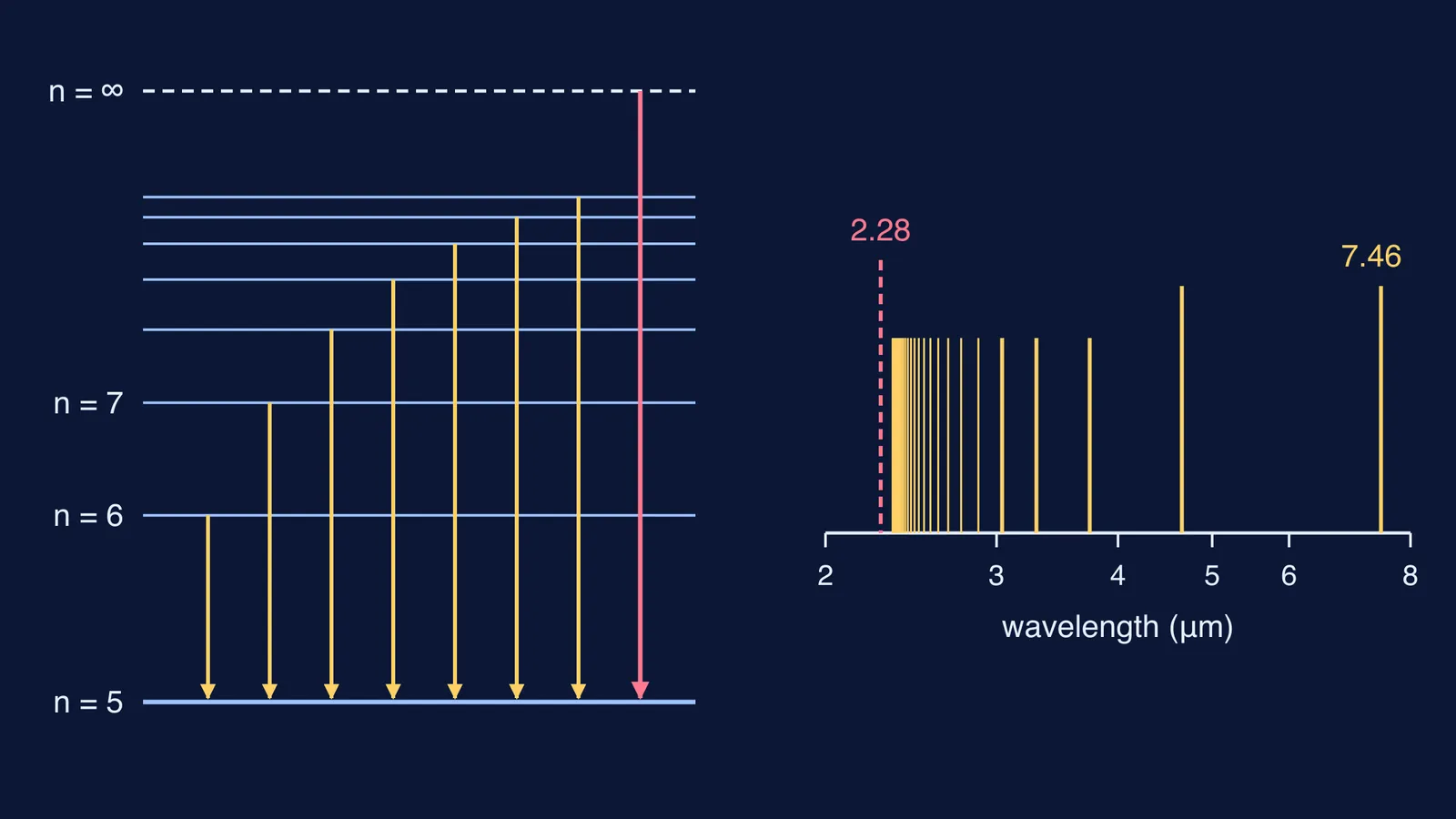
The Pfund series is the set of hydrogen lines emitted when an electron falls from any level n = 6, 7, 8 and so on down to n = 5 (hydrogen spectral series overview).
Its wavelengths run from 7460 nm for the first line (6 to 5, called Pfund-alpha) down to a series limit of 2279 nm, all in the infrared (same source).
You can get every line from the Rydberg formula, 1/λ = R(1/5² − 1/n²), with R for hydrogen equal to 1.09677 × 10⁷ m⁻¹ (hydrogen spectral series overview). That value is slightly smaller than the textbook Rydberg constant, 10 973 731.568 157 m⁻¹ in CODATA 2022 (NIST value), because the hydrogen nucleus is not infinitely heavy.
Pfund-alpha (6 to 5): about 7.46 μm
Pfund-beta (7 to 5): about 4.65 μm
Pfund-gamma (8 to 5): about 3.74 μm
Series limit (from n = ∞ to 5): about 2.28 μm
The lines crowd together near the limit, as Balmer's do.
How do you find the Pfund series limit?
The series limit is the shortest wavelength in a series: an electron that starts essentially free (n = ∞) drops to the lower level.
Write the formula with the lower level fixed: 1/λ = R(1/5² − 1/n²).
Let n go to infinity, so 1/n² becomes 0: 1/λ = R/25.
Rearrange: λ = 25/R.
Put in the hydrogen value R = 1.09677 × 10⁷ m⁻¹ (from the series overview): λ = 25 ÷ (1.09677 × 10⁷) m = 2.279 × 10⁻⁶ m.
Convert: λ ≈ 2279 nm, or 2.28 μm.
Check it with energy. The n = 5 level sits at −13.6/25 = −0.544 eV, so the limit photon carries 0.544 eV. Using hc ≈ 1240 eV nm, λ = 1240/0.544 ≈ 2279 nm.
We worked through the same method for the Lyman and Balmer limits in our series limit walkthrough. If you get stuck on a variant, such as the longest line or a ratio of two wavelengths, the Fermi Problem Library has worked problems with a step-by-step solver that explains the reasoning rather than printing an answer.
How does the Pfund series compare with the other hydrogen series?
All values below are from the hydrogen spectral series overview, which gives each discoverer, year and wavelength range.
Lyman (lower level n = 1): Theodore Lyman, 1906-1914; 91.2 to 121.6 nm; ultraviolet. Read how Lyman found the ultraviolet lines.
Balmer (n = 2): Johann Balmer, 1885; 364.6 to 656.3 nm; visible.
Paschen (n = 3): Friedrich Paschen, 1908; 820.4 to 1875 nm; infrared. Read the story of the Paschen series.
Brackett (n = 4): Frederick Brackett, 1922; 1458 to 4051 nm; infrared.
Pfund (n = 5): August Pfund, 1924; 2279 to 7460 nm; infrared.
Notice that the Pfund limit (2279 nm) is shorter than Brackett-alpha (4051 nm). From Paschen onwards, neighbouring series overlap, so you identify a line by its exact wavelength, not its range.
What should you remember for exams?
The lower level names the series. Pfund means the electron lands on n = 5.
Longest line: n = 6 to 5. Shortest line (limit): n = ∞ to 5.
Limit wavelength = 25/R; the higher the lower level, the longer the wavelengths, so Pfund reaches further into the infrared than the four series before it.
If the idea of energy levels itself feels shaky, the Fermi Concept Library gives every concept in physics its own lesson and shows where it sits in the map, so you can fill the gap before more numericals.


