On this page
Two wires carrying current in the same direction pull towards each other. That result, which you now write as F/L = μ₀I₁I₂/2πd, was found in a few weeks of intense work in Paris in 1820. For most of the last century it also defined the unit of current itself. This post covers who André-Marie Ampère was, what he found, a worked example, and what a student can take from his way of working.
Who was André-Marie Ampère?
An article by CIGRE, the international council on large electric power systems, gives his background. He was born in 1775 into a family in Lyon. His father educated him at home with no school or tutor, and he taught himself from the family library, including Diderot and d'Alembert's Encyclopédie. His father was guillotined in 1793 during the Terror, and his first wife died in 1803. He taught at Bourg-en-Bresse and Lyon, became a mathematics teacher at the École Polytechnique in Paris in 1804, entered the Academy of Sciences in 1814, became a professor at the Collège de France in 1824, and died in Marseille in 1836 while on an inspection tour.
What did he discover in 1820?
In 1820 the Danish physicist Hans Christian Oersted showed that a wire carrying current deflects a compass needle. CIGRE records that Oersted's experiment was repeated before the Paris Academy, and a week later, on 18 September 1820, Ampère presented his first ideas on the equivalence of magnets and currents.
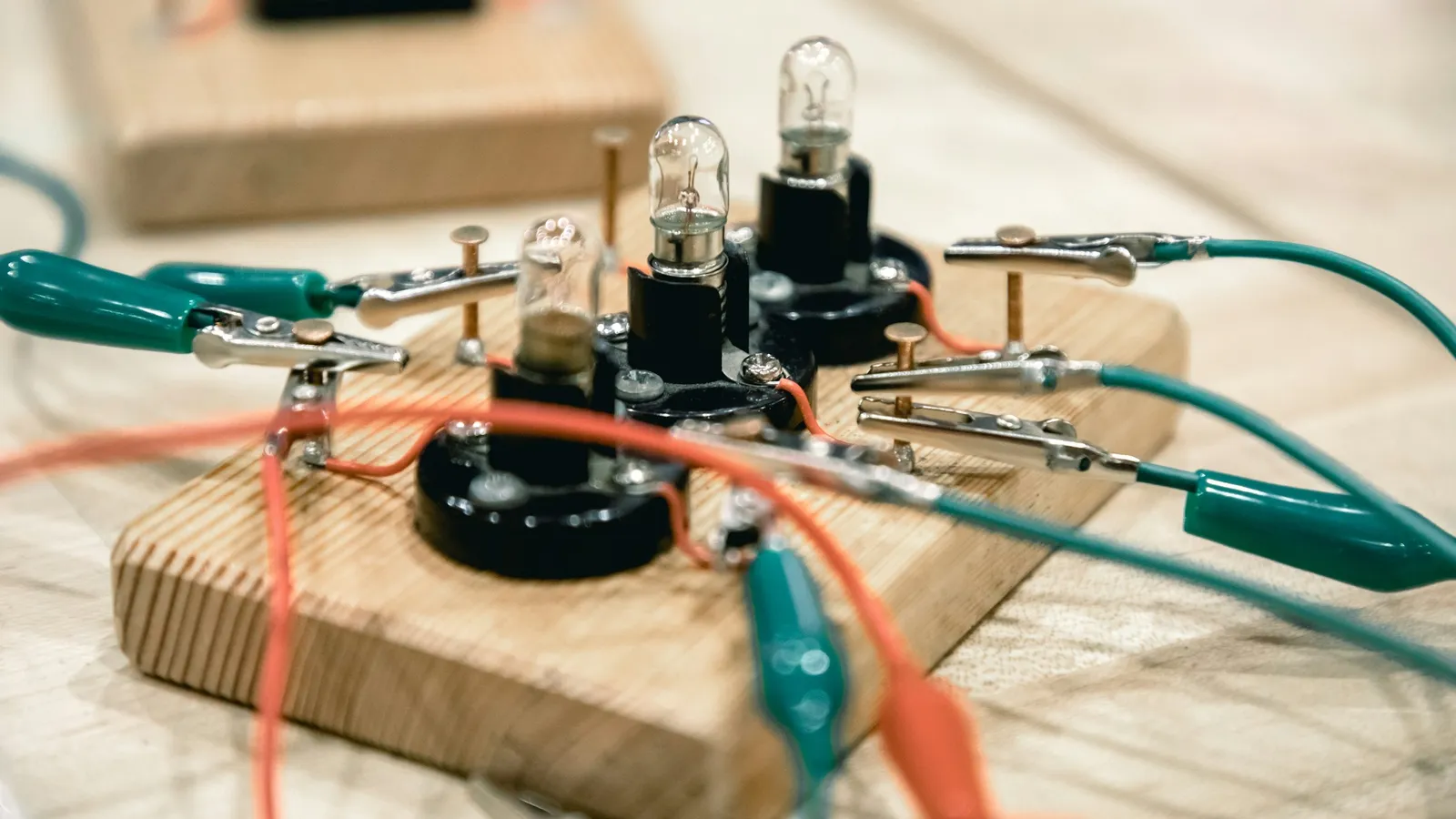
His memoir, presented on 2 October 1820 and summarising what he read on 18 and 25 September, is available in English translation from the Joseph Henry Project at Princeton. In it he describes fixing one straight wire and hanging a second, parallel one so that it could move. He observed that "they attracted each other when the two currents were in the same direction; and that they repelled each other when they took place in opposite directions."
He also pointed out how strange this was. With static charges, opposite kinds attract and like kinds repel. With currents it is the other way round: like directions attract. And the effect stops the instant the circuit is broken.
CIGRE adds the rest of his programme from 1820 to 1826: astatic needles to cancel the Earth's field, coils and helices that behaved like magnets (he coined the word "solenoid"), the idea that magnetism comes from currents inside magnets, and a mathematical formula for the force between small elements of current.
How was the ampere defined by his force?
In 1881 the first international congress of electricians named the unit of current after him. According to the US National Institute of Standards and Technology, until 2019 the official definition was "that constant current which, if maintained in two straight parallel conductors of infinite length, of negligible circular cross-section, and placed 1 meter apart in vacuum, would produce between these conductors a force equal to 2 x 10⁻⁷ newton per meter of length." NIST describes it as a general version of Ampère's own experiment.
Since 20 May 2019 the BIPM defines the ampere by fixing the elementary charge at exactly 1.602176634 × 10⁻¹⁹ C. One ampere is now the current carried by 1/(1.602176634 × 10⁻¹⁹) elementary charges per second.
Worked example: the force between two wires
The field of a long straight wire at distance d is B = μ₀I₁/2πd. A second wire carrying I₂ feels a force per length F/L = BI₂, so F/L = μ₀I₁I₂/2πd.
Check the old definition. With I₁ = I₂ = 1 A, d = 1 m and μ₀ = 4π × 10⁻⁷ N/A²: F/L = (4π × 10⁻⁷ × 1 × 1)/(2π × 1) = 2 × 10⁻⁷ N/m. That is exactly the number in the pre-2019 definition.
A realistic case. Two parallel wires 2.0 cm apart carry 10 A and 5.0 A in the same direction. F/L = (2 × 10⁻⁷ × 10 × 5.0)/0.020 = 5.0 × 10⁻⁴ N/m, attractive. On a 2 m length that is 1.0 × 10⁻³ N, about the weight of a 0.1 g object, which is why Ampère needed a very freely hung wire to see it.
Since 2019, μ₀ is a measured quantity. The NIST value is 1.25663706127 × 10⁻⁶ N/A², which agrees with 4π × 10⁻⁷ to better than one part in a billion, so your textbook value is still fine.
Mistakes to avoid:
Wrong direction. Same-direction currents attract. Use the right-hand rule for the field, then F = IL × B for the force; our guide to magnetic force and the right-hand rule walks through it.
Forgetting it is force per length. Multiply by the length for a total force.
Using d in centimetres. Convert to metres first.
To see the fields and forces between wires change as you move them, the Fermi Simulation Lab has interactive simulations for ideas that are easier to see than to read.
What can a student take from how he worked?
Move fast on a new result. He went from hearing about Oersted to new experiments within a week.
Design the experiment to isolate the effect. His astatic needles removed the Earth's field so the current's effect stood alone.
Notice what does not fit. The reversed rule for currents was his most important clue.
Turn observations into a formula. He did not stop at "attract" and "repel"; he wanted the law.
Our guide to the Biot-Savart law and Ampère's law takes his ideas into the problems you will meet, and Faraday's field lines show the next step in the story.
Try it: find the force per metre between two wires 5.0 mm apart carrying 3.0 A in opposite directions, and say whether it attracts or repels.