

On this page
In 1950 the French physicist Alfred Kastler proposed sorting atoms with light: shine circularly polarised light on a vapour and the atoms gather in chosen energy sublevels. Optical pumping was central to his 1966 Nobel Prize in Physics, awarded "for the discovery and development of optical methods for studying Hertzian resonances in atoms".
What is optical pumping?
In a magnetic field, an atom's energy level splits into closely spaced sublevels, labelled by a number m that describes how the atom is oriented in space. Normally atoms are shared out almost evenly among them.
Optical pumping is the use of resonant light, usually circularly polarised, to make atoms concentrate in certain sublevels and take a preferred orientation in space, as Ivar Waller of the Nobel Committee for Physics put it in the 1966 presentation speech.
Hertzian resonances arise when atoms interact with radio waves or microwaves, which Waller noted have a frequency at least a thousand times lower than visible light. Once atoms are piled into one sublevel, a radio wave at the right frequency shuffles them back, and the light passing through the vapour changes in an easily observed way.
How did Kastler discover optical pumping?
Kastler was born in Guebwiller, Alsace, on 3 May 1902, and entered the École Normale Supérieure in Paris in 1921, according to his Nobel biography. His teacher Eugène Bloch pointed him to Sommerfeld's book on atomic structure. In his Nobel lecture, Kastler recalled that the book got him interested in conservation of angular momentum when light and atoms interact.
A photon, he explains, carries angular momentum +ħ or −ħ depending on whether the light is circularly polarised to the right or the left. He credits C. V. Raman and S. Bhagavantam, who saw proof of photon spin in experiments (read how Raman and Bhagavantam showed the photon spins).
He also credits the ground-state resonance methods of Isidor Rabi. In a 1950 paper in the Journal de Physique et le Radium, Kastler showed that circularly polarised light could transfer its angular momentum to atoms and concentrate them in the positive or negative m sublevels of the ground state. Jean Brossel, Kastler's former pupil, performed the experiment with Kastler and Winter two years later, and the first tests used a beam of sodium atoms.
"I must confess that, at that time, I had absolutely no knowledge of the slowness of the relaxation processes in the ground state," Kastler said in the lecture. Slow relaxation made sealed vapour cells practical, and the narrow resonance lines that followed "led to metrological applications which had not been suspected at the start."
How does circularly polarised light sort atoms?
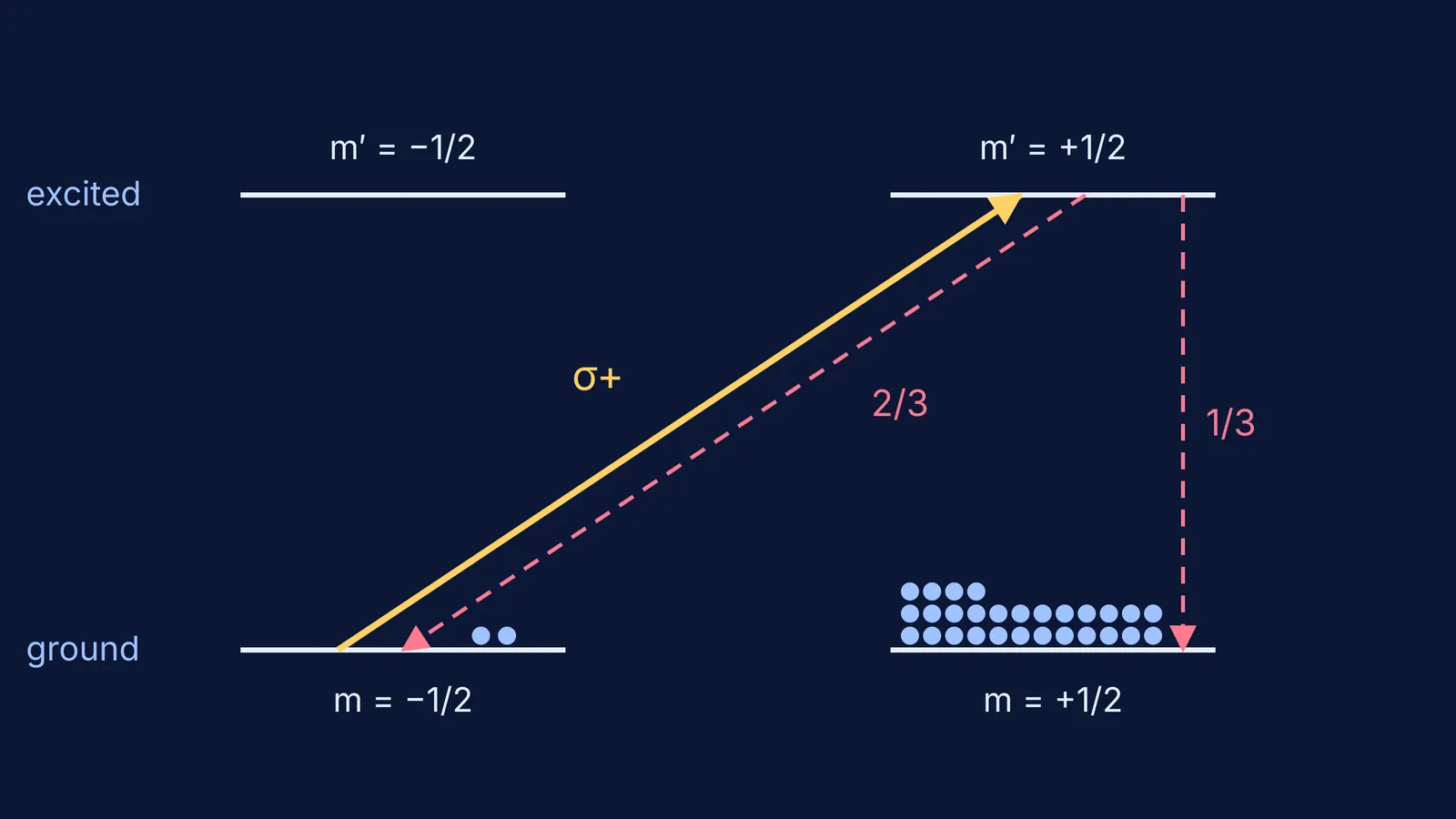
Take the simplest case, as in Zotin Chu's paper on optical pumping: an alkali atom whose ground and excited levels each have two sublevels, m = −1/2 and m = +1/2.
Shine σ+ light, which carries +ħ. Each absorbed photon must raise m by exactly 1.
An atom in m = −1/2 can jump to m′ = +1/2. An atom in m = +1/2 cannot, because there is no m′ = +3/2 to reach. To this light it is "dark".
The excited atom falls back. Chu notes it is twice as likely to fall to −1/2 as to +1/2, so 2/3 return to the start and 1/3 land in the dark level.
Repeat. Atoms in +1/2 stay; atoms in −1/2 try again.
Start with 50% of atoms in each sublevel. After n cycles, 50% × (2/3)^n remain: 6.6% after 5 cycles and 0.87% after 10, so more than 99% of the atoms sit in m = +1/2. Real vapours fall short because relaxation slowly undoes the sorting.
Why does optical pumping matter for lasers and atomic clocks?
Waller's presentation speech is direct: "Kastler's ideas about optical pumping played an important part in the development of the laser. Optical pumping has permitted the construction of easy to use and very sensitive magnetometers as well as atomic clocks."
Clocks and magnetometers use the detection side: light through a pumped vapour changes when a radio or microwave field hits the right frequency, so electronics can lock onto it. A review by Dmitry Budker and Michael Romalis lists their uses, from geomagnetic and space measurements to biomagnetic fields, NMR and MRI. For the laser side of the story, read how Zhores Alferov made lasers work at room temperature.
How can you learn from Kastler's idea?
A short plan to make it stick:
Draw the four-sublevel diagram from memory and mark the one jump σ+ light allows.
Recompute the fraction left in −1/2 after 2, 5 and 10 cycles.
Explain, in two sentences, why atoms in m = +1/2 are dark, naming the conservation law involved.
If level diagrams still feel abstract, the Fermi Simulation Lab has interactive simulations for ideas that are easier to see than to read. The Fermi Concept Library gives each concept in physics and chemistry its own lesson, so you can revise photon energy or angular momentum first.
A conservation law, applied carefully, became a tool for sorting atoms one photon at a time.


