

On this page
What did Raman and Bhagavantam find in 1931?
C. V. Raman and S. Bhagavantam sent the journal Nature a radiogram dated 28 September 1931, which it printed as it went to press (Nature, 1931). They had scattered monochromatic light off carbon dioxide gas and examined it with a spectroscope.
The theories of the day predicted that once the unshifted Rayleigh line was separated from the nearby rotational scattering, its depolarisation should drop to one quarter of its value. It did not. In their words, "the actual observed diminution, from 10 per cent to 6 per cent, is quantitatively explicable, assuming that common light consists of spinning quanta possessing one Planck unit of angular momentum" (Nature, 1931).
The full paper, "Experimental proof of the spin of the photon", appeared in the Indian Journal of Physics in October 1931. In a Nature letter of January 1932 they reported more precise results and repeated their conclusion that "the light quantum possesses an intrinsic spin equal to one Bohr unit of angular momentum" (Raman and Bhagavantam, Nature 129, 22).
Raman had won the 1930 Nobel Prize in Physics "for his work on the scattering of light and for the discovery of the effect named after him" (Nobel Prize). Bhagavantam, born in 1909, had joined Raman in 1928 and later became director of the Indian Institute of Science (Wikipedia). For Raman's earlier scattering work, read about Raman's 1921 voyage and the blue colour of the sea.
Where did the idea of photon spin come from?
It began with S. N. Bose. In 1924 he derived Planck's radiation law by counting photon states, and had to multiply his count by 2 to get the right answer. Raman and Bhagavantam's 1931 paper reports, from a personal communication, that Bose "envisaged the possibility of the quantum possessing besides energy hν and momentum hν/c also an intrinsic angular momentum ±h/2π around an axis parallel to [the] direction of its motion", so the factor 2 meant right-handed or left-handed spin (Ghose, arXiv 2023).
The physicist Partha Ghose writes that Bose told him Einstein, who translated the paper into German, crossed the spin idea out and said the factor of 2 came from the two polarisation states of light (Ghose, arXiv 2023). Ghose calls the 1931 result "the first ever experimental determination of photon spin".
How does scattered light reveal a photon's spin?
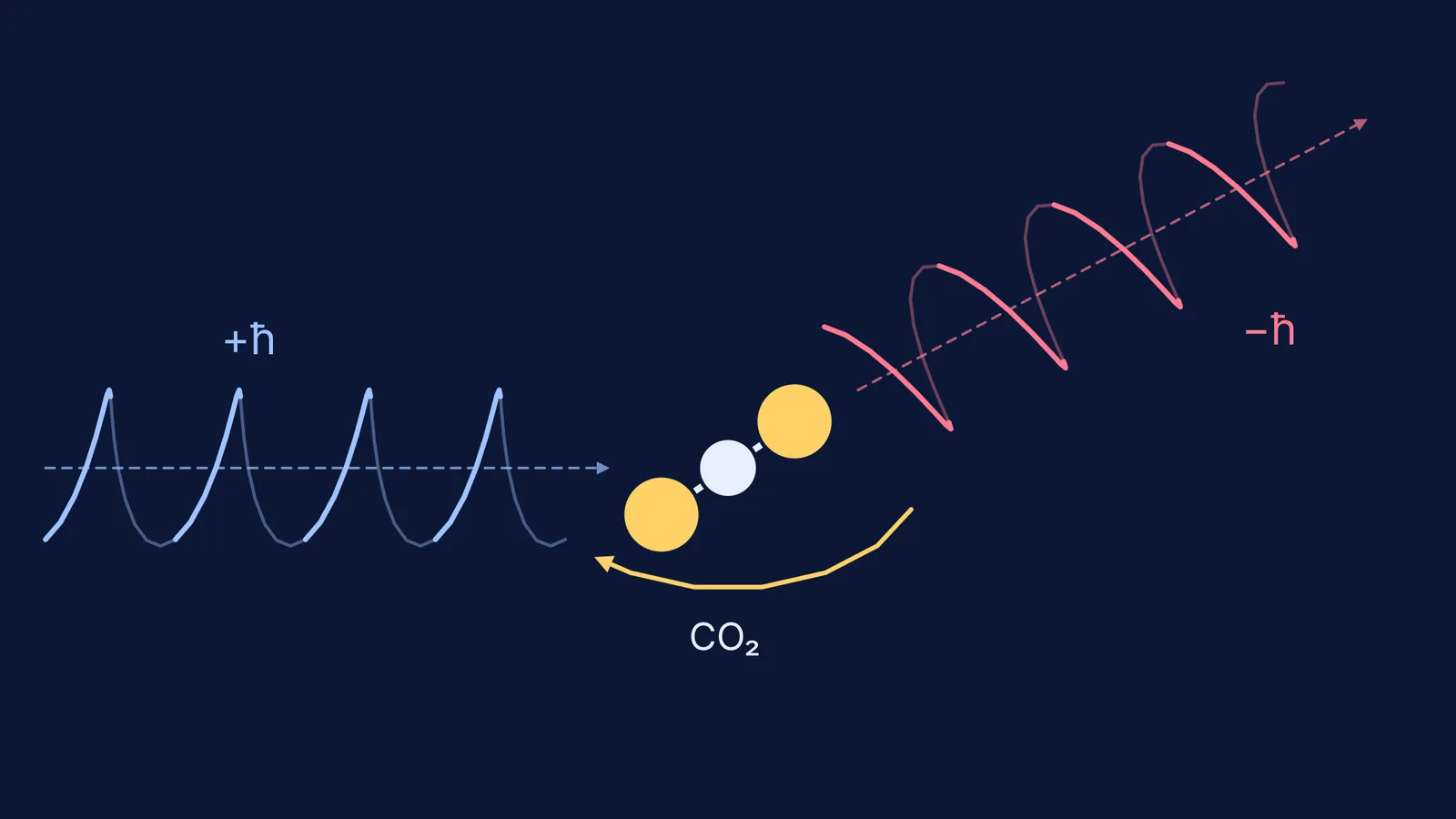
A carbon dioxide molecule is a straight rod, not a sphere. Light scattered off rods tumbling in a gas partly comes out with its polarisation changed: that is depolarisation. Some is also shifted slightly in colour as the molecule's rotation speeds up or slows down: rotational scattering, a form of the Raman effect.
Now apply conservation of angular momentum. In the simplest picture, if each photon carries exactly +h/2π or −h/2π, then a photon that arrives with +h/2π and leaves with −h/2π must hand 2 units to the molecule's rotation. Raman and Bhagavantam's second radiogram stated that the spin theory predicts rotational scattering reduced to half the classical value, and that measurements by Venkateswaran on carbon disulphide and benzene liquids confirmed it (Nature, 1931).
Five years later, Richard Beth detected and measured the angular momentum of light mechanically (Beth, Physical Review 50, 115).
How much torque does a photon's spin give a laser beam?
The unit is ħ = h/2π = 1.054571817 × 10⁻³⁴ J s (NIST). A photon's energy is E = ħω, so each photon carries angular momentum E/ω. A circularly polarised beam of power P that is fully absorbed therefore delivers a torque τ = P/ω.
Take a 1 mW green laser at λ = 532 nm, with c = 299 792 458 m/s (NIST).
Angular frequency: ω = 2πc/λ = 2π × 2.998 × 10⁸ / 5.32 × 10⁻⁷ ≈ 3.54 × 10¹⁵ rad/s.
Torque: τ = 10⁻³ / 3.54 × 10¹⁵ ≈ 2.8 × 10⁻¹⁹ N m.
That tiny torque is why measuring spin mechanically is hard, and why reading it off scattered light was a clever shortcut.
What can you learn from the 1931 experiment?
Use this five-question check on any famous experiment, here applied to the 1931 radiogram:
What did the old theory predict, as a number? (Depolarisation down to a quarter.)
What was measured? (10 per cent down to 6 per cent.)
Is the gap large compared with the prediction? (6 is 2.4 times 2.5.)
What single new assumption closes the gap? (Each photon carries ±h/2π.)
Was it checked another way? (Liquids in 1931, Beth's mechanical test in 1936.)
The same unit h/2π appears in Bohr's rule for electron orbits, which you meet in Class 11 chemistry and Class 12 physics, so photon spin links two chapters you already study. If that link feels shaky, the Fermi Concept Library gives every physics concept its own lesson and its place in the map.
To see polarisation for yourself, try the Malus's law polariser simulation, read why Rayleigh scattering makes the sky blue, or explore the Fermi Simulation Lab, built for ideas that are easier to see than to read.


