

On this page
In 1910, the scientific community had a simple explanation for the colour of the sea. Lord Rayleigh, the physicist who had successfully explained why the sky is blue using atmospheric scattering, argued that the ocean itself was colourless. He maintained that the dark blue of the deep sea was merely a reflection of the sky above it. This view became the established scientific consensus for more than a decade.
Why did scientists think the sea reflects the sky?
In the late 19th century, Rayleigh had established the mathematics of how light scatters when it hits tiny particles in the atmosphere. This process, now known as Rayleigh scattering, explains that air molecules scatter short, blue wavelengths of light much more effectively than the longer, red wavelengths. When we look up at the daytime sky, we see this scattered blue light.
However, when Rayleigh turned his attention to the ocean in 1910, he did not apply this scattering theory to water molecules. Instead, he argued that water was largely transparent and colourless. He believed that the dark blue of the deep sea was entirely an optical illusion caused by the sky mirroring off the surface. If you could eliminate the sky, he reasoned, the sea would appear dark.
What happened on C. V. Raman's 1921 voyage?
In September 1921, the Indian physicist C. V. Raman was travelling back to Bombay after his first ever visit to Europe, where he had attended a universities congress in Oxford. Sailing through the Mediterranean Sea aboard the S.S. Narkunda, Raman spent hours staring at the water. He was struck by its intense, opal-blue hue.
Despite his immense respect for Rayleigh's earlier work, Raman began to doubt the reflection theory. He suspected that the ocean's colour was an intrinsic property of the water, not just a trick of the light from above.
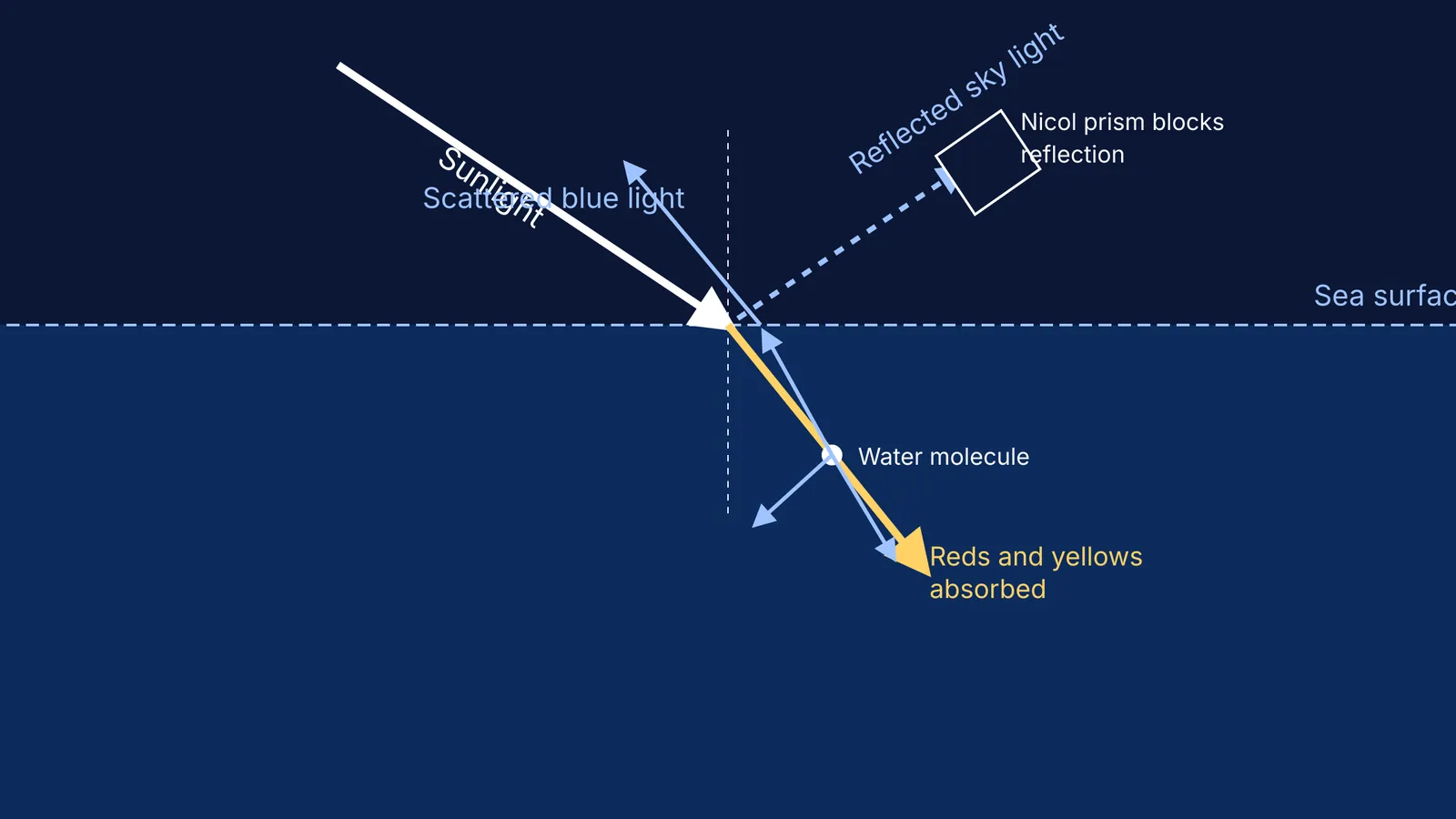
To test the idea on the spot, Raman used a handheld Nicol prism—a crystal device that polarises light and is commonly used in optical experiments. When sunlight reflects off the surface of a body of water at a specific angle, the glare is highly polarised. By looking down at the water through his Nicol prism and rotating it to the correct angle, Raman was able to completely block the surface reflection from reaching his eye.
If Rayleigh was correct, removing the sky's reflection should have left the water looking dark or colourless. Instead, Raman observed that the sea remained a brilliant, saturated blue. The colour was undeniably coming from within the water itself, emerging from the depths rather than just bouncing off the surface. (For a related look at how light behaves as it moves between materials, see Light entering glass: what happens to speed, wavelength, frequency).
How does water scatter light?
Raman realised that the sea's colour relies on the exact same physical principle as the sky's blue colour, but occurring inside a dense liquid. Water molecules themselves act as scattering agents for the incoming sunlight.
When white sunlight enters the ocean, two distinct physical processes shape the light that eventually reaches our eyes:
Absorption: Water absorbs longer wavelengths of light—the reds, oranges and yellows—very effectively. Within the first few metres of depth, most of the red light is absorbed and converted into heat.
Scattering: As the remaining light penetrates deeper into the water, the water molecules themselves scatter the shorter, blue wavelengths in all directions. Some of this scattered blue light is directed back up towards the surface and escapes into the air.
Because liquid water is much denser than the atmosphere, this molecular scattering happens intensely. While the reflection of the sky does contribute to the ocean's overall appearance—especially at very low viewing angles or on overcast days—the deep, majestic blue of the open sea is a fundamental property of water molecules scattering light. The sea is blue for the same underlying reason the sky is blue.
What did this discovery lead to?
Before his ship even reached port, Raman wrote a short paper titled "The Colour of the Sea". It was published in the journal *Nature* in November 1921. By demonstrating that molecules in a liquid scatter light, he opened a new field of inquiry.
He spent the rest of the decade investigating how light interacts with various liquids and gases (you can read more about classical optics in Dispersion of white light by a glass prism). This continuous research culminated in his 1928 discovery of the Raman effect—the phenomenon where a small fraction of scattered light changes its wavelength, revealing the molecular structure of the material. This breakthrough earned Raman the 1930 Nobel Prize in Physics.
If you are studying scattering and optics, Fermi's AI tutor teaches rather than answers, helping you work through the principles. When you struggle to picture how waves and molecules interact, the Fermi Simulation Lab provides interactive simulations for the ideas that are easier to see than to read.


