

On this page
In the 1960s, semiconductor lasers existed, but they were highly impractical outside the laboratory (NobelPrize.org). These early devices, called homojunction lasers, were made of a single semiconductor material with a simple p-n junction.
To produce a laser beam, they required massive electrical currents. This immense current generated so much heat that the lasers would destroy themselves unless they were operated in short pulses or cooled to cryogenic temperatures (such as 77 K in liquid nitrogen) (NobelPrize.org). The world needed a laser that could stay on continuously at room temperature.
How did Zhores Alferov build the semiconductor heterostructure laser?
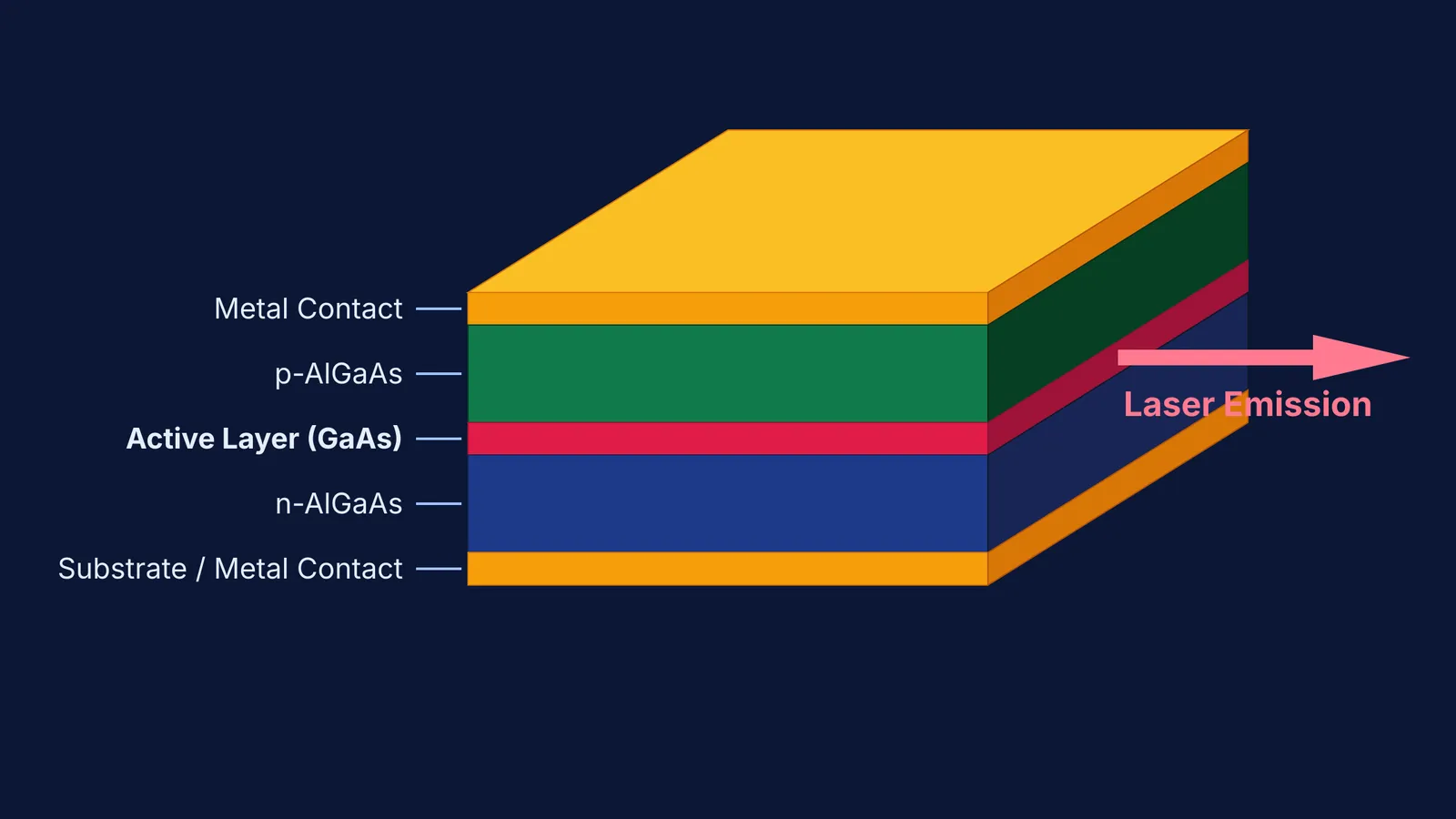
In 1963, Russian physicist Zhores Alferov and American physicist Herbert Kroemer independently proposed a solution: the double heterostructure. Instead of a single material, they suggested a layered "sandwich" of different semiconductors (Nobel Prize Press Release).
By May 1970, Alferov’s team at the Ioffe Physico-Technical Institute in St. Petersburg successfully built this structure using gallium arsenide (GaAs) and aluminium gallium arsenide (AlGaAs) (NobelPrize.org).
This double heterostructure works through two types of confinement:
Carrier confinement: The active middle layer (GaAs) has a narrower energy bandgap than the outer cladding layers (AlGaAs). Electrons and holes become trapped in this thin middle well, forcing them to recombine and emit light highly efficiently.
Optical confinement: The GaAs layer has a higher refractive index than the surrounding AlGaAs. This acts like an optical waveguide, trapping the emitted photons within the active layer and directing them out as a focused beam.
The key parameter here is the threshold current density—the minimum electrical current per unit area required for lasing to begin. In homojunction lasers, this threshold was so incredibly high that the resulting heat rapidly destroyed the device unless it was operated at 77 K. By utilizing the double heterostructure to trap both carriers and light in a microscopic active region, the threshold current density dropped by several orders of magnitude. This dramatic reduction in required current finally eliminated the catastrophic overheating problem (NobelPrize.org).
Why was the 1970 breakthrough so important?
When Alferov's team turned on their new double-heterostructure laser in 1970, it stayed on, continuously, at room temperature (NobelPrize.org).
The ability to operate continuously at room temperature transformed the semiconductor laser from a fragile laboratory curiosity into a robust, practical component. Without this breakthrough, modern fibre-optic communication networks would be physically impossible. The light emitted by these lasers serves as the carrier wave for nearly all data transmitted across the internet, pulsing billions of times per second to encode information. Furthermore, because these devices are extremely small, efficient, and cheap to manufacture, they quickly found their way into everyday consumer electronics. The same fundamental double-heterostructure technology powers the lasers in CD and DVD players, checkout barcode scanners, and everyday laser pointers (Nobel Prize Press Release).
For his pioneering work on semiconductor heterostructures, Alferov was awarded a share of the Nobel Prize in Physics in 2000 (Nobel Prize Press Release).
What should you know about semiconductor physics?
When studying the physics of semiconductors and lasers for your exams, use this checklist to ensure you understand the core principles:
Band theory: Can you draw and compare the energy bands of conductors, insulators, and semiconductors?
Doping: Do you know how adding impurities creates n-type and p-type materials?
Junctions: Can you explain what happens at a p-n junction and how a depletion region forms?
Confinement: Can you describe how a double heterostructure confines both charge carriers (using bandgaps) and photons (using refractive indices)?
To build a strong foundation, start by reviewing how Energy bands: conductors, semiconductors and insulators compared and practicing n-type and p-type semiconductors: carrier concentration problems.
If you find ideas like bandgaps, refractive indices, and heterojunctions hard to picture, you are not alone. The Fermi Concept Library contains every concept in physics, chemistry, biology, mathematics and computing, each with its own lesson and its place in the map.
When you tackle these advanced topics, Fermi's AI tutor works out what you already know and builds a plan for the session—teaching through it, drawing the figures, and checking understanding as it goes.


