

Isidor Isaac Rabi grew up in a traditional family in New York. Later in life, he often told a story about how his mother sparked his career in science. When other children came home from school, their parents would ask what they had learned. Rabi's mother took a different approach: "Izzy, did you ask a good question today?"
That habit of active inquiry shaped his approach to physics. Instead of simply accepting the theoretical models of the atomic nucleus, Rabi wanted to measure its properties directly and with unprecedented precision.
If you are a student, this is a powerful study habit. Passive reading rarely exposes the gaps in your understanding. True mastery comes from framing the right questions when you are stuck. When you are studying physics and the textbook stops making sense, Fermi's AI tutor can work out what you already know and build a plan for the session, so you sit down to a clear next step.
What is molecular beam magnetic resonance?
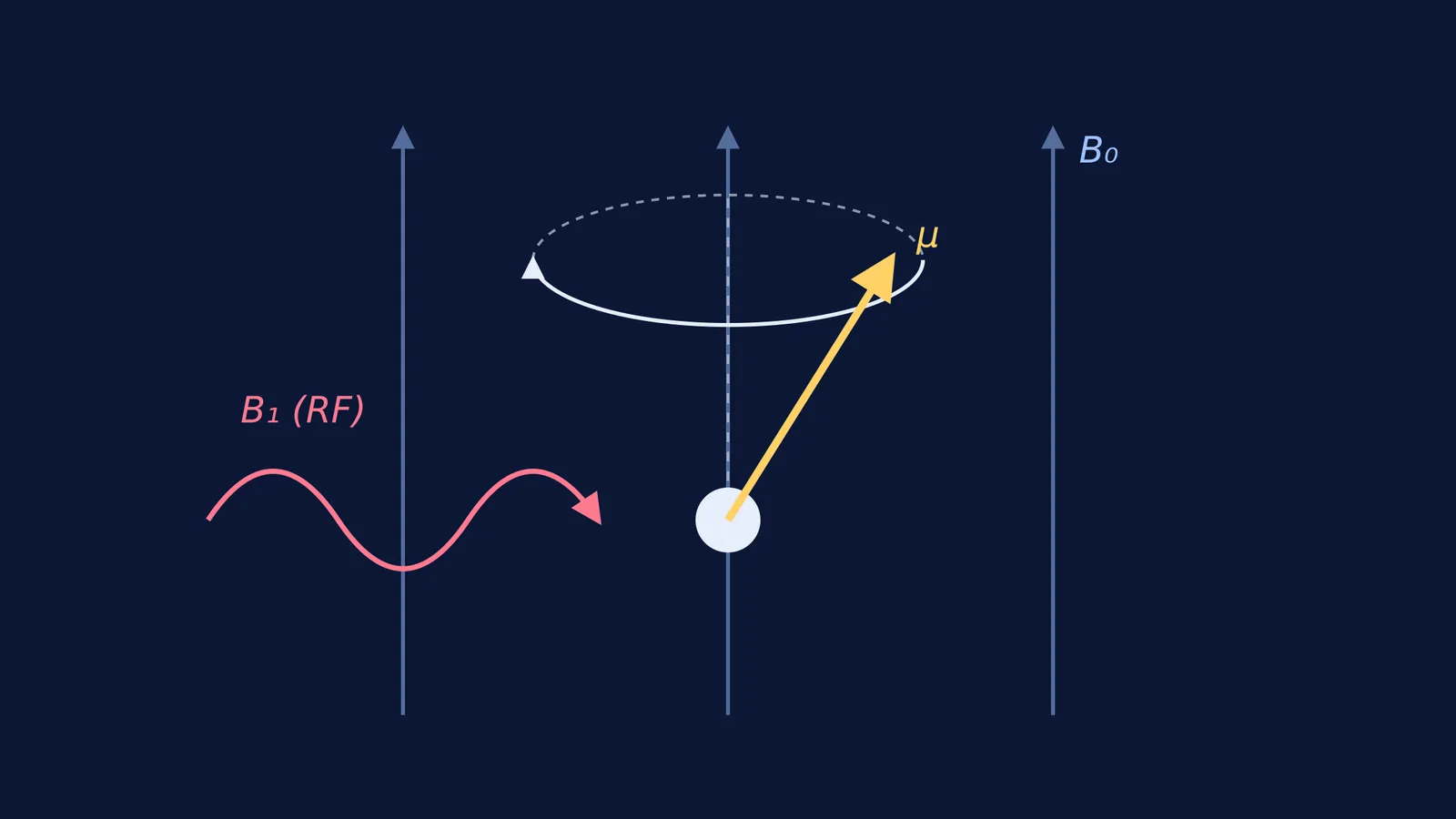
By the 1930s, physicists knew that atomic nuclei had a property called "spin," which gives them a magnetic moment—essentially making each nucleus a tiny bar magnet. When placed in a strong, uniform magnetic field, these nuclear magnets do not just perfectly align; they precess, or wobble like a spinning top, at a specific rate called the Larmor frequency. This frequency depends strictly on the nucleus's unique properties and the strength of the magnetic field.
Rabi's genius was to combine this steady precession with an oscillating radio-frequency (RF) wave. In his landmark 1938 paper, published in the *Physical Review*, Rabi and his colleagues Jerrold Zacharias, Sidney Millman, and Polykarp Kusch detailed their new molecular beam method.
The Beam: They heated a substance to a gas in an oven and shot a beam of molecules, such as lithium chloride, through a high-vacuum chamber.
The First Deflection: The beam passed through an uneven (inhomogeneous) magnetic field, which exerted a force on the magnetic moments, deflecting the molecules onto a curved path based on their spin.
The Resonance Region: In the middle of the apparatus, the molecules entered a uniform magnetic field, keeping their precession steady, while a wire coil bathed them in radio waves.
The Flip: When the radio frequency exactly matched the Larmor precession frequency of the nuclei, a quantum resonance occurred. The nuclei absorbed the energy and "flipped" their spin orientation.
This spin flip changed how the molecules interacted with a final uneven magnetic field. Instead of being guided toward the detector at the end of the machine, the flipped molecules were pushed away and missed it. By simply tuning the radio dial until the detector registered a sharp drop in particle intensity, Rabi could read off the nucleus's exact resonance frequency, and thereby its magnetic moment, with incredible accuracy.
If you want to understand how a related concept like the magnetic moment works in practice, you can explore the physics of a spinning charged ring or disc, or read about how scientists like George Uhlenbeck and Samuel Goudsmit discovered the spin of the electron. For a comprehensive overview of magnetism, the Fermi Concept Library maps out every concept in physics, each with its own lesson and its place in the map.
How did Rabi's discovery lead to MRI and atomic clocks?
Rabi's 1938 experiment was performed on isolated molecules in a vacuum. For this breakthrough in measuring the magnetic properties of atomic nuclei, he received the 1944 Nobel Prize in Physics.
However, the story did not end there. In 1945, Rabi publicly suggested that because the resonance frequency of an atom's nucleus is constant and untouched by its environment, it could serve as a perfect "pendulum" for a timekeeping device. This idea led directly to the development of the atomic clock. Today, the length of the SI second is officially defined by the resonance frequency of a cesium atom—a direct legacy of Rabi's work.
Furthermore, Rabi's resonance principle was a triumph of experimental physics, yielding measurements far more accurate than previous techniques (see NobelPrize.org). In 1946, building directly on Rabi's insights, physicists Felix Bloch and Edward Purcell independently figured out how to detect nuclear magnetic resonance (NMR) in bulk matter—solid and liquid samples—eliminating the need for a vacuum beam.
By the 1970s, scientists realized that by applying a magnetic field gradient across a human body, they could use NMR to pinpoint exactly where the radio signals were coming from. That advancement became Magnetic Resonance Imaging (MRI). Every time an MRI scanner produces a detailed, non-invasive image of the human body, it relies on the same fundamental spin-flip resonance that Rabi first measured in 1938.


