On this page
Abraham Gesner was an extraordinary 19th-century polymath whose discoveries helped launch modern industrial chemistry. Born on May 2, 1797, near Cornwallis, Nova Scotia, Gesner initially trained in London as a physician under surgeons Sir Astley Cooper and Dr. John Abernethy before shifting his focus to field geology. As documented in the Dictionary of Canadian Biography, he was appointed provincial geologist of New Brunswick in 1838, making him the first government geologist in any British colony. Over a five-year survey ending in 1843, Gesner mapped mineral deposits across the Atlantic provinces and founded Gesner's Museum in Saint John in 1842, one of the earliest public natural history museums in Canada, as noted by The Canadian Encyclopedia.
How did Abraham Gesner invent kerosene from coal?
During his geological surveys across New Brunswick and Prince Edward Island, Gesner observed vast formations of bitumen and cannel coal. Most urban lighting in the 1840s relied on costly animal oils or dangerous mixtures of alcohol and turpentine known as camphene, which frequently exploded in home lamps. Gesner realised that solid fossil hydrocarbons could yield a clean liquid fuel if broken down under carefully controlled heat.
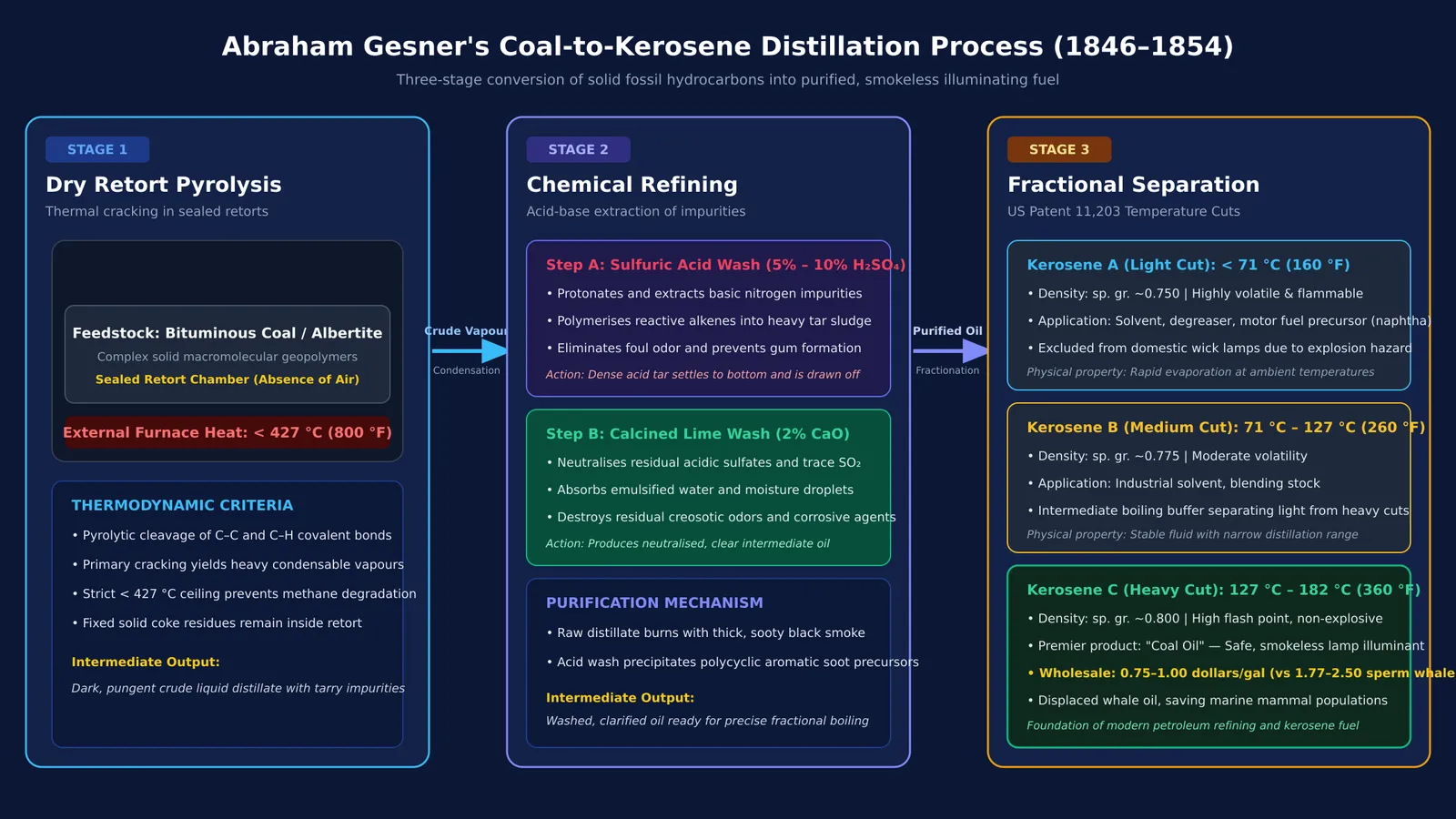
In August 1846, Gesner delivered a public lecture in Charlottetown, Prince Edward Island, where he demonstrated a new illuminating fluid extracted through the dry distillation of bituminous materials. According to historical analysis in the Business History Review, Gesner heated solid bitumen and coal in sealed cast-iron retorts at temperatures below 427 °C (800 °F). Keeping the retort below this threshold prevented the material from breaking down into useless fixed gases such as methane. Gesner coined the word kerosene from the Greek noun keros, meaning wax, and the suffix -ene to reflect its volatile hydrocarbon character.
What were the three grades in Gesner's 1854 patents?
After commercial setbacks in Canada, Gesner relocated to New York in 1853 to establish the North American Kerosene Gas Light Company on Long Island. On June 27, 1854, the United States Patent Office granted him three landmark patents for his process, led by US Patent 11,203. Gesner separated his distillate into three distinct commercial fractions:
Kerosene A: A volatile, light fraction distilled at temperatures up to 71 °C (160 °F), functioning as a solvent and motor fuel precursor similar to modern naphtha.
Kerosene B: An intermediate cut distilled between 71 °C and 127 °C (260 °F), used primarily for blending.
Kerosene C: A heavy, non-explosive cut collected between 127 °C and 182 °C (360 °F), which became the premier illuminating oil known commercially as coal oil.
Raw distillates produced heavy soot and pungent creosotic fumes. In his 1861 manual A Practical Treatise on Coal, Petroleum, and Other Distilled Oils, Gesner explained how treating the crude distillate with 5% to 10% concentrated sulfuric acid precipitated tarry residues and unsaturated impurities. A subsequent wash with 2% freshly calcined lime (calcium oxide) neutralised residual acid and removed traces of moisture. Understanding why unsaturated hydrocarbons burn with a sooty flame helps explain why Gesner's chemical purification was crucial: removing conjugated alkenes produced a bright, smokeless yellow flame.
How did kerosene replace whale oil in the 1850s?
Before Gesner's refining process reached commercial scale, urban households depended on oil rendered from sperm whales and right whales. By the 1850s, overhunting had decimated Atlantic whale stocks, forcing whaling ships on voyages lasting three to four years. A research study in Sustainability found that premium sperm whale oil rose to between 1.77 and 2.50 dollars per gallon during the 1850s, turning nighttime lighting into a luxury.
According to market analyses in the Business History Review, Gesner's coal-distilled kerosene sold wholesale for approximately 0.75 to 1.00 dollar per gallon in the late 1850s, providing superior luminosity without spoiling or giving off rancid odors. When the discovery of crude petroleum at Titusville, Pennsylvania, in 1859 allowed refiners to bypass coal retorts, kerosene prices plummeted below 0.40 dollars per gallon. The rapid transition collapsed the commercial whaling fleet and protected marine mammal populations from systematic depletion. Comparing the calorific value of fuels shows why kerosene quickly dominated: liquid hydrocarbons provide high energy density while burning predictably through woven cotton wicks.
What can students learn from coal distillation chemistry?
Gesner's retorting and fractional condensation laid the chemical engineering groundwork for the modern energy industry. Decades before synthetic petroleum processes such as the Bergius process used high pressure to liquefy coal, Gesner demonstrated how thermal cracking breaks complex macromolecular geopolymers into light aliphatic hydrocarbons.
When analysing fractional distillation in school chemistry, students can apply this four-point framework:
Volatility and boiling range: Lighter hydrocarbons with shorter carbon chains boil at lower temperatures and distill over first.
Pyrolysis versus separation: Destructive distillation chemically cracks large carbon skeletons, whereas fractional distillation of crude oil separates existing molecules by boiling point.
Chemical purification: Treating crude fractions with acid or alkali removes unstable sulfur and nitrogen compounds that degrade combustion quality.
Operational safety: Controlling distillation temperatures prevents explosive light vapours from contaminating heavier illuminating cuts.
When examining how boiling points and volatility govern vaporisation in fractional distillation columns, the Fermi Simulation Lab provides interactive simulations for the ideas that are easier to see than to read. To see how thermal decomposition, hydrocarbon fractions, and combustion reactions connect across the curriculum, the Fermi Concept Library covers every concept in physics, chemistry, biology, mathematics and computing, each with its own lesson and its place in the map.