

On this page
In 1913, a German chemist found a way to create liquid fuel from solid rock. Developed by Friedrich Bergius, the Bergius process is a chemical method for the direct liquefaction of coal, converting solid lignite into liquefied oil. By adding hydrogen directly to the carbon structure of coal, the method bridges the chemical gap between a solid fuel and a liquid one.
For a student studying chemical equilibrium, the process is a perfect case study in how extreme conditions force reluctant molecules to react. This work laid the foundation for modern industrial chemistry and earned its creator a Nobel Prize.
What is the Bergius process?
The Bergius process transforms coal into a synthetic liquid fuel through a reaction with hydrogen gas at high temperature and pressure. The technique was first developed as early as 1913. During World War II, this synthetic fuel was vital for Germany, allowing the country to produce liquid fuel without relying on natural petroleum sources. Today, the core chemistry still serves as the basis for direct coal liquefaction technologies worldwide.
How does the Bergius process convert coal to petrol?
Coal is mostly carbon, while petrol is a mixture of hydrocarbons (molecules containing both carbon and hydrogen). To turn the solid into a liquid, you have to break the large carbon networks and force hydrogen atoms into the gaps.
Here is how the chemistry works in practice:
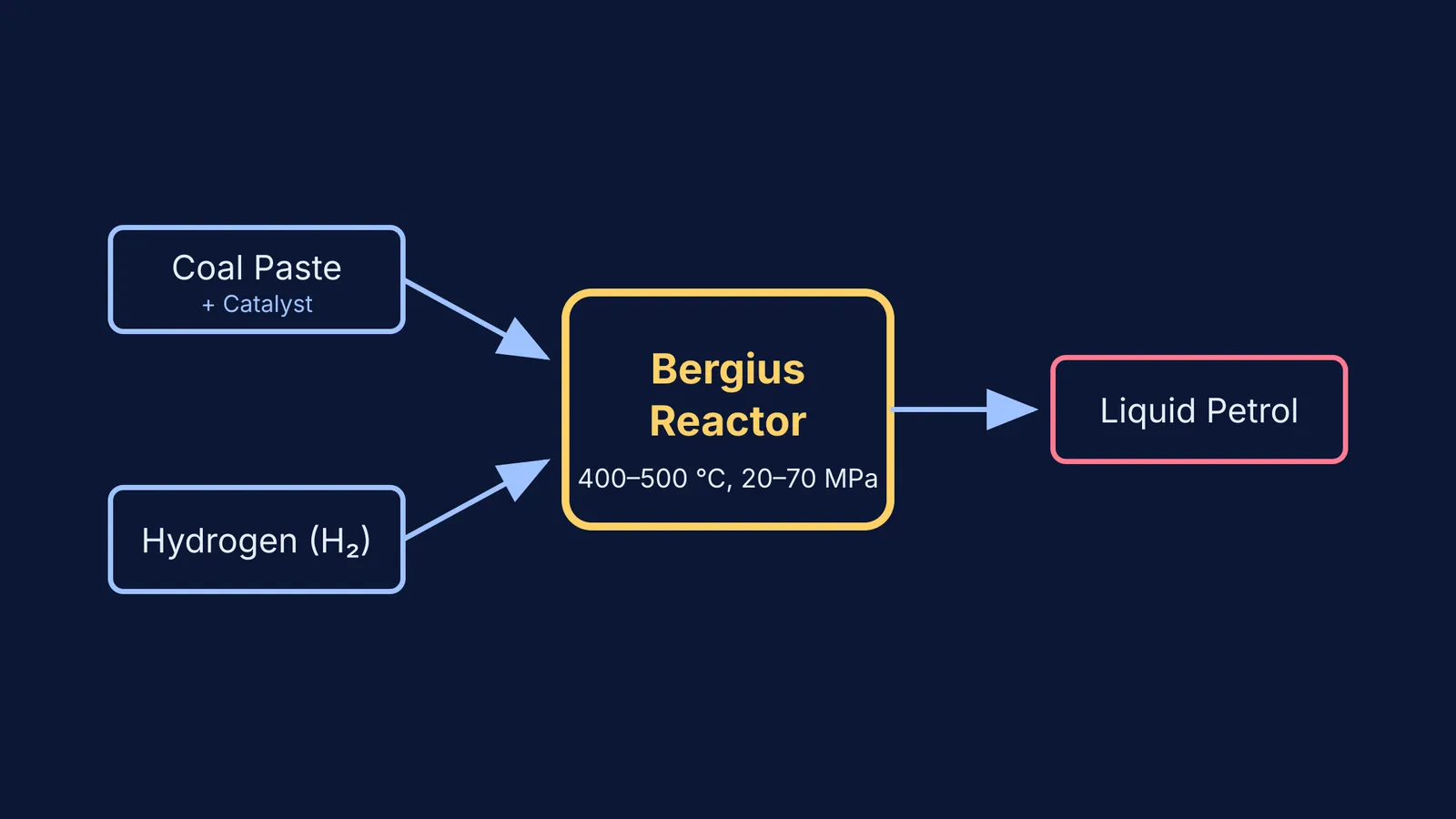
Preparation: Lignite or brown coal is ground into a fine powder and mixed with a heavy oil (recycled from previous runs) to form a thick paste.
Catalysis: A catalyst is added to speed up the reaction. While the iron sulfide naturally present in coal sometimes works, industrial plants use more efficient catalysts like tungsten disulfide or molybdenum disulfide.
Hydrogenation: The paste is pumped into a massive reactor vessel alongside hydrogen gas. The reaction requires a temperature between 400 and 500 °C. It also demands intense hydrogen pressure, ranging from 20 to 70 megapascals.
Separation: The extreme heat and pressure crack the coal's structure, allowing hydrogen to bond with the carbon. The resulting mixture is cooled and separated into gases, heavy oils, and liquid petrol.
Why did Friedrich Bergius win the Nobel Prize?
In 1931, Friedrich Bergius was awarded a share of the Nobel Prize in Chemistry, splitting the honour with Carl Bosch. The official motivation from the Nobel committee praised them "in recognition of their contributions to the invention and development of chemical high pressure methods."
Before their work, many chemists believed that scaling up high-pressure, high-temperature gas reactions was too dangerous and unpredictable for industrial manufacturing. Bergius proved that with the right engineering, extreme pressure could be controlled to build the molecules society needed. His discoveries paved the way not just for synthetic fuels, but for the modern production of countless other everyday chemicals.
How does high pressure shift chemical equilibrium?
If you are preparing for your chemistry exams, the Bergius process is a classic real-world application of Le Chatelier's principle. The reaction forces hydrogen gas into a solid to make a denser liquid. Because the product side of the equation occupies far less volume than the gaseous reactants, increasing the pressure pushes the equilibrium forward, favouring the creation of petrol.
Memorising reaction temperatures is less useful than understanding *why* the pressure is needed. If you find it hard to picture how changing pressure shifts a reaction, the Fermi Simulation Lab has interactive simulations for the ideas that are easier to see than to read, letting you compress a reaction vessel and watch the equilibrium shift. Or, if you need a structured review of thermodynamics before a test, the Fermi Concept Library covers every concept in physics, chemistry, biology, mathematics and computing, each with its own lesson and its place in the map.
For more on how early chemists manipulated extreme conditions, read about Denis Papin and the pressure cooker of the 1600s, or see how reaction rates were understood by Elizabeth Fulhame and the first idea of how catalysts work.


