On this page
Writing and City Life is the first theme in NCERT's Themes in World History for Class 11, and it rests on one argument: city life and writing grew up together in southern Mesopotamia, the land between the Euphrates and the Tigris that is now part of Iraq. Hold that thread and the dates stop feeling like separate facts.
Why did Mesopotamian cities need writing?
Cities did not grow just because the farmland was rich. They grew when an economy developed trade, manufactures and services, and people came to depend on one another. A seal carver needs bronze tools he cannot make; the toolmaker needs copper and tin he does not fetch himself. NCERT calls this division of labour “a mark of urban life”, and adds that urban economies “often require the keeping of written records”.
The south had plenty of food but few minerals: no stone for tools, poor timber and no metal. So it probably traded textiles and farm produce for wood, copper, tin, silver, gold and stone from Turkey, Iran and across the Gulf, moving goods by boat along rivers and canals because water transport was cheapest.
How did cuneiform writing develop?
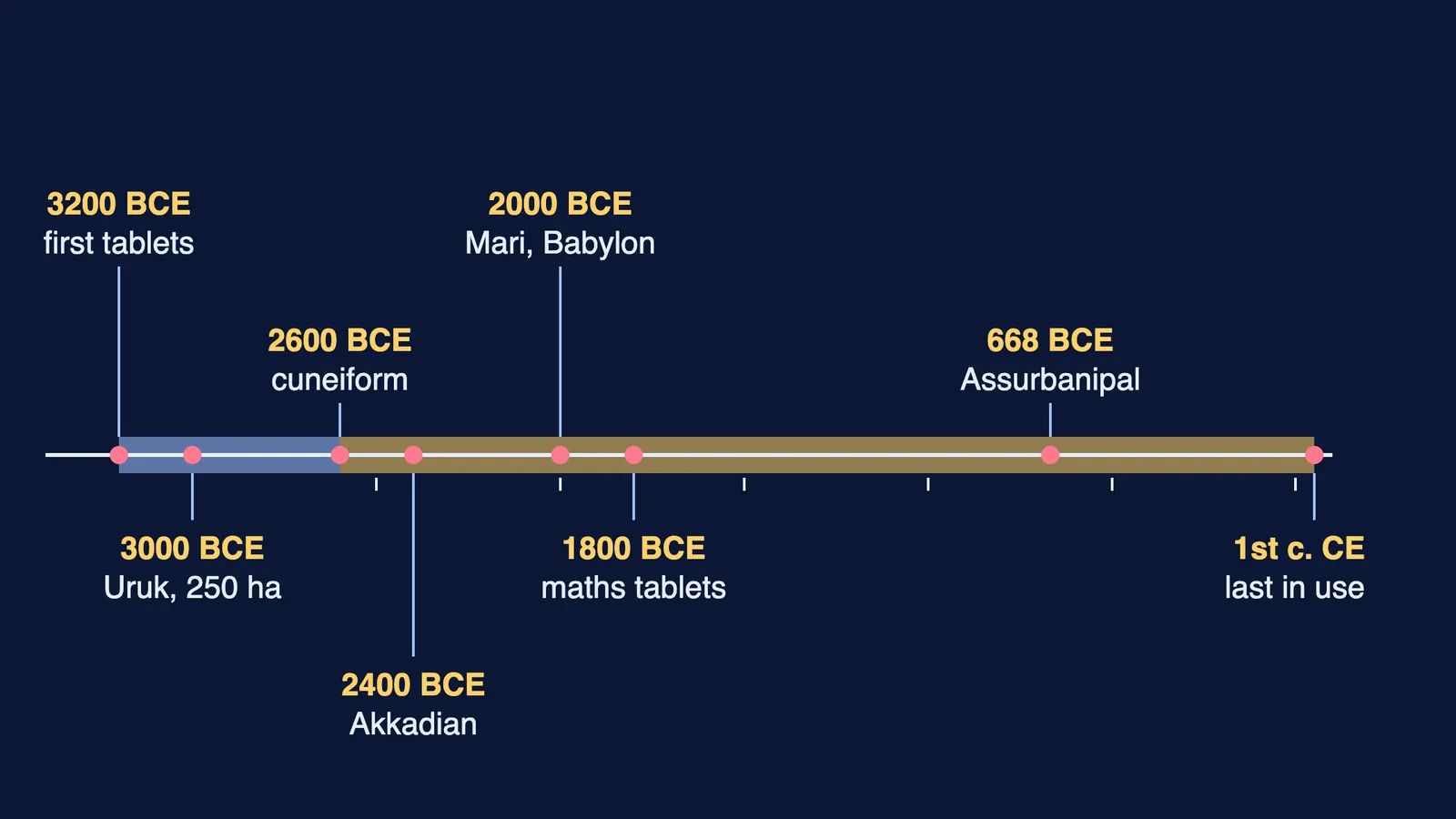
The first Mesopotamian tablets, written around 3200 BCE, were about 5,000 lists of oxen, fish, bread loaves and other goods brought into or given out from the temples of Uruk (NCERT, Theme 1). Writing began, the chapter argues, when society needed to keep records of transactions.
Cuneiform means wedge-shaped, from the Latin cuneus (wedge) and forma (shape). A scribe pressed the cut end of a reed into damp clay; once dried in the sun, a tablet was “almost as indestructible as pottery”, and each transaction needed its own tablet, which is why tablets turn up by the hundreds. By 2600 BCE the signs had become cuneiform and the language was Sumerian; Akkadian gradually replaced Sumerian after 2400 BCE, and cuneiform in Akkadian stayed in use until the first century CE. Each sign stood for a syllable, not a single letter, so scribes had hundreds of signs to learn, and very few people could read.
What do Ur and Mari show about city life?
Ur’s ordinary houses were excavated in the 1930s (NCERT). Narrow, winding streets meant carts could not reach many houses, and irregular plots show no town planning. There were no street drains like Mohenjo-daro’s; rainwater was probably channelled through drainpipes into sumps in inner courtyards. Compare it with our guide to how Harappan finds are read in Bricks, beads and bones.
Mari, far upstream on the Euphrates, flourished after 2000 BCE as a trading town in a pastoral zone, ruled by Amorite kings. Its officers boarded passing boats, inspected cargoes of wood, wine, oil and grinding stones, and charged about one-tenth of the value before letting them go on (NCERT). King Zimrilim’s palace (1810-1760 BCE) had 260 rooms over 2.4 hectares, including a scribes’ office with clay bins for storing tablets.
Worked answer: causes, conditions or outcomes?
Exercise question 2 in the NCERT chapter asks you to sort six items. Use this test: a condition is something cities needed but that did not create them on its own; a cause pushed people into cities; an outcome came after cities existed. Here is one defensible sorting, each backed by the chapter:
Highly productive agriculture: condition. The chapter warns against thinking cities grew “simply because of rural prosperity”.
Water transport: condition. Moving grain or charcoal on pack animals was too costly for a city economy.
Lack of metal and stone: cause. It forced organised trade and foreign expeditions.
Military power of kings that made labour compulsory: cause. Around 3000 BCE, as Uruk grew to 250 hectares, dozens of small villages were deserted.
Division of labour: outcome, “a mark of urban life”.
Use of seals: outcome. NCERT’s box on seals is titled “The Seal – An Urban Artefact”.
Some items can be argued either way, so always write the because-clause.
What is the legacy of writing in Mesopotamia?
Stories can travel by word of mouth, but science needs texts later scholars can build on. Tablets from around 1800 BCE carry multiplication and division tables, square-root tables and tables of compound interest (NCERT). One gives the square root of 2 in base 60 as 1 + 24/60 + 51/60² + 10/60³.
Work it out yourself: 1 + 0.4 + 0.0141667 + 0.0000463 = 1.4142130, against the true value of 1.4142136. The 12-month year, the 24-hour day and the 60-minute hour also reached us from Mesopotamia. If place value in another base feels slippery, the Fermi Concept Library has its own lesson for every concept in mathematics.
For a revision pass, draw the timeline from first tablets to the last cuneiform from memory, then attach one city and one use of writing to each date. For how inscriptions work as sources closer to home, read our notes on Kings, farmers and towns for Class 12.