

On this page
Wisdom teeth usually start coming through in your teens or early 20s, according to the NHS guide to wisdom tooth removal. For many people they arrive in a jaw with no room left. The reason involves evolution, cooking and how bone responds to chewing.
Why do we have wisdom teeth at all?
Wisdom teeth are third molars: the last grinding tooth on each side of the upper and lower jaw, so a full set is four. Our ancestors had larger jaws and molars for chewing tough food, and in that jaw the third molar was just another working tooth.
Over human evolution, teeth got smaller. A 2016 Nature study by Evans and colleagues notes that the shrinking of tooth size, and the extra shrinking of the third molar, has been recorded for over a century and put down to changes in diet or to cooking (Evans et al., Nature, 2016). The team showed that one developmental rule, the inhibitory cascade, predicts the sizes of the lower back teeth along the row in species of Homo, including us.
For the bigger picture of how our skulls changed, see our post on human evolution from Australopithecus to Homo sapiens.
Why do wisdom teeth often not have enough room?
Jaw bone grows partly in response to the strain of chewing. Softer food means less strain and less growth.
Daniel Lieberman's team at Harvard tested this in rock hyraxes, small mammals whose face, like ours, does not jut forward (Lieberman et al., Journal of Human Evolution, 2004). Chewing raw food produced strains up to twice as high as chewing cooked food at some sites. Hyraxes raised on cooked food had about 10% less growth in the lower and back parts of the face, where strains were highest.
Human jaws point the same way. A 2011 University of Kent study compared lower jaws from hunter-gatherer and farming populations worldwide, controlling for shared population history, geography and climate (von Cramon-Taubadel, PNAS, 2011). Hunter-gatherers had consistently longer, narrower lower jaws than farmers. The paper argues that less chewing stress changes how the jaw grows, which would explain the mismatch between lower face and teeth, and the crowding seen in modern industrial populations.
How common are impacted or missing wisdom teeth?
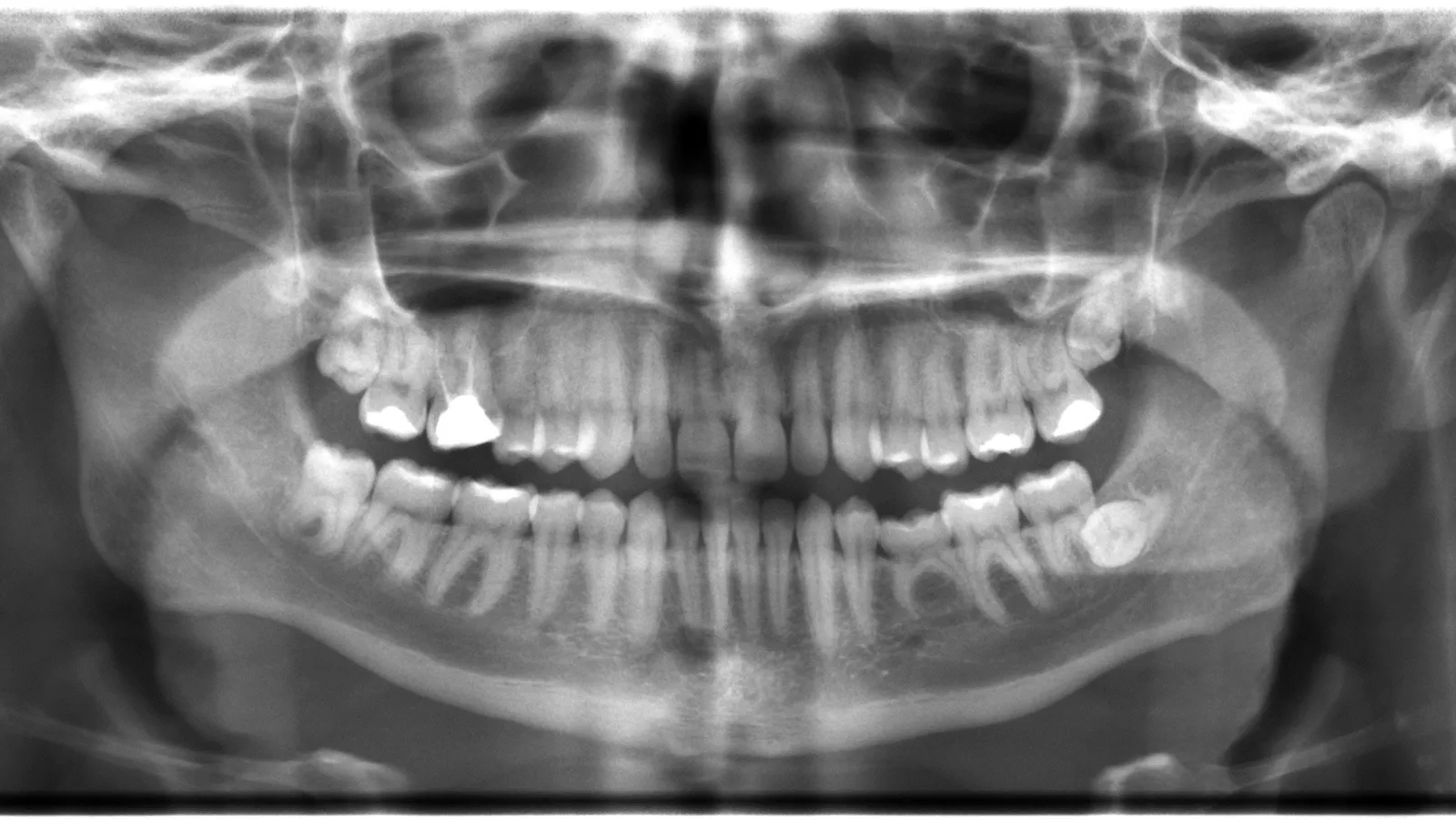
A wisdom tooth is called impacted when another tooth blocks it from coming through fully, as the NHS guide puts it.
A meta-analysis of 49 studies covering 83,484 people aged 17 and over who had dental X-rays found that 24.4% had impacted wisdom teeth (Carter and Worthington, Journal of Dental Research, 2016). The odds of impaction were about 58% higher in the lower jaw than the upper.
Some people never form them. A second meta-analysis, of 92 studies and 63,314 people, put the worldwide rate of missing wisdom teeth at 22.6%, with single studies ranging from about 5% to 56% (Carter and Worthington, Journal of Dental Research, 2015).
Are wisdom teeth vestigial, then? It depends on the jaw: where there is room, a third molar chews like any other. Our post on vestigial organs in humans explains what that label means and how biologists use it as evidence.
How do you explain wisdom teeth in a biology answer?
A strong answer runs in four steps:
Structure: wisdom teeth are third molars, the last of the grinding teeth.
Past state: ancestral humans had larger jaws and teeth for a tougher diet.
Mechanism: jaw growth responds to chewing strain, and cooked, processed food lowers that strain.
Evidence: hyraxes fed cooked food grew about 10% less in the lower and back face (Lieberman et al., 2004).
The most common mistake: writing that jaws shrank because we stopped using them, and the smaller jaw was passed on. That is Lamarck's idea, not Darwin's. The hyrax result is growth within one lifetime. Keep change within a life (how bone grows) apart from change across generations (which genes spread).
If that line is still blurry, the Fermi Concept Library has a lesson for every concept in biology, each with its place in the map, so you can see where growth and natural selection connect.
What should you do if your wisdom teeth are coming in?
The NHS guide says trouble can start when a wisdom tooth does not have enough space to come through fully. That can cause:
pain and swelling
infection in the gum around the tooth (pericoronitis)
food getting stuck, tooth decay or gum disease
A dentist may take X-rays to check how the teeth are positioned. If a wisdom tooth is not causing problems, the NHS says it is usually left where it is and monitored at routine check-ups.
In India, see a registered dentist about pain or swelling. A useful question to ask: does this tooth have room to come through fully, and what signs would change the plan?
Curious how dentists use slow bone change on purpose? Read how braces move teeth with small forces and slow bone remodelling.


