

On this page
If you or your child has just had braces fitted, two questions come up fast: how does a thin wire move a tooth set in bone, and why does it take so long? The answer joins school physics, springs and pressure, to the biology of living bone.
What actually holds a tooth in your jaw?
A tooth is not cemented into the jawbone. Its root sits in a socket in the alveolar bone, slung there by the periodontal ligament, a thin layer of fibres between root and bone. Our guide to the structure of a tooth, from enamel to cementum covers the layers that ligament attaches to.
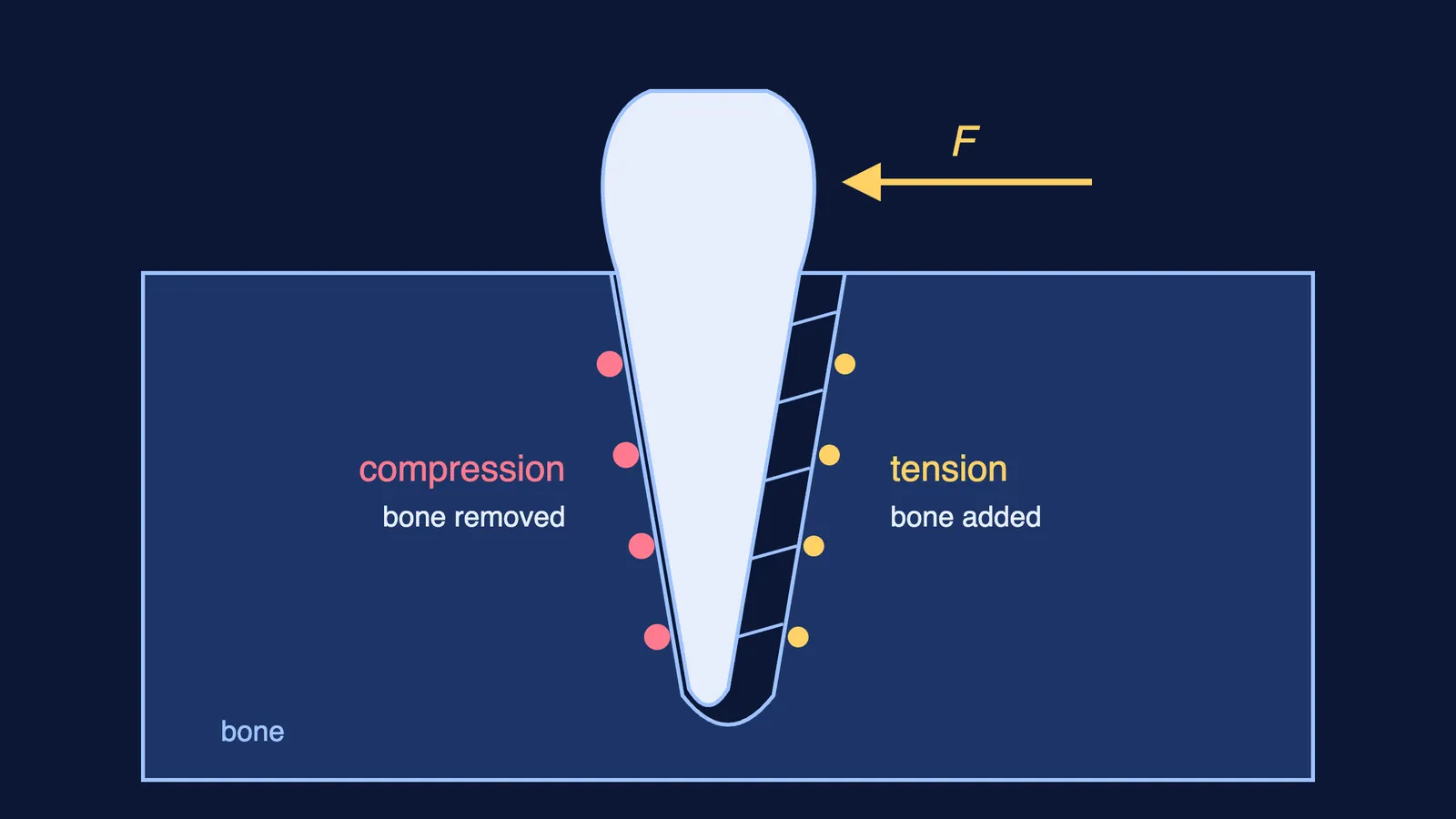
Push a tooth and the ligament is squeezed on the side it moves towards and stretched on the other. The bone around it is living tissue that reshapes itself to the loads it carries, which is also why astronauts lose bone in weightlessness.
How do braces move teeth?
The archwire is tied into brackets on teeth that are not yet where they should be. Like a bent spring, it pushes back towards its original shape, roughly in proportion to how far it is bent (Hooke's law), so each tooth feels a small, steady force.
A 2015 review in The Scientific World Journal sums up the mechanism, while calling it an oversimplification: the response to orthodontic force is bone formation on the tension side and bone resorption on the compression side. Cells called osteoclasts dissolve bone where the ligament is squeezed. Cells called osteoblasts lay down new bone where it is stretched. The socket itself travels through the jaw, and the tooth goes with it.
So braces do not drag a tooth through bone. They hold a gentle push long enough for the body to rebuild the socket around a new position.
Why is a gentle force better than a strong one?
A bigger push sounds faster. But pressure is force divided by area, the idea behind why heavy trucks spread their load over many wheels, and the thin ligament holds tiny blood vessels.
The same 2015 review explains what happens when the force is too large. Larger forces compress the blood vessels and starve patches of the ligament of oxygen, causing tissue death and a change the review calls hyalinization. The tooth can then move only after that tissue is cleared and bone is removed from behind. Lighter forces cause little or no such damage and allow steadier movement, although the review adds that in practice some of this is unavoidable.
How light is light? A 2003 systematic review that found over 400 articles on the question concluded that no evidence about the optimal force level could be extracted from the literature. A 2019 systematic review of 12 randomised studies did better: forces between 50 cN and 250 cN produced a similar rate of tooth movement, and forces above 250 cN were slightly faster but came with adverse effects. Its authors concluded that 50 to 100 cN seems optimal, while warning that the evidence is not strong.
Why do braces take so long?
The 2015 review describes three stages of tooth movement:
The initial stage lasts about 24 to 48 hours, as the tooth shifts within the ligament space.
The lag stage lasts 20 to 30 days, while the dead, compressed tissue is cleared, with little or no tooth movement.
The post-lag stage is when the tooth moves, as osteoclasts and osteoblasts remodel the bone.
Bone is rebuilt cell by cell, so the slow step is biology, not the wire. The same review notes that people given apparently identical forces move at quite different rates.
A 2016 systematic review of 22 studies with 1,089 participants found that fixed braces take an average of 19.9 months. The five studies in it that counted appointments averaged about 18 visits. The studies ran in university clinics, so treat this as typical, not a promise.
What can you do to help braces work?
Tooth movement needs a steady force, and some of that is in your hands. A checklist for the fridge:
Wear elastics for the hours your orthodontist sets. A force that is off for half the day is not steady.
Keep every appointment, where your orthodontist checks progress and adjusts the wires.
Report a broken bracket or poking wire promptly.
For soreness, ask your orthodontist or dentist what to use rather than guessing.
Wear your retainer as told. A 2023 Cochrane review notes that without a retention phase, teeth tend to relapse towards their old position.
A useful script for the first appointment: "What force system are you using, how long is each stage likely to take, and what should I do if something breaks?"
To see the physics, the Fermi Simulation Lab has interactive simulations for ideas that are easier to see than read. And if Hooke's law or pressure still feels shaky, the Fermi Concept Library covers every concept in physics, chemistry, biology, mathematics and computing.
No change in the mirror? The bone under your gums is being rebuilt, one cell at a time.


