

On this page
Unit 3 of Kaveri, the new NCERT English textbook for Class 9, pairs a factual article about the Indian hand fan with a short poem about gardens. Everything about the texts here comes from the NCERT Unit 3 chapter PDF; the practice questions are our own.
What is Winds of Change in Class 9 Kaveri about?
Winds of Change is an expository article: it informs rather than narrates. The book credits the website Gaatha.com for it rather than a named author, so call it "the writer" in your answers (Kaveri prelims).
The article moves in four steps (chapter PDF):
Origins. The word pankha comes from pankh, a bird's feather. Small plumed fans appear in Buddhist wall paintings at Ajanta dating back to the 2nd century CE. Fans once cooled deities and kings.
Spread. Pankhas travelled along trade routes as stylish goods, but each region built its own version from local materials.
Variety. A tour of states and their fans.
Change and survival. Today the pankha is mostly decorative, and technology puts the craft at risk. Once made for personal use, it now gives artisans a livelihood. The writer calls celebrating the craft one of the first steps to preserving it, helped by pankha-making workshops.
The unit also carries O. Henry's The Last Leaf (abridged) and Toru Dutt's poem A Sea of Foliage Girds Our Garden Round, both to read for enjoyment. Neither is the paired poem.
Which pankhas does the chapter describe, state by state?
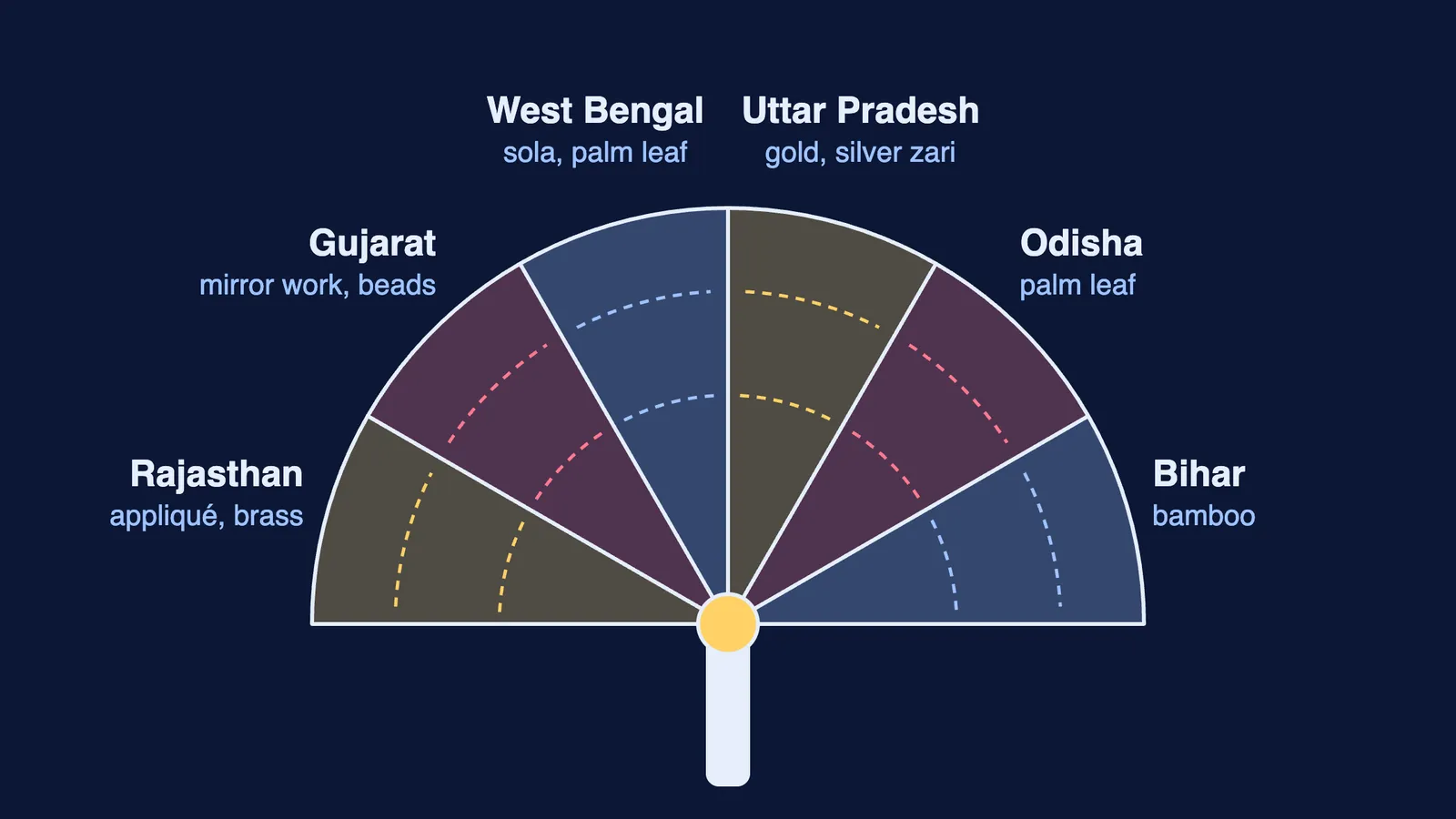
The states and their fans (chapter PDF):
Rajasthan: appliqué fans of sewn fabric, zardozi fans with gold thread, and engraved brass temple fans.
Gujarat: cotton fans with mirror work, bead fans with silver handles, and stitched leather fans from Kutch.
West Bengal: fans of sola, the white spongy core of a water grass, and palm-leaf Tal Patar Pankha.
Uttar Pradesh: Phadh fans trimmed with gold, silver zari, silk and satin.
Odisha and Bihar: large palm-leaf fans and sturdy bamboo fans.
Tribal makers: grass, cane and metal, with geometric patterns in white on red.
What is the poem Canvas of Soil about?
Canvas of Soil, by Maya Anthony, is the paired poem (chapter PDF). It has 12 lines in three stanzas, with lines rhyming in pairs, and the whole poem is one extended metaphor: a garden is a painting.
The earth is the palette where colours are mixed.
Seeds are brushstrokes, laid down with care to wait for spring.
Flowers in bloom are the finished picture.
Each plot is a canvas, and the gardener is the artist.
The poet sees beauty as the result of patient work, in a place "where art and life coincide". Look for metaphor, colour imagery and alliteration. Before naming a device, see our guide to checking figures of speech in NCERT poems.
What are the main themes of Unit 3?
Craft as identity: a fan's material and design tell you where it was made.
Tradition meeting change: technology took over the pankha's old job, but not its value.
Work with dignity: the chapter praises Gujarat's industrious home-based women workers, and the poem turns the gardener into an artist.
Art in daily life: art lives in fans and flowerbeds, not museums.
How is Unit 3 tested in the 2026-27 CBSE exam?
The CBSE Class IX English curriculum for 2026-27 gives Section C, Language through Literature, 30 marks. In the R1 paper that means:
extract-based questions worth 10 marks: one extract (from a choice of two) from prose or drama and one from poetry;
five of six short questions, 40-50 words and 2 marks each;
two answers of 120-150 words, 5 marks each, each chosen from two.
The chapter practises the present perfect tense, which the curriculum tests under sequence of tenses; the writing section offers a 120-150 word factual description (5 marks).
Practice questions for Winds of Change and Canvas of Soil
Why does the writer list so many materials, from palm leaf to silver? What does this suggest about who used pankhas? (2 marks)
Why does the chapter mention the home-based women workers of Gujarat? (2 marks)
Which sense does Canvas of Soil appeal to most? Give two images from the poem that show it. (2 marks)
Both texts show makers as artists. Compare the pankha artisan and the gardener in 120-150 words. (5 marks)
For question 4, say what each maker works with and produces, then the shared idea: skill turns useful things into art.
Wondering why waving a pankha cools your face? That is physics. The Fermi Concept Library has every concept in physics, chemistry, biology, mathematics and computing, each with its own lesson and its place in the map.
For the rest of the book, see our Kaveri Class 9 English new book guide, and for Unit 1, How I Taught My Grandmother to Read explained.


