

On this page
On 15 April 2015, NASA's Curiosity rover photographed the sun setting over Gale Crater, and the glow around the sun was blue, not orange. NASA's caption for the image says it was Curiosity's first colour sunset, taken with the left-eye Mastcam on the mission's 956th Martian day and white-balanced to remove camera artifacts. It wasn't a one-off: the true-colour sky in Mars Pathfinder's sunset image from Ares Vallis, July 1997, is pale blue near the sun.
Why are sunsets on Mars blue?
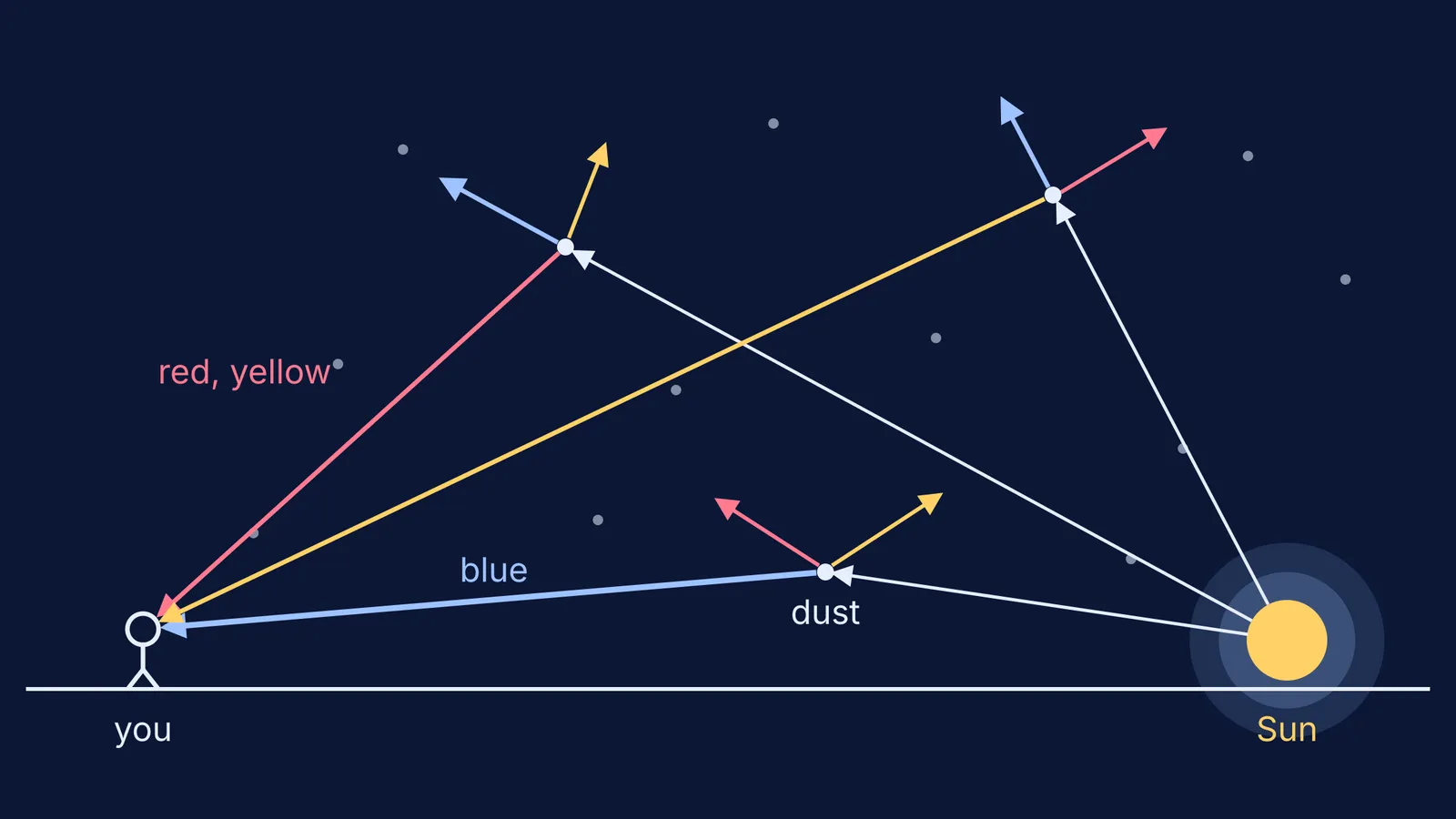
The Martian air carries a lot of fine dust. NASA's caption says this dust "has fine particles that permit blue light to penetrate the atmosphere more efficiently than longer-wavelength colors". Blue therefore stays near the sun, while yellows and reds scatter across the rest of the sky.
Mark Lemmon, a member of Curiosity's science team at Texas A&M University, explained it in the JPL release reported by Spaceflight Now: "When the blue light scatters off the dust, it stays closer to the direction of the sun than light of other colors does. The rest of the sky is yellow to orange, as yellow and red light scatter all over the sky instead of being absorbed or staying close to the sun."
NASA's caption adds that the effect is most pronounced near sunset, when sunlight crosses a longer path through the atmosphere.
How is this different from a red sunset on Earth?
On Earth, most of the scattering is done by air molecules, which are far smaller than the wavelength of light. Small scatterers remove much more blue than red from the direct beam, so the sun looks yellow or orange near the horizon. A 2014 paper in Applied Optics, Blue moons and Martian sunsets by Ehlers, Chakrabarty and Moosmüller, calls this selective extinction (scattering plus absorption) of blue light by gas molecules and small aerosols, explainable with the Rayleigh scattering approximation.
Mars is different. The same paper notes that the Martian atmosphere is dominated by micron-size dust. Using Mie theory, the authors found that the bluish glow around the setting sun comes from "the dominance of near-forward scattering of blue light by dust particles". It "cannot be explained by a simple, Rayleigh-like selective extinction explanation".
What size is Martian dust, and why does it matter?
Particle size decides the scattering pattern. Particles much smaller than the wavelength scatter in a Rayleigh-like way, to the sides and backwards as well as forward. Particles about as large as the wavelength, or larger, send most of their scattered light forward, and how tight that forward beam is depends on colour.
Rover data put Martian dust in the second group. A 2017 study in Geophysical Research Letters by Vicente-Retortillo and colleagues estimated dust size above Gale Crater from Curiosity's UV and Mastcam data. It found the dust's effective radius ranges from about 0.6 micrometres in the low-dust season to about 2 micrometres in the high-dust season.
So the Class 12 explanation of Earth's red sunset does not carry over: different-sized scatterers, different scattering.
How do you predict the colour of any sunset?
Use these three questions on any planet.
How big are the scatterers compared with the wavelength of light? Much smaller (gas molecules) means Rayleigh-like scattering. Comparable or larger (dust, smoke, droplets) means strong forward scattering.
Where does each colour go? Rayleigh-like: blue is scattered in all directions, so the direct beam loses blue. Martian dust: blue stays close to the sun's direction, while red and yellow spread more widely.
Where are you looking? Near the sun you see the direct beam plus forward-scattered light. Away from the sun you see only light scattered at wide angles.
Worked through for Earth: molecules (1), blue scattered in all directions (2), so the open sky is blue and the low sun is red-orange (3). For Mars: micron-size dust (1), blue kept forward (2), so the patch around the sun is blue and the rest of the sky is yellow to orange (3).
Here is a model 3-mark answer: "The Martian atmosphere carries dust grains about a micrometre in size. These scatter blue light mainly forward, close to the direction of the sun, while red and yellow light is scattered over wider angles. At sunset the light crosses a long dusty path, so an observer sees a bluish glow around the sun and a yellow-orange sky elsewhere."
How can you see forward scattering for yourself?
Our post on why Mars looks red covers the dust itself, and Rayleigh and the blue sky explains the Earth case this post builds on. To see Earth's version change as the light path gets longer, try the red sunset scattering simulation.
The Fermi Simulation Lab has interactive simulations for ideas that are easier to see than to read.
Next red sunset you see, run the three questions and picture it through Curiosity's camera.


