

On this page
Your nani's dabba of urad papads sits on the shelf from summer until Diwali and nothing grows on it. Leave a fresh red chilli out for the same time and it goes soft, then dark, then fuzzy. The difference is water.
Why do sun-dried papads and chillies keep for months?
Mould and bacteria are living cells. To grow and divide they must take in water from the food they sit on, and they can only use water that is free, not water held tightly by starch, sugar or salt. Food scientists measure that free water as water activity, written aw.
The US Food and Drug Administration defines water activity as the ratio between the vapour pressure of the food and the vapour pressure of distilled water under identical conditions (FDA inspection guide on water activity). Pure water therefore scores 1.0, and the drier a food, the lower its score.
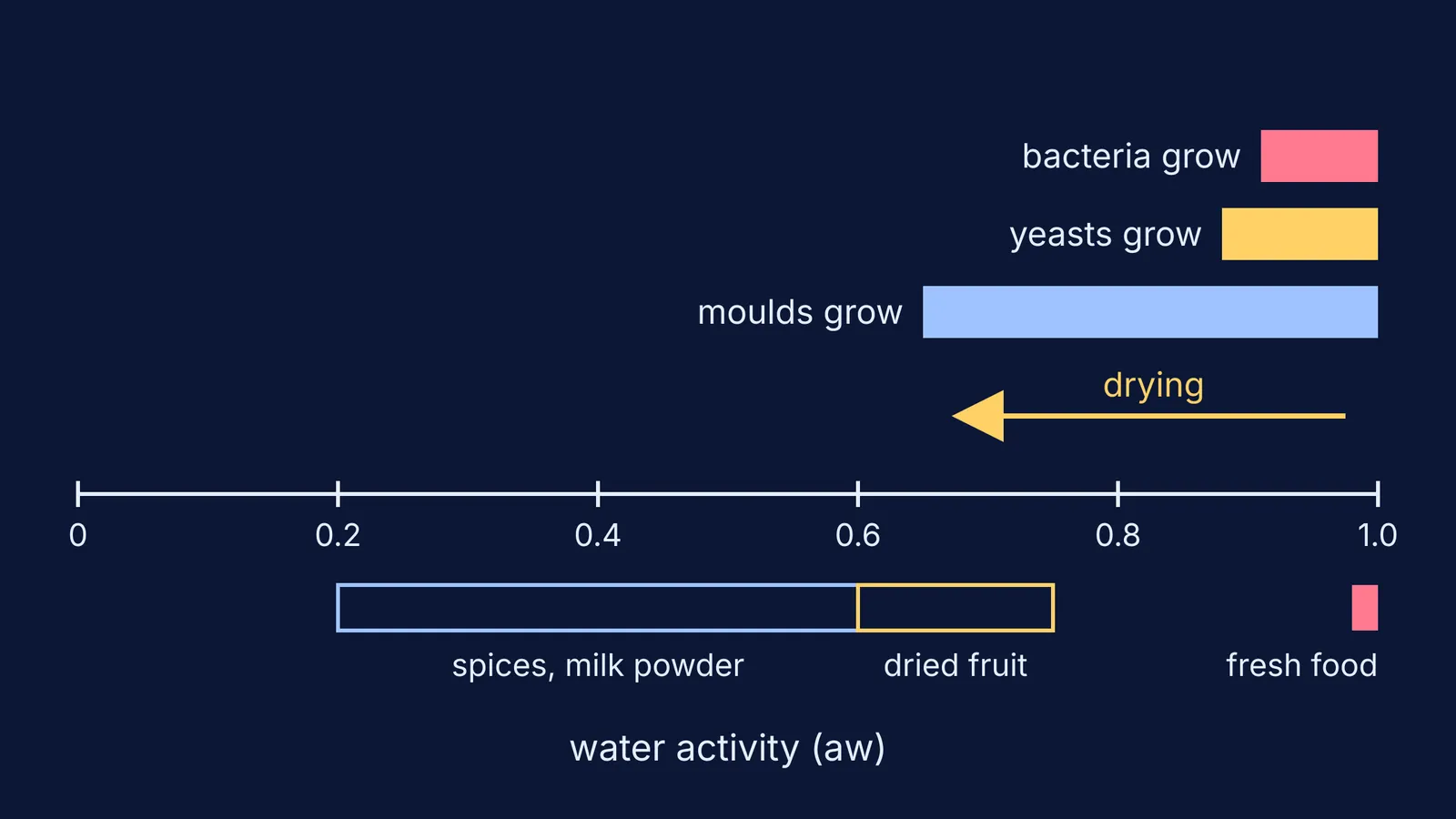
Every microbe has a floor below which it cannot grow. The UC Master Food Preserver Program puts the numbers like this:
Most bacteria need a water activity above 0.91.
Most yeasts need a water activity above 0.88.
Moulds hold on longest, with a limit of about 0.65.
Fresh fruits, vegetables and milk have a water activity of 0.98 to 1.00, according to Virginia Cooperative Extension. So a fresh chilli is a comfortable home for microbes. Good drying pushes food down towards or below those floors. The spores that land on a dry papad are not necessarily killed; they simply cannot grow, so the papad stays as it was.
How dry does a papad or chilli actually get?
Papad dough is rolled 0.3–2.0 mm thin, and market papads hold about 12–16% moisture, according to a study of black gram papad in the Journal of Food Science and Technology (Gaikwad, Pare and Sunil, 2021). Their traditionally sun-dried papads, laid out in May at about 40 °C and 32% relative humidity, ended at about 13% moisture. Being thin helps: water has very little distance to travel before it escapes.
Chillies start much wetter. In a study from Malaysia, red chillies were dried from about 80% moisture to 10% in 33 hours in a solar dryer, against 65 hours in open sun, a 49% saving in drying time (Fudholi and colleagues, 2013).
Moisture and water activity are different numbers. Moisture counts all the water in the food; water activity counts only the water microbes can use. Dried fruits sit at 0.60–0.75 and spices and powdered milk at 0.20–0.60 (Virginia Cooperative Extension), well below the 0.91 most bacteria need.
Worked example: how much water does the sun take out?
Take 1 kg of fresh red chillies at 80% moisture, the starting point in the Malaysian drying study, and dry them to 10% moisture.
Water at the start = 0.80 × 1 kg = 0.80 kg, so the dry solids are 0.20 kg.
After drying, the solids make up 90% of the new mass: 0.20 ÷ 0.90 = 0.222 kg of dried chillies.
Water left = 0.222 − 0.200 = 0.022 kg.
Water removed = 0.80 − 0.022 = 0.778 kg, about 97% of the water the chillies started with.
So a kilo of fresh chillies becomes about 220 g of dried ones.
Why do papads go soft and mouldy in the monsoon?
Drying can be undone. A dry papad left open in humid air takes water vapour back in, its water activity climbs, and once it crosses the mould floor the spores already sitting on it can start to grow. It is the same reason bread and leftovers turn faster in the rains, which we explain in why food spoils faster in the rainy season.
A quick kitchen checklist:
Store papads and dried chillies in an airtight steel or glass container, not an open packet.
Close the lid straight after taking some out, especially on humid days.
Use a dry spoon and dry hands; a wet hand puts water exactly where you do not want it.
If a papad bends instead of snapping, it has taken up water, so use it soon.
Throw away anything with visible mould or a musty smell.
How does drying compare with other ways to preserve food?
Every preservation method takes away something microbes need, or makes conditions too harsh for them:
Drying removes the water itself: papads, dried chillies, vadis and dried fish.
Salt and sugar tie up water, so a wet food can still be hostile to microbes: see why pickles last for months.
Heat kills most of the microbes present, as in pasteurised milk: see food preservation methods from pasteurisation to vinegar.
Cold slows microbes down without removing water, which is why the fridge keeps fresh food for days rather than months.
Free water is hard to picture because you cannot see it. The Fermi Simulation Lab has interactive simulations for ideas that are easier to see than to read, and the Fermi Concept Library gives each concept in chemistry and biology its own lesson.
Next time you open the papad dabba, check that the lid shuts tight: you are keeping the water activity low.


