

On this page
Every station announcement asks you to stand behind the yellow line. Falling is part of it, but the bigger reason is invisible: a fast train moves a large mass of air, and that moving air can shove, tug and drag things standing near the edge.
What happens to the air when a train rushes past?
The UK's Rail Accident Investigation Branch (RAIB) explains it in its report on an accident at Twyford station. Air touching the train's surface travels at the train's speed, while air far away stays still. The band in between is the slipstream: turbulent air flowing mostly in the same direction as the train. It is strongest close to the train and weakens with distance, and it is stronger for rough-sided freight trains and for trains with big gaps between wagons.
The nose matters too. A simulation study found that high-speed trains push air to the front, sides and over the top, with pressure pulses at the nose and tail (Hemida, Baker and Gao, 2012). A computer study of a subway station with platform screen doors found a positive pressure peak on the doors as a non-stopping train's head passed and a negative one as its tail passed (Zeng and colleagues, 2023). In everyday terms: first a shove, then a tug.
This links to Class 11 fluids. The push from moving air depends on ½ρv², the same dynamic-pressure term that appears in Bernoulli's equation, as our explainer on how Bernoulli's principle explains lift, atomisers and storms shows.
Can the wind from a train really pull you in?
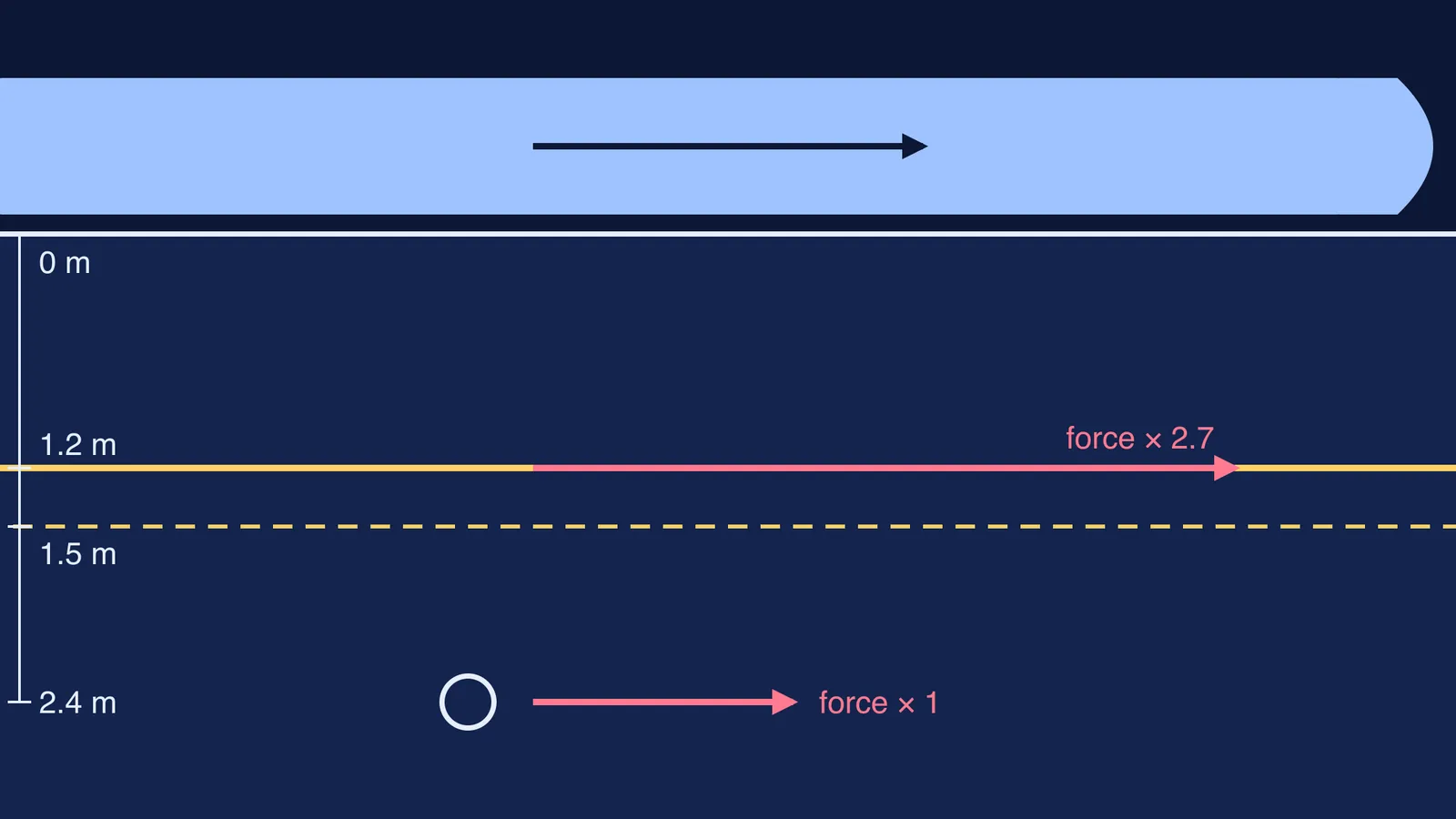
Yes, and it can happen behind the yellow line. According to the RAIB report, on 7 April 2016 a teenage girl in a wheelchair was waiting with her mother on platform 4 at Twyford station in England. The wheelchair's centre was about 2.4 metres from the platform edge, well behind the yellow line, and the brakes were on.
A freight train passed without stopping at about 72 km/h, with a light breeze blowing the same way. Roughly 13 seconds after the locomotive went by, the wheelchair began to roll towards the train and struck its wagons several times. The girl suffered a minor foot injury. When University of Birmingham researchers later measured similar freight trains at Twyford at that same 2.4 metre distance, one typical pass produced slipstream peaks of nearly 7 metres per second, about 25 km/h.
RAIB found the wheelchair needed 87 newtons to move at its second brake setting and 181 newtons at its third. The brakes were on the second setting, and the air flow could overcome it; it could not have overcome the third. The report's learning point for the public is plain: "trains passing through platforms, particularly freight trains, can generate powerful slipstreams sufficient to move a wheelchair or pushchair against its brakes."
Why does the push get so much stronger near the edge?
The RAIB report states that the force from a slipstream depends on the square of the air's speed, along with air density, the object's area and its drag coefficient.
Call the push on the wheelchair at 2.4 m from the edge F.
Using British Rail data from 1976, RAIB estimated the push could rise to about 2.7F by the time the wheelchair was 1.2 m from the edge.
Since force scales with speed squared, the air speed rose by only the square root of 2.7, about 1.64 times. A 64% faster wind gives a 170% bigger push.
Now double the train's speed. Scale-model tests suggest slipstream speeds scale with train speed (Baker and colleagues, 2001), so the push becomes about four times larger.
That is why the line moves back where trains are faster. RAIB notes that the yellow line on Twyford's platform 4 was 1.2 m from the edge, and that UK platforms where passenger trains pass at over 161 km/h or freight trains at over 97 km/h must have the line 1.5 m from the edge, to reduce exposure to slipstreams.
How do you stay safe on a railway platform?
Run through this with children:
Stay behind the yellow line until your train has fully stopped.
If an announcement or the board shows a train that is not stopping, step further back, towards the back of the platform.
Put pushchair and wheelchair brakes fully on and keep a hand on the handles, as RAIB recommended the public be told.
Hold small children by the hand and keep light bags, umbrellas and dupattas close.
Keep holding on until the whole train, including the last wagon, has passed.
How can you picture slipstreams for yourself?
The Fermi Simulation Lab has interactive simulations for ideas that are easier to see than to read. If Bernoulli questions keep catching you out, start with our list of common mistakes in fluids and Bernoulli problems, and see how engineers reshape train noses in the story of the kingfisher's beak and the bullet train.
Next time you hear the announcement, you will know why: it is about air, and air pushes harder than it looks.


