

On this page
The 500 Series Shinkansen entered commercial service on 22 March 1997 (Trellis), running at up to 300 km/h with a needle-like nose that looks nothing like a bullet. JR West has said it will retire the 500 Series from regular service on 13 January 2027, three decades after its debut (Bernama), so its nose is worth a closer look.
Why did bullet trains boom when they left tunnels?
A train entering a tunnel works like a piston pushed into a pipe. The air ahead cannot get out of the way fast enough, so it is squeezed into a compression wave. According to Tom McKeag's account of the redesign on Trellis, these pressure waves reached the tunnel exit at the speed of sound, and residents 400 metres away heard sonic booms.
Engineers call the pulse that bursts out of the far end a micro-pressure wave. A 2013 study of Shinkansen tunnels states that “the micro-pressure wave magnitude is approximately proportional to the maximum pressure gradient of the tunnel compression wave arriving at the exit portal” (Miyachi et al., Journal of Fluid Science and Technology). In plain words, the boom depends not just on how much the pressure rises but on how suddenly it rises.
How did a kingfisher beak inspire the bullet train?
Eiji Nakatsu was general manager of the technical development department for the bullet trains, says the Trellis account. When a junior engineer remarked that the test train seemed to “shrink” in a tunnel, Nakatsu put it down to a sudden change in air resistance, from open sky to closed tunnel. In the account's words, he “wondered if there was an organism that was adapted to such conditions.”
From his birdwatching, he remembered the kingfisher, which dives from air into water, a fluid 800 times denser, with barely a splash. His team shot bullets of different shapes into a pipe, from a traditional bullet nose to one modelled on the kingfisher, and dropped model solids into water to compare the splashes (Trellis).
The same account gives these results:
30% less air resistance than its predecessor, the 300 Series
13% less power needed on a measured run with a top speed of 270 km/h
Shin-Osaka to Hakata cut from 2 hours 32 minutes to 2 hours 17 minutes
higher speeds while still meeting the government's 70 dBA noise standard
Many retellings, including Wikipedia's 500 Series page, say instead that the design cut energy use by 15% and raised speeds by 10%. We use the Trellis figures because they name the comparison train and test run.
Why does a longer nose make a quieter tunnel exit?
Here is a worked example using a simplified model and made-up nose lengths, not the real train's.
In this model, the total pressure rise depends on how much of the tunnel the body blocks, so the same body gives the same rise, whatever the nose.
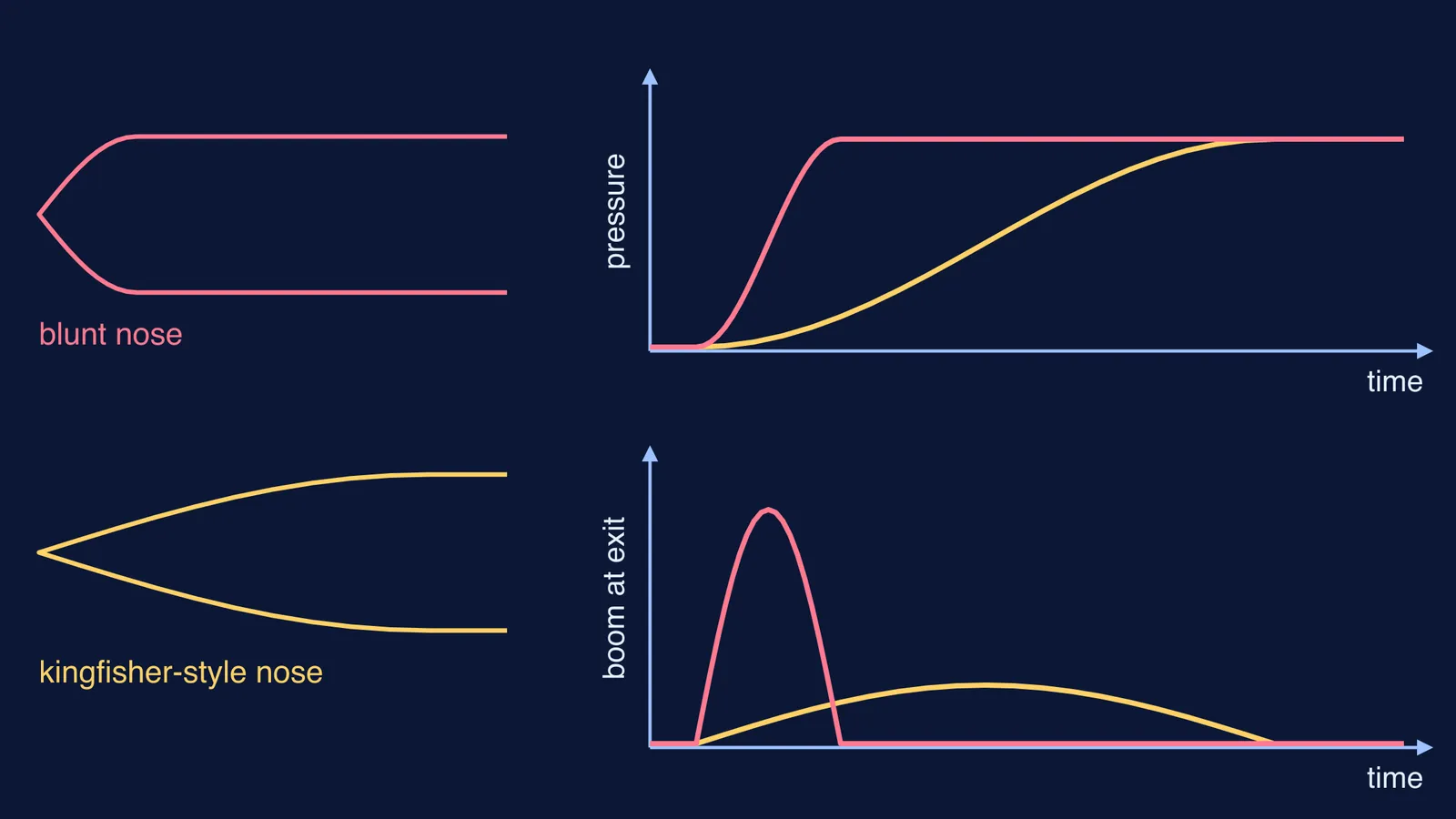
The nose sets how long that rise takes. Say a blunt nose reaches full width over 3 m and a kingfisher-style nose over 12 m.
At 300 km/h (83.3 m/s), the blunt nose enters in 3 ÷ 83.3 ≈ 0.036 s. The long nose takes 12 ÷ 83.3 ≈ 0.144 s.
The rise is the same but takes four times as long, so the steepest slope is about four times smaller. Since the boom follows that slope, in this model it drops to roughly a quarter.
The diagram at the top of this post plots exactly this model. Real tunnels are messier. In long Shinkansen tunnels with smooth concrete slab track, the compression wave steepens as it travels (Miyachi et al.). Engineers are still refining nose shapes to cut micro-pressure waves, as a 2023 study shows (Miyachi, Okubo and Kikuchi, Quarterly Report of RTRI).
The Fermi Simulation Lab has interactive simulations for ideas like this, which are easier to see than to read. If pressure in a sound wave still feels slippery, read our explainer on displacement and pressure waves in sound.
How can you think like a biomimicry engineer?
Biomimicry means borrowing a solution nature has already tested. Nakatsu's story gives you a four-step method for a school project or olympiad-style problem:
Name the physics, not the object. Not “the train is loud” but “the pressure changes too suddenly”.
Ask who in nature faces the same physics: a kingfisher meets a sudden jump in resistance at the water.
Find the shared variable: how gradually the cross-section grows.
Test cheaply. Nakatsu's team used pipes and water before anyone built a train.
Velcro followed the same pattern: read how Velcro was copied from burrs. For where the bullet train began, read how Hideo Shima engineered the Shinkansen.
To turn this into a study session on waves, Fermi's AI tutor can work out what you already know and build a plan for the session.
Next time you see a long-nosed train, look at its face: it is shaped to make the pressure change slowly.


