

On this page
When the Tokaido Shinkansen opened in 1964, it changed how the world looked at trains. Before then, railways were widely seen as a dying technology, soon to be replaced by air travel and highways. The Shinkansen proved that trains could be faster, safer and more efficient than driving or flying for medium distances. By the mid-1950s, the original narrow-gauge Tokaido Main Line was operating at double its intended capacity, straining under the demands of a rapidly growing economy. A radical solution was needed to connect Tokyo and Osaka 2.
The success of the bullet train was not the result of a single magical invention. It came from treating the railway as an integrated system, led by the chief engineer of the Japanese National Railways, Hideo Shima (1901–1998) 1.
Who was the engineer behind the Shinkansen?
Hideo Shima began his career designing traditional steam locomotives, such as the Class C62 and D62 1. As he rose to become the chief engineer at Japanese National Railways, he realised that simply putting a bigger, heavier engine at the front of a train would never yield the immense speeds Japan needed for its future.
Working with JNR president Shinji Sogo, Shima insisted that true high speed required rethinking every part of the journey. He discarded experimental ideas like magnetic levitation and gas turbines, choosing instead to perfect and combine proven technologies. His team's work allowed the first Series 0 Shinkansen to cruise at 210 km/h 2.
Why did the Shinkansen use distributed motors?
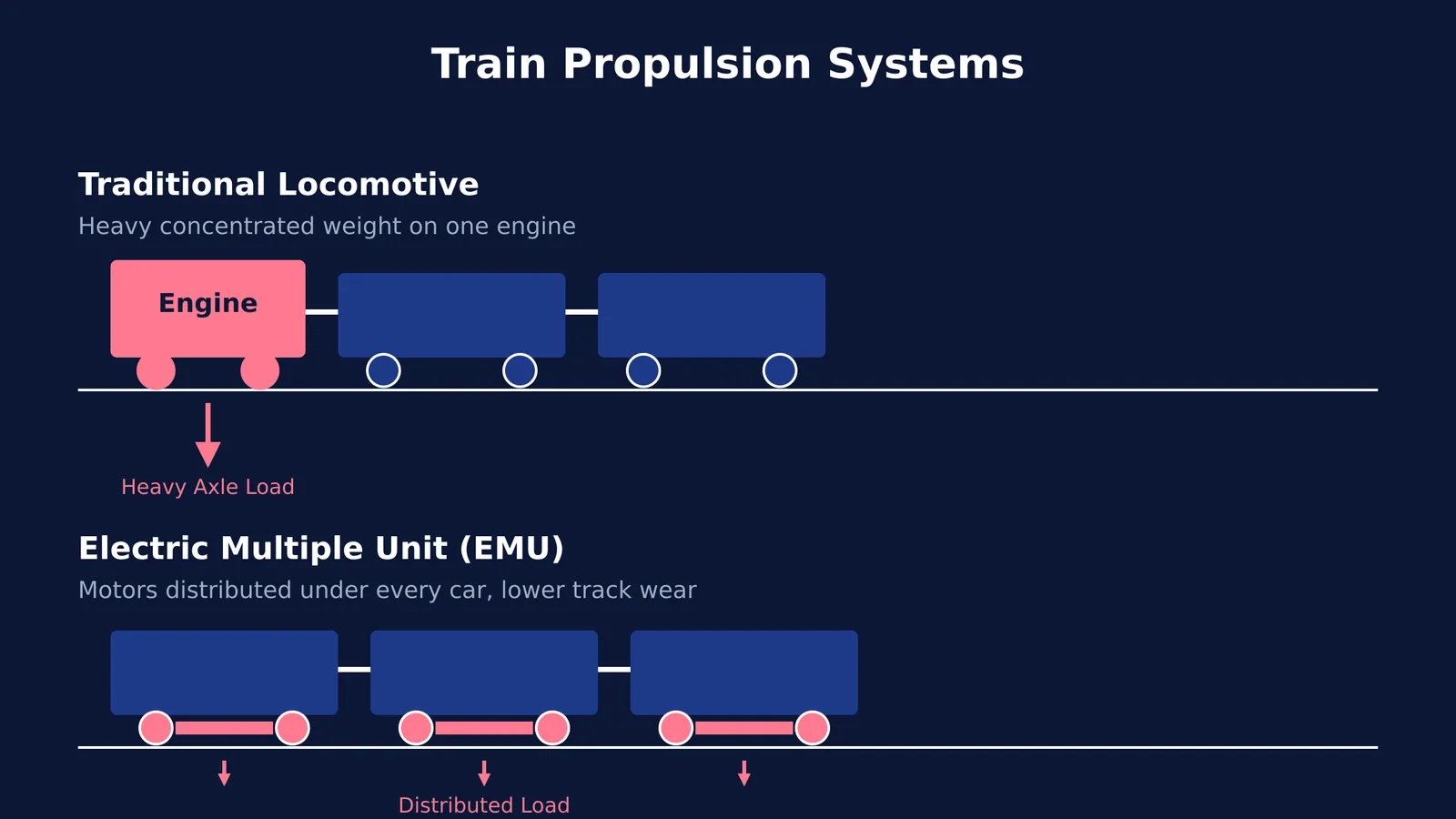
The most critical shift in Shima's design was the move away from the traditional locomotive. In older trains, one massive, heavy engine pulled a string of unpowered passenger cars.
Shima advocated for the Electric Multiple Unit (EMU) system, a concept he had been refining for years 1. Instead of one engine, smaller electric motors were distributed under the floor of nearly every passenger car. This distributed power solved several physics problems at once:
Lower axle load: Distributing the weight prevented any single wheel from pressing too hard on the rails. This was vital for protecting Japan's soft ground and reducing track wear at high speeds.
Faster acceleration and braking: Because more wheels were powered and had grip on the track, the train could speed up and slow down much more efficiently, making it possible to run more trains per hour.
Redundancy: If one motor failed, the train could still complete its journey using the remaining units.
Why did the bullet train need a dedicated track?
Japan's existing railway network was built on a narrow gauge of 1,067 mm. Shima knew that a fast, wide train would be unstable on narrow tracks. He successfully argued for building a completely new track using the international standard gauge of 1,435 mm 2.
This dedicated track was designed strictly for the Shinkansen. It featured large-radius curves to handle the high speeds without throwing passengers off balance. Just as calculating the radius of curvature of a projectile's path or the forces on a car over a hump relies on balancing speed and normal force, the Shinkansen's curves were mathematically tailored to keep the train grounded.
More importantly, the new line had zero level crossings 2. By elevating the tracks or fencing them off completely, Shima eliminated the risk of cars or pedestrians blocking the line.
How did Automatic Train Control keep the Shinkansen safe?
At 210 km/h, human reaction time is not fast enough to read trackside signals and apply the brakes manually. To solve this, Shima's team implemented Automatic Train Control (ATC) 2.
The ATC system sent continuous speed limits directly through the rails into the driver's cab, eliminating the need to rely on visual signals in bad weather. If the train exceeded the safe speed for its section of track, the ATC would automatically apply the brakes without driver intervention. Analysing how quickly a heavy train stops requires tracking its distance in the nth second of deceleration; ATC continuously computed these physical margins to keep trains safely apart, allowing for high-frequency service. This failsafe mechanism is the main reason why the Tokaido Shinkansen has maintained a flawless safety record, with zero passenger fatalities due to collisions or derailments since it opened in 1964 2.
If you are learning the physics of motion, acceleration and forces, picturing how systems like ATC and EMUs work can be challenging. The Fermi Concept Library maps out every core idea in mechanics, helping you link the abstract maths to real physical systems. When you get stuck on a difficult kinematics calculation, the Fermi Problem Library offers a step-by-step solver that explains the reasoning rather than just printing an answer.
Through careful systems engineering, Hideo Shima and his team transformed global transport. He proved that solving a massive engineering problem often means breaking it down and distributing the effort—from the motors under the floor to the signaling logic in the rails. It is a principle of distributed workload that is as true in building effective study habits as it is in designing high-speed rail networks.


