

On this page
Outside the International Space Station, nothing shields an astronaut from the full glare of the Sun except the suit. Its white outer layer bounces most of that sunlight away and makes a small human easy to spot against the dark. Here is the physics, with NASA's fabric data.
Why are space suits white?
The main reason is heat. NASA's Spacewalk Spacesuit Basics page says it plainly: "The white outer layer reflects heat from the sunlight." The same page says temperatures on spacewalks may vary from minus 250 degrees Fahrenheit to 250 degrees in sunlight, which is roughly −157 °C to +121 °C.
Les Padilla, hardware manager for NASA's spacewalk suit, explained it on NASA's Houston We Have a Podcast in 2017: "The outer layer is white because it reflects heat." If it were black, he said, "it would absorb the heat, get a lot hotter quicker."
The second reason is being seen. NASA's caption for a spacewalk photo of Nick Hague describes his white suit as "contrasted by the blackness of space." On the same 2019 spacewalk, Anne McClain wore a white suit with red stripes; NASA's basics page says some suits carry stripes "to help tell one spacewalker from another."
What is the white outer layer made of?
The flexible parts of a spacewalk suit are made from as many as 16 layers of material, according to NASA. The outer layer blends three threads: one for water resistance, one used in bullet-proof vests, and one that resists fire. A 2026 NASA conference paper names this fabric Ortho Fabric, made of Gore-Tex, Nomex and Kevlar, and measured how it handles light.
Solar absorptance (α) is the fraction of incoming sunlight a surface absorbs. Clean Ortho Fabric measured 0.200 in the NASA tests, over a black backing that gives a cautious, worst-case value.
Emissivity (ε) is how well a surface radiates its own heat as infrared, compared with a perfect black body. Clean Ortho Fabric measured 0.837.
Designers want low α and high ε: low absorptance keeps sunlight out, while high emissivity lets the suit shed heat by radiating it. For its new Moon suit fabric, the team set targets of absorptance below 0.3 when clean and emissivity above 0.8.
Read more on Kirchhoff's law of radiation.
How hot would a space suit get in sunlight?
Take a small patch of suit facing the Sun, its back perfectly insulated, so heat leaves only by radiating from the front. Once the temperature settles, sunlight absorbed equals heat radiated:
α × S = ε × σ × T⁴, so T = (α × S ÷ (ε × σ))^(1/4)
S is the sunlight arriving near Earth, about 1,360 watts per square metre according to NASA. σ is the Stefan–Boltzmann constant, 5.670 × 10⁻⁸ W m⁻² K⁻⁴, from NIST.
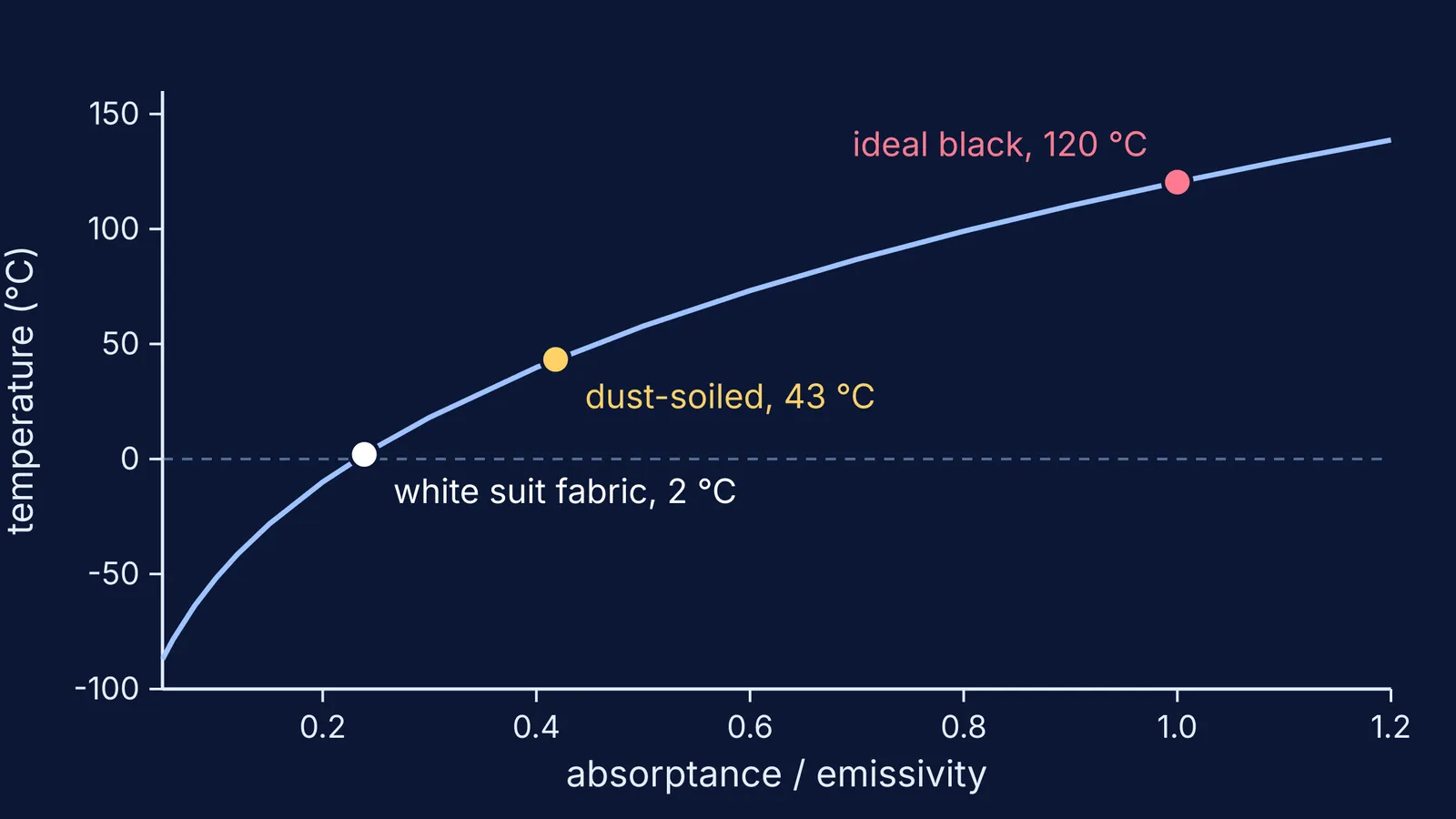
Clean white Ortho Fabric, from the NASA tests: α ÷ ε = 0.200 ÷ 0.837 = 0.239. T = (0.239 × 1360 ÷ (5.670 × 10⁻⁸))^(1/4) ≈ 275 K, about 2 °C.
Dust-soiled fabric: after the NASA team tumbled it with lunar dust simulant and vacuumed it, α rose to 0.362 and ε to 0.866. The ratio is 0.418, giving about 316 K, or 43 °C.
An ideal black surface: α = ε = 1, giving about 394 K, or 120 °C.
The black result is close to the 250 °F (121 °C) sunlight figure on NASA's spacesuit page, while the white fabric sits near freezing. That gap is why suits are white.
This model ignores body heat, the suit's water cooling, infrared from Earth and slanting sunlight. Our explainer on whether space is hot or cold covers the cold of shadow.
If a slider helps more than a formula, the Fermi Simulation Lab has interactive simulations for ideas that are easier to see than to read.
Why does dust on a white suit matter?
In the 2026 tests, lunar dust simulant raised Ortho Fabric's absorptance from 0.200 to 0.362, and in our model that adds about 40 °C. The Artemis III Moon suit prototype that Axiom Space unveiled in 2023 used a dark grey cover, but NASA says the final version "will likely be all-white" on the Moon.
How can you test this at home?
NASA's Cool Spacesuits lesson for school students uses black and white construction paper, small boxes and two thermometers. A plan for a sunny afternoon:
Cover one shoebox in white paper and one in black, with a thermometer inside each.
Write down which will warm faster, and by how much.
Put both on the same sunny windowsill and read them every five minutes for half an hour.
Plot both lines on one graph and explain the gap using α and ε.
Dust the white box with a little soil and repeat.
Parents can finish by asking why NASA makes spacewalk suits white; a strong answer uses absorptance and emissivity. If those terms are new, the Fermi Concept Library has its own lesson for every concept in physics, chemistry, biology, mathematics and computing.


