

On this page
Watch a garden snail cross a wet wall after monsoon rain and you will see two things: it does not slip off, and it leaves a shiny line behind it. Both come from the same material. The slime is not waste; it is the surface the snail walks on. That makes the trail a neat case study in adaptation, friction and trade-offs.
Why do snails leave a slimy trail?
Snails and slugs move by a method called adhesive locomotion: they crawl on a thin layer of slime from the underside of the foot. According to a study of pedal mucus by Ewoldt and colleagues at MIT (Soft Matter, 2007), this layer is typically 10-20 micrometres thick and serves both as glue and lubricant, which is how snails climb walls and crawl across ceilings.
The same paper describes pedal mucus as a gel containing only 0.3-9.9% solid matter by weight, the rest being water (Ewoldt et al., 2007). Some of that layer stays behind when the snail moves on, and that film is the trail you see.
How can the same slime grip and slide?
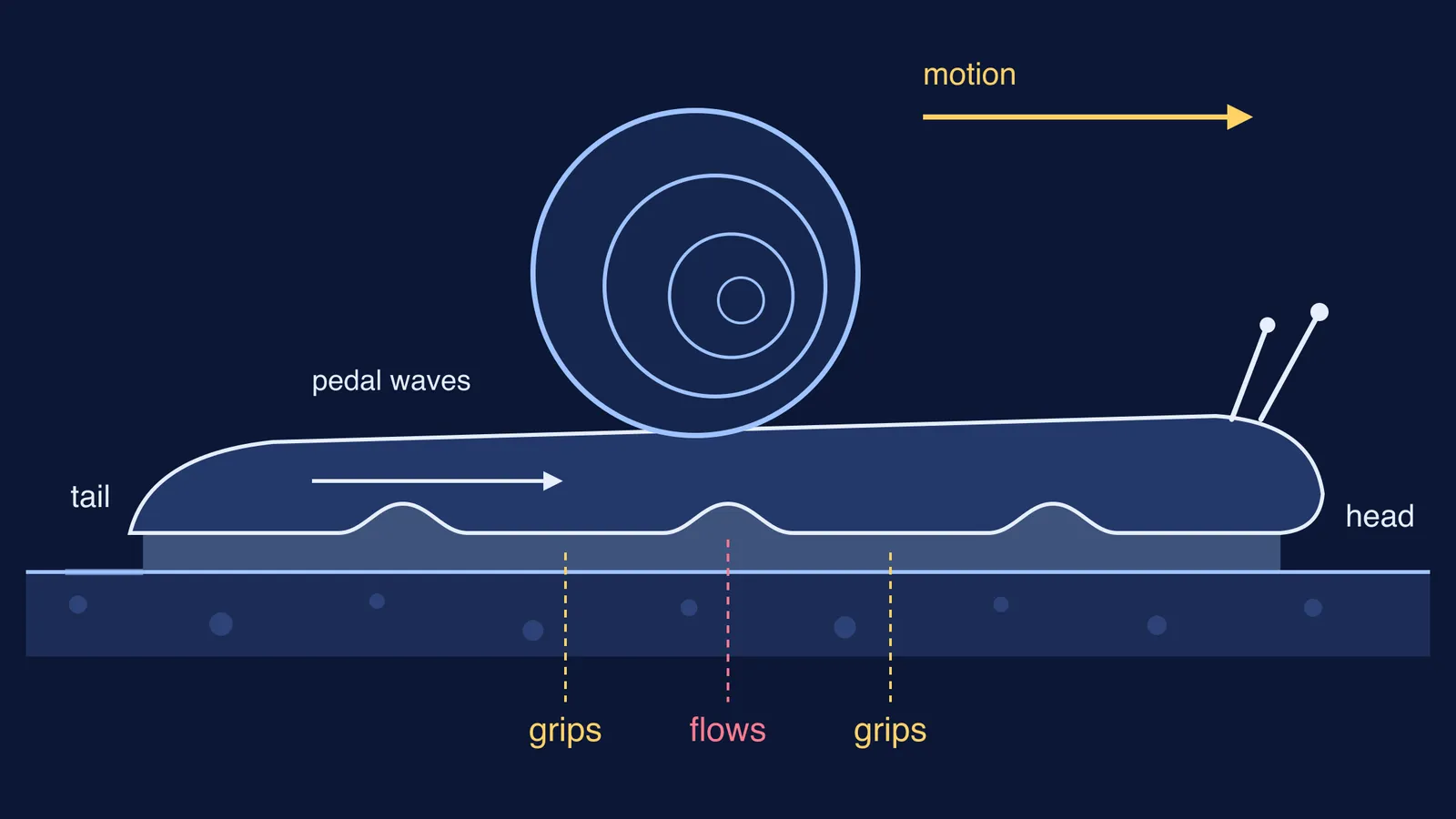
The trick is a property called yield stress: below a certain push the gel holds like a soft solid, and above it the gel breaks and flows like a liquid. Ewoldt's team explains that at high stress the network breaks so the foot can glide over a fluid layer, while in low-stress regions it reforms into a solid-like layer joining foot to ground (Ewoldt et al., 2007).
The snail makes use of this with ripples of muscle along its foot, called pedal waves. In land snails and slugs, these waves travel from tail to head, as Lai and colleagues describe (Journal of Experimental Biology, 2010). Using force measurements under crawling slugs and snails, they found the mucus's yield stress is important for generating thrust, and that the foot lifts slightly as each wave passes.
So at any moment the foot has two kinds of zones:
Under a wave, the stress is high, the mucus flows, and that patch of foot slides forward.
Between waves, the stress is low, the mucus holds, and that patch acts as an anchor to push against.
Lai's team also recorded how fast this goes: mean crawling speeds of 2.49 mm per second for garden slugs and 1.57 mm per second for banana slugs (Lai et al., 2010).
Some ideas are easier to see than to read, and the Fermi Simulation Lab has interactive simulations for exactly those. For the fluid side, our post on the force needed to move a plate over an oil layer covers the viscosity law behind the sliding zones.
What else does snail slime do?
The Museum für Naturkunde in Berlin notes that the slime reduces friction, protects against injuries from sharp surfaces, helps the snail stick so it can crawl vertically and upside down, and protects it from drying out.
Snails also make more than one kind of mucus. A 2026 study in Science by Gabler, Jehle and colleagues at the Max Planck Institute of Colloids and Interfaces examined five mucus-based materials from the snail Cepaea nemoralis. They found the snail uses collagen VI as the main structural part and adds calcium during secretion, with calcium and protein content tuning each material for lubrication, adhesion, protection or defence.
Why is a slime trail so expensive to make?
Crawling on slime is costly. Mark Denny measured slugs and found the energy cost of crawling was 904 joules per kilogram per metre, considerably more than other forms of locomotion, mostly because of the mucus (Science, 1980).
One way snails save energy is by reusing old trails. Davies and Blackwell found that periwinkle snails following a fresh trail made only about 27% of the mucus that the first snail laid (Proceedings of the Royal Society B, 2007). The authors argue that energy saving may help explain why trail following is so common among snails.
How do you write this as an exam answer?
Use this four-step frame for a 3- or 5-mark question on snail movement or adaptations:
Structure: a muscular foot that secretes pedal mucus, a thin water-rich gel.
Mechanism: pedal waves run along the foot; mucus flows under the waves and holds between them.
Adaptive value: grip on vertical and upside-down surfaces, protection of the foot from rough ground, less water loss.
Trade-off: mucus is expensive, so trail following saves energy.
A quick worked number makes the answer stand out. At 2.49 mm per second, a garden slug takes 1000 ÷ 2.49 ≈ 402 seconds, a little under 7 minutes, to cross one metre. Taking Denny's figure as a rough estimate, a 5 g slug spends about 0.005 × 904 ≈ 4.5 joules on that metre.
For the wider picture, see how earthworms, snails and birds move. If yield stress or viscosity still feels fuzzy, the Fermi Concept Library has a lesson for every concept in physics, chemistry, biology, mathematics and computing. Then explain the trail out loud in under a minute.


