On this page
In 2025, small telescopes showed Saturn's rings thinned almost to a line. Nothing had happened to the rings. Earth had lined up with their flat plane, so we saw them edge-on. Here is why that happens, why it repeats on an uneven schedule, and how to model it at home.
Why do Saturn's rings disappear from view?
The rings are enormous across but very thin. According to EarthSky, they span about 282,000 km. BBC Sky at Night Magazine puts their thickness at only around 1 km, and Scientific American notes that some parts are only about 10 m thick.
Worked example: if the rings are 282,000 km wide and 1 km thick, the ratio is 282,000 to 1. Shrink them to 28.2 cm across, roughly the length of a sheet of paper, and the thickness becomes 28.2 cm ÷ 282,000, about one-thousandth of a millimetre. Scientific American's version: at that scale, the rings would be about a hundred times thinner than the paper.
Tilted towards us, all that ice reflects plenty of sunlight. Edge-on, almost nothing faces you, so small telescopes show at most a faint line.
Why does Saturn's tilt make this happen twice per orbit?
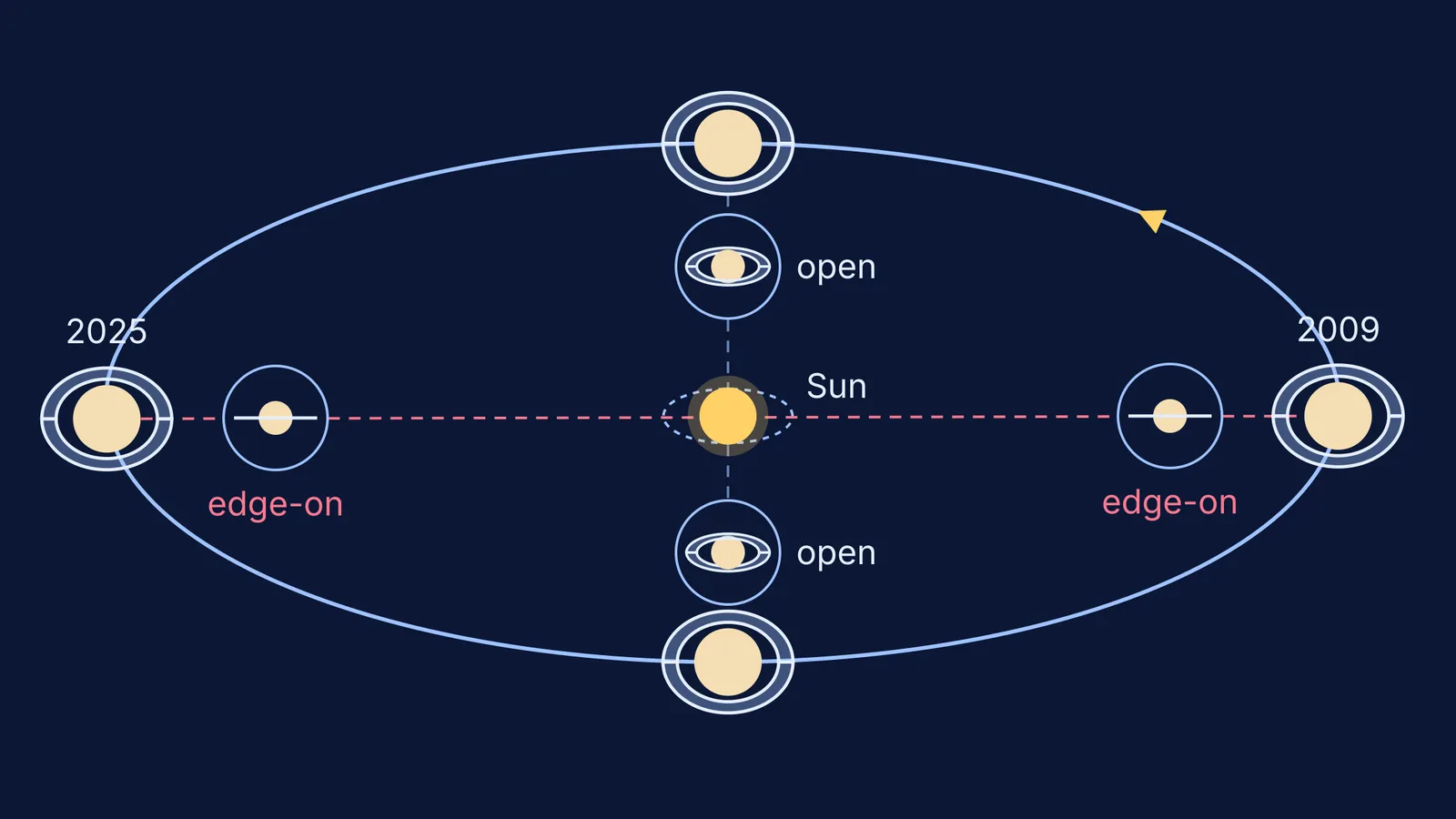
Saturn's spin axis is tilted 26.73° to its orbit, and one trip around the Sun takes 10,755.7 days, or about 29.4 years, according to the NASA Saturn fact sheet. The rings circle Saturn's equator, so they share that tilt. Saturn's axis keeps pointing the same way in space while the planet travels around the Sun.
So for part of the orbit, the Sun (and Earth, close to the Sun on this scale) sees the top face of the rings; for the other part, the bottom face. In between, at Saturn's equinoxes, the Sun shines straight over Saturn's equator and the rings are lit edge-on. As this ring-crossing explainer puts it, that happens twice in every Saturnian year of 29.4 Earth years. It is the same fixed-tilt geometry behind Earth's seasons, which you can test with our axial tilt simulation guide.
Galileo saw Saturn's "companions" in 1610 and found them gone in 1612. It took Christiaan Huygens to explain that Saturn wears a thin, flat ring.
Why is the gap 13.75 years one time and 15.75 years the next?
The Astronomical Association of Queensland gives the intervals as 13.75 and 15.75 years. Check it with two dates:
The Sun crossed the ring plane at Saturn's equinox on 11 August 2009, according to the ring-crossing table.
The next Sun crossing was on 6 May 2025, from the same table.
That is 5,747 days, or 15.73 years.
One full orbit is 10,755.7 days, or 29.45 years, so the other half takes 29.45 − 15.73 = 13.72 years.
The halves are unequal because Saturn's orbit is a slightly stretched ellipse, with eccentricity 0.052 (NASA). Saturn was last closest to the Sun on 26 July 2003 (PyMeeus). Feed that into Kepler's equation and the 2009 to 2025 stretch turns out to contain aphelion, the farthest point. Saturn moves slowest there, so that half takes about two years longer.
If Kepler's laws are still shaky, the Fermi Concept Library has a lesson for every concept in physics, each with its place in the map.
When can you see Saturn's rings edge-on again?
23 March 2025: Earth crossed the ring plane, but Saturn was too close to the Sun to watch, according to Sky at Night.
23 November 2025: the rings looked narrowest from Earth, EarthSky reported.
2032: the rings open widest towards us again, also per EarthSky.
October 2038 to July 2039: the next crossings (crossing table), and Sky at Night expects them to be well placed for viewing.
How can you model it at home?
Put a lamp in the middle of a table. It is the Sun, and your eye next to it stands in for Earth.
Push a pencil through a CD or a cardboard disc and tilt the pencil about 27° from upright, Saturn's tilt in the NASA fact sheet.
Point the top of the pencil at one wall of the room and keep it pointing there throughout.
Ask someone to carry the disc slowly around the lamp while you watch from beside it.
Notice the two places where the disc turns into a thin line, and the two where you see its face most widely.
If the disc looks the same from every position, you let the pencil turn with you. The tilt must stay fixed in space; that one rule explains the whole cycle. To see it in motion rather than on a table, the Fermi Simulation Lab has interactive simulations for ideas that are easier to see than to read.
Next question: what are the rings made of? Read how Maxwell proved Saturn's rings are made of particles.