

On this page
Through a small telescope, Saturn's rings look like one solid disc. For about two centuries after Christiaan Huygens worked out that Saturn wears a ring, nobody knew what that ring was made of. James Clerk Maxwell, then a young professor at Aberdeen, settled it with pencil and paper.
What was the Adams Prize question about Saturn's rings?
St John's College, Cambridge set the motion of Saturn's rings as the subject of the Adams Prize, and Maxwell spent much of his first two years at Aberdeen on it (MacTutor). His winning essay was printed as "On the Stability of the Motion of Saturn's Rings; an Essay which obtained the Adams' Prize for the Year 1856" (summarised in the Monthly Notices of the Royal Astronomical Society, 1859). The full essay came out as a book from Macmillan in 1859 (scanned copy on the Internet Archive).
In the opening, Maxwell notes that Laplace had shown "a uniform solid ring cannot revolve permanently about a planet" (Maxwell, 1859). That left three possibilities to test: an uneven solid ring, a fluid ring, or a ring of many separate pieces.
Why can't Saturn's rings be solid or liquid?
Solid ring. Maxwell found that a solid ring could stay stable only if it carried one heavy lump on one side. In his worked case, the lump holds 82 parts of the mass to the rest of the ring's 18 (Maxwell, 1859). He wrote that such a load would be "inconsistent with the observed appearance of the rings" and so finely tuned that "a very small error in excess or defect would render the ring again unstable."
Fluid ring. For a continuous liquid ring, his conclusion was blunt: "it will be necessarily broken up into small portions" (Maxwell, 1859).
Separate particles. A ring of many independent bodies, each orbiting like a tiny moon, could stay stable: small disturbances travel round it as waves instead of growing into collapse.
He also noted that Saturn's edge had been seen through the inner ring without distortion, so the light "did not pass through a medium at all, but between the solid or liquid particles of which the ring is composed" (Maxwell, 1859).
How fast do the particles in Saturn's rings move?
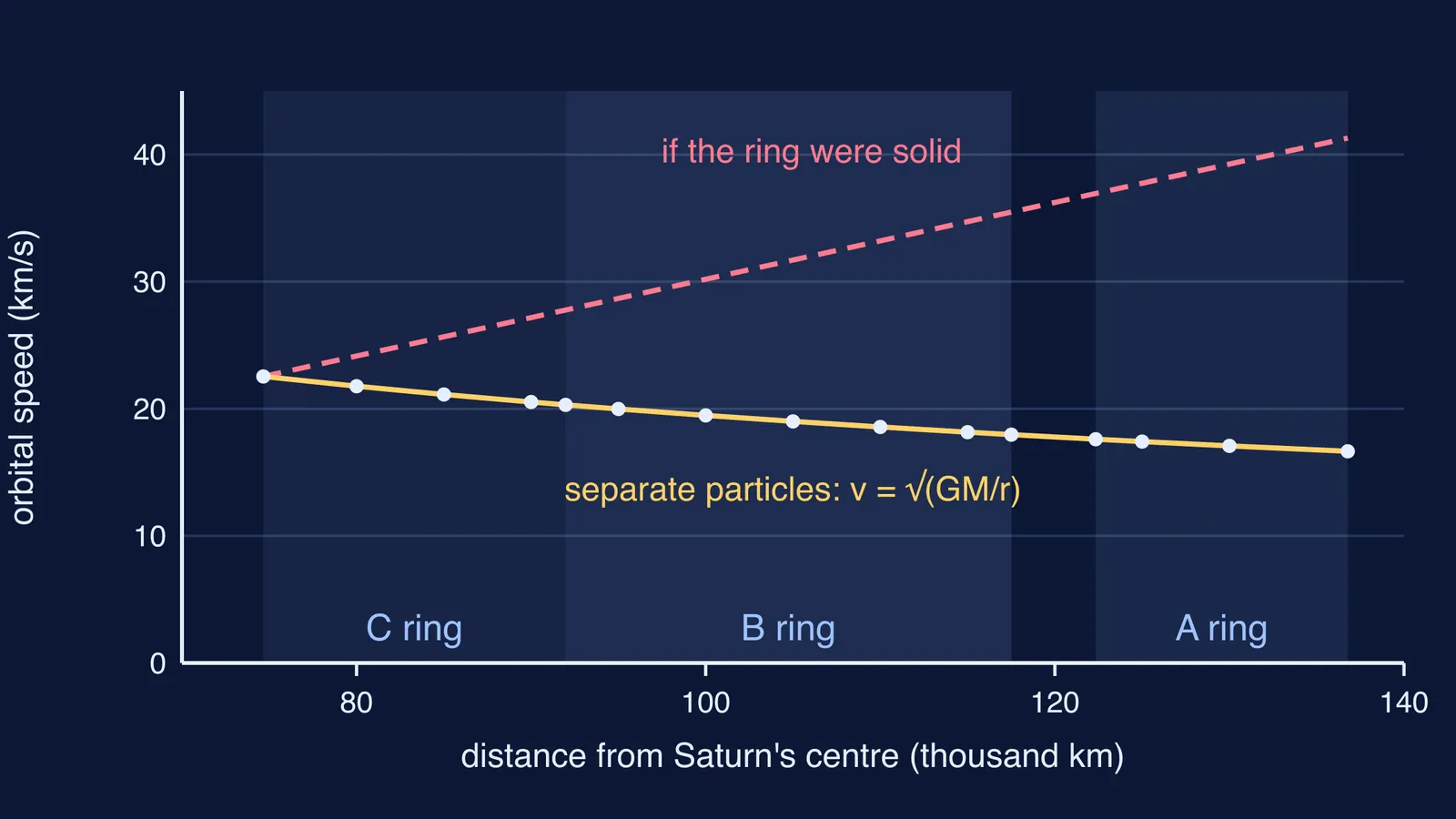
You can check the idea yourself with Class 11 gravitation. If every particle is its own small moon, its circular orbital speed is v = √(GM/r), the same formula you use for satellites (see how it is derived). Saturn's GM is 37.931 × 10^6 km³/s² (NASA Saturn fact sheet). The C ring starts 74,658 km from Saturn's centre and the A ring ends at 136,780 km (NASA ring fact sheet).
Inner edge: v = √(37,931,000 ÷ 74,658) = √508.1 ≈ 22.5 km/s.
Outer edge: v = √(37,931,000 ÷ 136,780) = √277.3 ≈ 16.7 km/s.
Time for one lap, T = 2πr/v: about 20,800 s (5.8 hours) at the inner edge and about 51,600 s (14.3 hours) at the outer edge.
Check with Kepler's third law: (136,780 ÷ 74,658)^1.5 ≈ 2.48, and 5.8 × 2.48 ≈ 14.3 hours. It agrees.
A solid ring turns as one piece, so speed grows with distance. With its inner edge at 22.5 km/s, its outer edge would move at 22.5 × (136,780 ÷ 74,658) ≈ 41.3 km/s, about 2.5 times the circular orbital speed there.
How was Maxwell's prediction confirmed?
On 9 and 10 April 1895, James Keeler photographed the spectrum of Saturn with a 13-inch refracting telescope at the Allegheny Observatory and used the Doppler effect to measure the rings' speeds; he found the inner edge travelling faster than the outer edge (Earth Magazine). He published the result as "A Spectroscopic Proof of the Meteoric Constitution of Saturn's Rings" in the Astrophysical Journal that year.
Today NASA describes the rings as "billions of small chunks of ice and rock", from dust-sized grains to chunks as big as a house, with a few as large as mountains, and the main rings typically only about 10 metres thick (NASA Saturn facts). Why they never clumped into a moon is explained by Édouard Roche's limit.
What can you learn from how Maxwell worked?
Maxwell did not guess. He listed every model, tested each against the laws of motion, and kept what survived. Try the same routine on a tough problem:
List every possible picture of the system.
Write the law each must obey (here, gravity supplying the centripetal force).
Work out what each picture predicts that the others do not.
Reject any picture that needs a finely tuned condition.
Name the measurement that tells the survivors apart, as Keeler's spectrum did.
George Airy, the Astronomer Royal, called the essay "one of the most remarkable applications of mathematics to physics that I have ever seen" (MacTutor).
If orbits are easier for you to see than to read, the Fermi Simulation Lab has interactive simulations for ideas like this. For practice with v = √(GM/r), the Fermi Problem Library has worked problems with a step-by-step solver that explains the reasoning rather than printing an answer.


