

On this page
You drop your phone on the floor, pick it up and the screen is fine. Untreated glass of the same thickness would be far more likely to crack. The difference is a piece of Class 11 chemistry: swapping one alkali metal ion for a bigger one.
Why does ordinary glass break so easily?
Glass is strong in theory and weak in practice. An American Ceramic Society explainer puts the theoretical strength of flawless glass at about 35 GPa. The same article says ordinary glass actually breaks at 7 to 100 MPa, hundreds to thousands of times lower.
The gap comes from tiny flaws on every real glass surface. When you bend a sheet, one face gets pulled (tension). Tension opens a flaw's tip and the crack runs. So the way to make glass tougher is to stop surface flaws from feeling tension.
How does swapping sodium for potassium make glass stronger?
Cover glass contains sodium ions in a silicate network. René Gy's review of ion exchange for glass strengthening describes the process, called chemical tempering: alkali ions are exchanged in a molten salt below the glass transition temperature, so the glass stays rigid.
A Corning patent, Ion exchangeable glass with high compressive stress, gives typical conditions: a potassium nitrate (KNO3) bath at or below about 420 °C, for up to about eight hours in some versions and up to about 16 hours in others. Sodium ions leave the glass and potassium ions take their places.
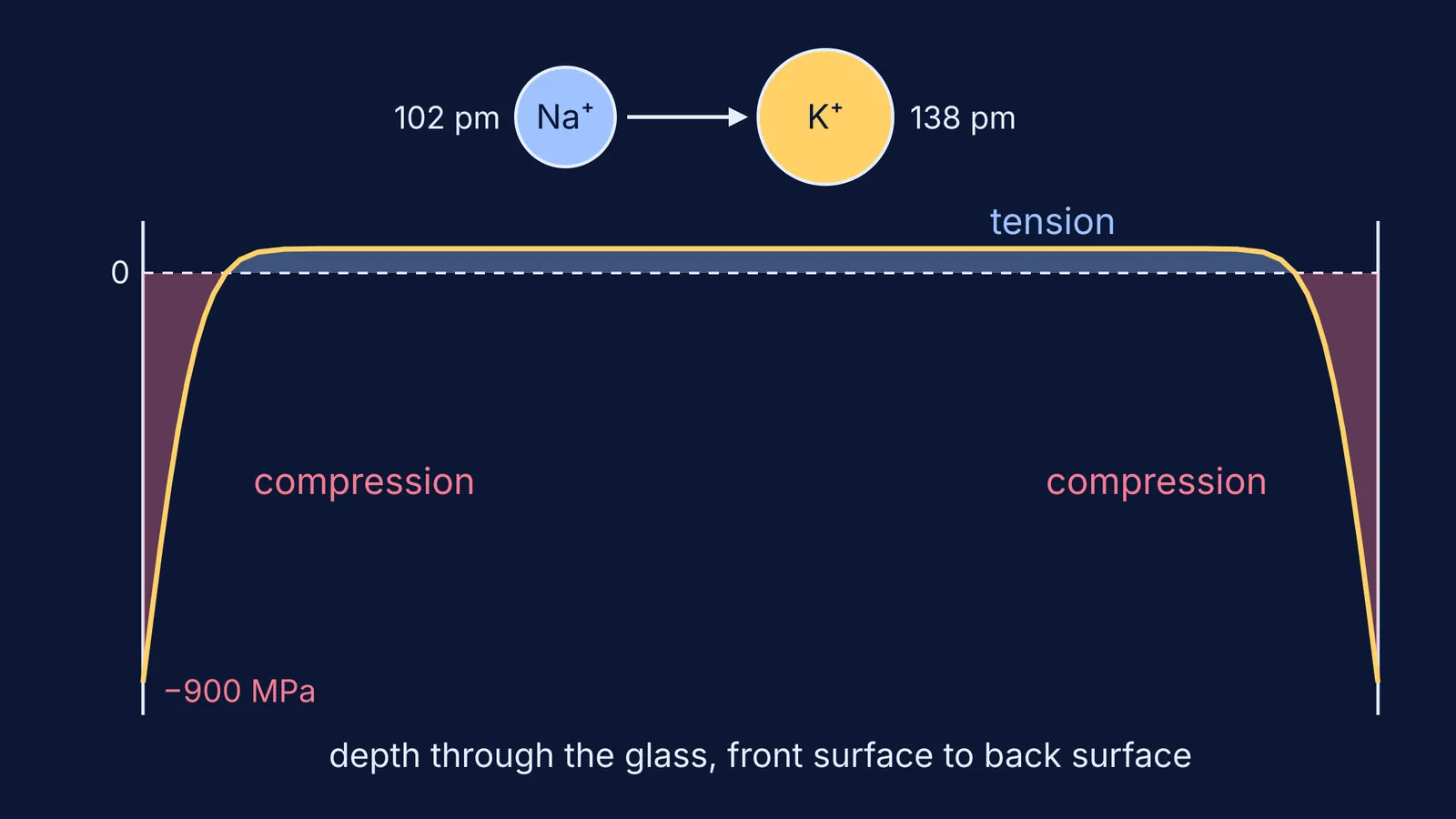
The key is ion size. In R. D. Shannon's table of effective ionic radii, a six-coordinate Na+ ion has a radius of 102 pm and K+ has a radius of 138 pm (values as listed in this summary table).
That makes each potassium ion about 35% wider than the sodium ion whose site it takes. Above the glass transition the network could relax and make room. Below it, the network cannot, so the surface layer ends up jammed and pushing outwards against its neighbours: it is under compression. The Corning patent links the compressive stress to larger potassium ions sitting in smaller sodium sites. It aims for at least about 900 MPa of surface compression, and two of its example glasses reached 1,012 and 1,423 MPa, with compressed layers 47 and 55 µm deep.
Why does a squeezed surface stop cracks?
The ACerS explainer gives the reason in one line: an applied tension must overcome the compression before crack growth can occur. A flaw sitting in a squeezed layer is held shut.
Forces inside the sheet must balance, so the squeezed outer layers are matched by a gentle pull (tension) in the middle of the glass. That is what the hero diagram above shows: deep, narrow compression at both faces, and shallow tension across the core.
The example uses the ACerS breaking range and the patent's compression figure. It also shows the weak spot: a sharp impact, such as a corner landing on rough concrete, can drive a flaw past the compressed layer into the tensioned core. That is why a strengthened screen still shatters sometimes. Heat can squeeze a glass surface too, as in why toughened glass breaks into tiny cubes.
So why does my phone screen still get scratched?
Strength (resisting cracks) and hardness (resisting scratches) are different properties. The Mohs scale summary from Queensborough Community College rates a steel knife at 5, a glass plate at 5.5 and quartz at 7. A harder material leaves a permanent mark on a softer one. For how engineers measure hardness with numbers instead of a scratch test, see how the Brinell hardness test works.
A US Geological Survey soil study calls it the most abundant soil mineral in the United States. Grains of sand and dust in a pocket are a likely source of faint lines on your screen. Cover glass is a different recipe from window glass, but on the Mohs numbers above, steel is softer than plate glass, so grit is more of a worry than steel keys.
What to do with this:
Keep your phone away from pockets and bag compartments that collect sand.
Wipe the screen with a clean cloth, not a dusty one.
Treat a deep chip at the edge as a warning; the flaw may already reach the tensioned core.
What should you remember for exams?
Ionic radius increases down a group: K+ is bigger than Na+.
The exchange happens below the glass transition, so the network cannot relax around the bigger ions.
Surface compression must be overcome before a crack can grow, and it is balanced by tension in the middle.
Strength and hardness are different properties.
If stress inside a solid is hard to picture, the Fermi Simulation Lab has interactive simulations for ideas that are easier to see than to read. To revise ionic radii and periodic trends, the Fermi Concept Library gives each concept in chemistry and physics its own lesson.


