

On this page
On a crowded bus, a side window that breaks does not hang in sharp daggers. It falls apart into small, blunt cubes. That is built in at the factory, and Class 11 physics explains it: thermal expansion, stress and stored elastic energy.
How is toughened glass made?
Toughened (tempered) glass starts as ordinary flat glass. A glass maker's patent describes heating the sheet "to a temperature above the strain point of the glass and slightly below the glass softening temperature, e.g. to 600°-700° C", then blowing jets of cooling air onto both faces (Central Glass, US patent 4,735,646). The patent explains that this leaves permanent compressive stress in the surface layers, balanced by tension in the middle.
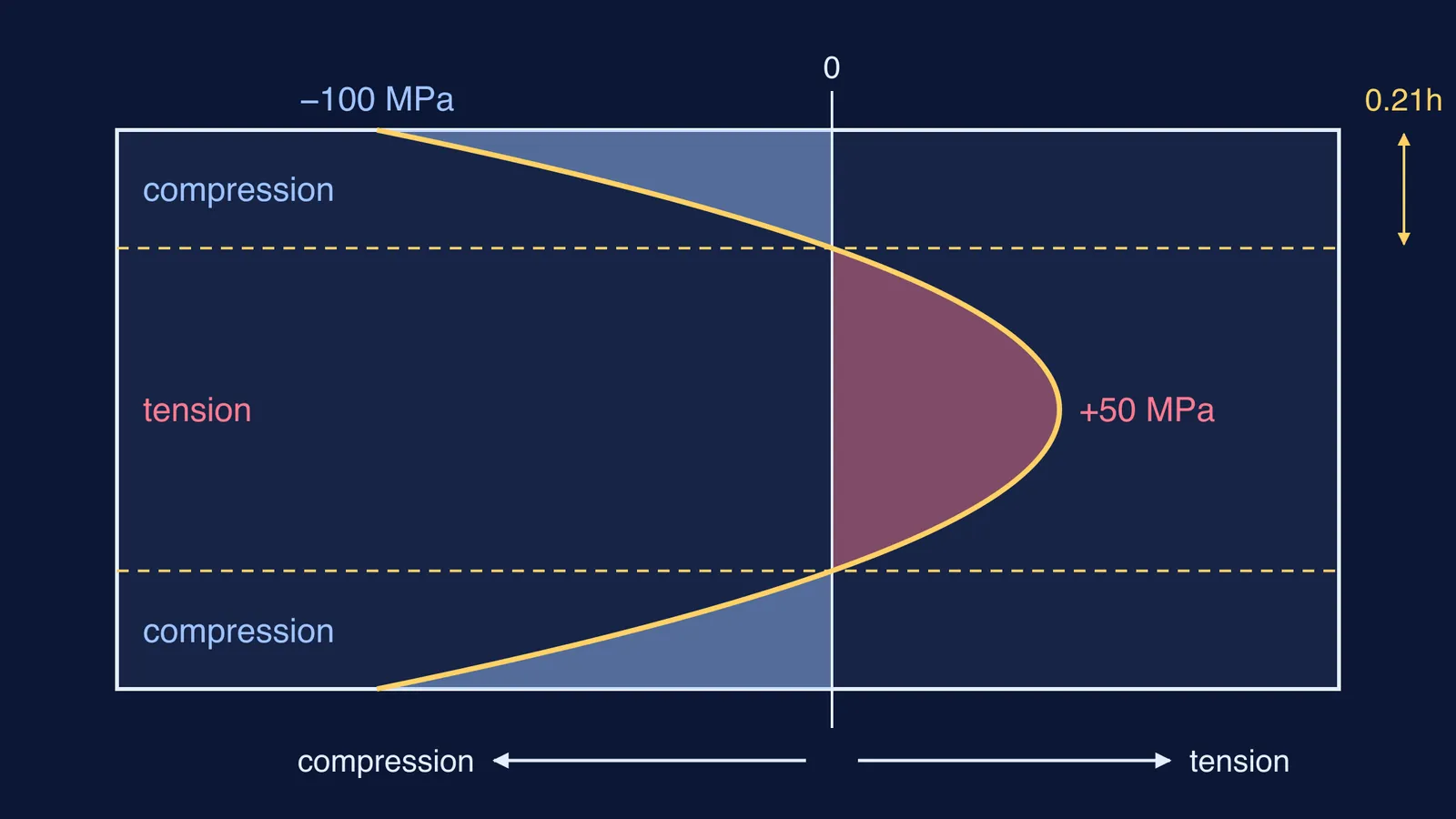
The outer skin cools first and goes rigid while the core is still hot and slightly soft. Later the core cools and shrinks, but it is bonded to a skin that has already set. The shrinking core pulls the skin inwards, squeezing it into compression, while the skin holds the core in tension. If you have read why a thick glass cracks when hot water is poured in, this is the same uneven expansion, used on purpose.
Engineers model the result as a parabola through the thickness: compression at both faces and tension in the middle, with the surface stress about twice the mid-plane tension and zero stress at about 21% of the thickness in from each face (Nielsen, Kraus and Schneider, arXiv 2110.09293).
Why is toughened glass stronger than ordinary glass?
Glass almost always breaks in tension, starting from tiny scratches on its surface. The same paper puts the tensile strength of ordinary annealed float glass between 30 MPa and 100 MPa because of those flaws (Nielsen et al.). In toughened glass those flaws are squeezed shut, so a load must first cancel the compression before any crack opens. A University of Southampton research page gives characteristic strengths of about 45 MPa for annealed glass and 120 MPa for tempered glass (University of Southampton).
Why does toughened glass break into tiny cubes?
The locked-in stresses store elastic strain energy across the whole pane. Once a crack gets through the skin into the tensile core, it runs and branches. Nielsen and colleagues note that the fracture front travels at about 1500 m/s and that tempered glass "typically fractures into small dices that are less harmful than shards from broken annealed glass" (arXiv 2110.09293). More stored energy means more branching and smaller pieces.
The paper gives the stored energy per unit volume as U = (1/5) × (1 − ν)/E × σ², where σ is the surface compression, E is Young's modulus and ν is Poisson's ratio. On its fit, the typical fragment size is δ ≈ 122.1 J/m² ÷ U, so pieces shrink as U grows.
Worked example: how hard must the factory quench?
Take the values the Nielsen paper uses for glass: E = 70 GPa and ν = 0.23.
Surface compression 100 MPa: U = 0.2 × 0.77 × (10^8)² ÷ (7 × 10^10) ≈ 22,000 J/m³.
Fragment size: δ ≈ 122.1 ÷ 22,000 m ≈ 5.5 mm.
Pieces in a 50 mm × 50 mm square: honeycomb cells with centres 5.5 mm apart each cover about 26 mm², so roughly 2,500 ÷ 26 ≈ 95 pieces.
Now halve the compression to 50 MPa. U falls to a quarter, about 5,500 J/m³; δ grows to about 22 mm, outside the paper's 3 to 12 mm range for building glass; the same square holds only about 6 pieces.
India's safety-glass standard for road vehicles, IS 2553 (Part 2), tests toughened glass by striking it with a centre punch and counting the pieces. In the 1992 edition, any 50 mm × 50 mm square must hold no fewer than 40 and no more than 400 fragments (panes 3.5 mm or thinner get a slightly looser rule), with no more than 5 elongated splinters between 75 mm and 150 mm long (BIS, IS 2553 Part 2:1992). On this model, the 100 MPa pane passes and the 50 MPa pane fails. The estimates are rough, but the chain holds: stress squared sets the energy, energy sets the piece size, and piece size decides safety.
Why are windscreens different?
The same standard lists uniformly toughened glass for panes other than the windscreen. For windscreens it lists laminated and zone-toughened glass, and says uniformly toughened windscreens were to be phased out from 1 April 1993 (BIS, IS 2553 Part 2). Laminated glass bonds glass to a plastic interlayer, and after the standard's head-form impact test its fragments must stay stuck to that layer. Zone-toughened glass is treated so the part in front of the driver breaks into larger pieces, keeping a field of view. Standards are revised, so check the current edition before quoting limits.
To watch stress, strain and stored energy change together, try the Fermi Simulation Lab, our interactive simulations for ideas that are easier to see than to read. For background, read how to read the stress-strain curve of a wire and thermal stress in clamped rods.


