

On this page
Your phone lasted a full day when it was new. Two years later it is gasping by evening. The battery has lost lithium, and places to store it, to chemistry that runs alongside the useful reaction every time you charge.
What happens inside a lithium-ion battery when you charge it?
A phone battery is a lithium-ion cell. Lithium ions shuttle through a liquid electrolyte between a graphite negative electrode and a metal-oxide positive electrode, the design that grew out of John Goodenough's cobalt oxide cathode. Charging pushes ions into the graphite; using the phone lets them flow back. For the Class 12 picture, see our walkthrough of batteries and fuel cells, from dry cells to lithium-ion.
Capacity is how much lithium can make that round trip. Lose ions, or the electrode material that holds them, and capacity falls.
Why does a phone battery lose capacity over the years?
Oxford researchers sum up battery ageing as three measurable degradation modes: loss of lithium inventory, loss of active positive electrode material and loss of active negative electrode material (Birkl et al., Journal of Power Sources, 2017). The mechanisms behind them are side reactions and mechanical wear, described in O'Kane et al.'s study of degradation models, published in Physical Chemistry Chemical Physics in 2022:
A film that eats lithium. The organic electrolytes in most lithium-ion batteries are unstable below about 1 V against lithium, so they react at the graphite surface and form a layer called the solid electrolyte interphase (SEI). The SEI's compounds contain lithium, and that lithium can no longer store charge.
Cracking from swelling. Graphite expands as lithium enters and contracts as it leaves. The stress can crack particles, and the cracks reveal fresh surface where more SEI grows, trapping more lithium.
Lithium plating. In the cold, when the graphite surface is already full, or during fast charging, lithium can deposit as metal on the graphite instead of slipping inside it. Some of it gets cut off by SEI growth and becomes “dead lithium” that cannot be recovered.
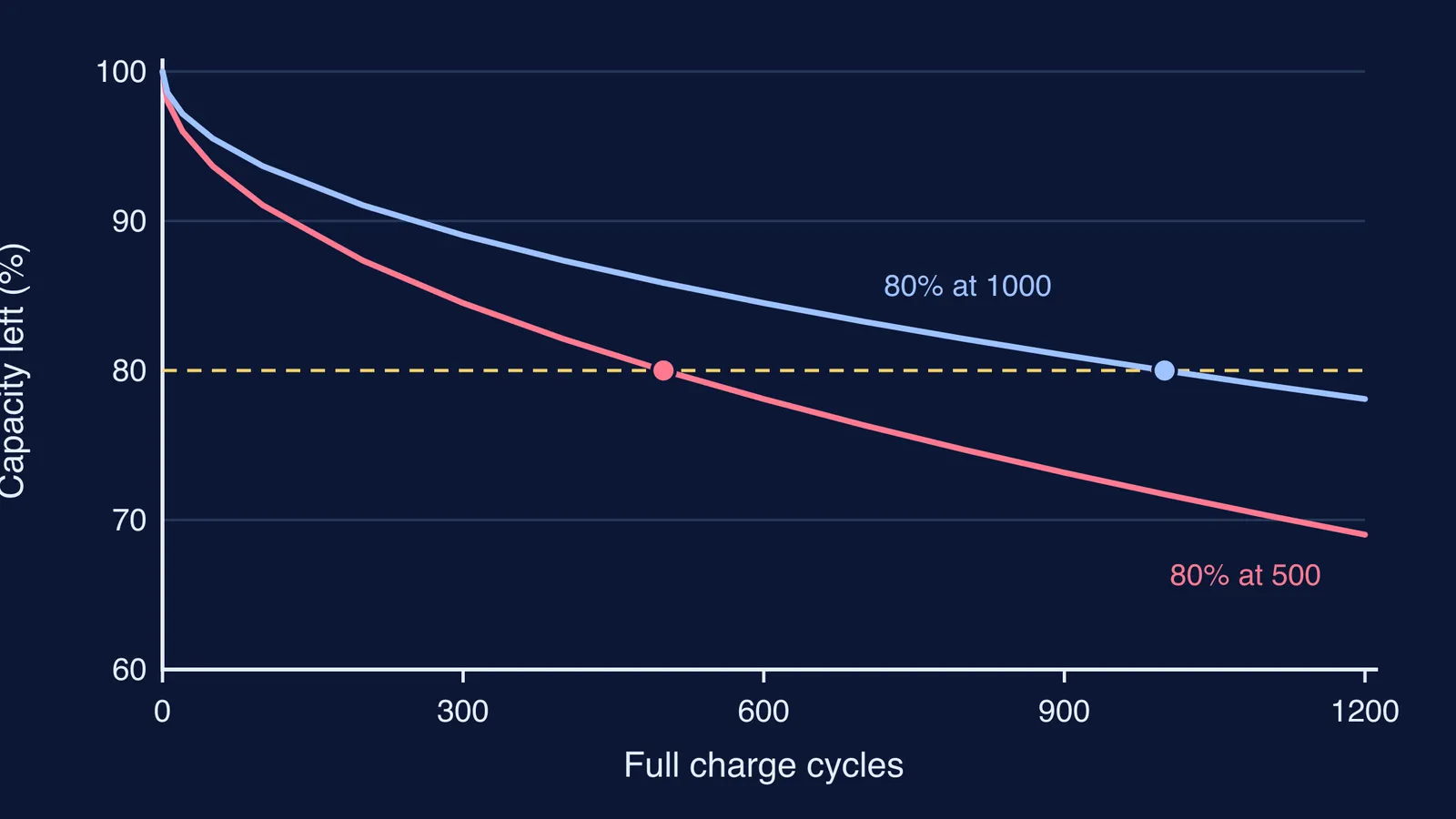
In the paper's model of diffusion-limited SEI growth, SEI thickness grows with the square root of time, so the rate of capacity fade slows as the battery ages instead of staying constant.
How many charge cycles does a phone battery last?
One charge cycle means using an amount equal to 100% of the battery's capacity, not necessarily from a single charge, as Apple explains. Apple says batteries of iPhone 14 models and earlier are designed to retain 80% of their original capacity at 500 complete charge cycles, and iPhone 15 models at 1,000 cycles, under ideal conditions (Apple India, battery service).
Worked example: how many years is 500 cycles? Say you use 70% of your battery each day. That is 0.7 cycles a day.
Days to 500 cycles: 500 ÷ 0.7 ≈ 714 days, just under 2 years.
Days to 1,000 cycles: 1,000 ÷ 0.7 ≈ 1,429 days, about 3.9 years.
A heavy user at 1.2 cycles a day: 500 ÷ 1.2 ≈ 417 days, about 14 months.
These are best cases: Apple's figures assume ideal conditions, and real use is rarely ideal.
Does heat or charging to 100% damage a phone battery?
Both speed up ageing. Apple calls 16 to 22 °C the ideal zone and says ambient temperatures above 35 °C can permanently damage battery capacity (Apple, maximising battery performance).
Heat and a full charge stack up. Estimates from Battery University's BU-808 guide say a lithium-ion battery stored for a year at 25 °C keeps about 96% of its capacity at 40% charge but 80% at 100% charge; at 40 °C those figures fall to 85% and 65%.
That is why iPhones have Optimised Battery Charging, which can delay charging past 80% and is designed to reduce wear by cutting the time the phone spends fully charged (Apple Support). Fast charging adds its own heat; our explainer on how fast charging works and what it means for battery health works through the numbers.
A five-point checklist to slow battery ageing
Each habit follows from the chemistry and Apple's battery guidance:
Keep the phone out of direct sun and off hot dashboards.
If it gets hot while charging, take it out of its case.
Turn on your phone's optimised charging or charge-limit setting if it has one.
Storing an old phone? Leave it at around 50% charge, not full or empty.
Note your battery health every few months; a steady slide is normal, a sudden drop is worth getting checked.
How can you see this chemistry instead of memorising it?
Battery ageing is the electrode reactions from your electrochemistry chapter plus unwanted ones running alongside, and it is easier to grasp when you can see it rather than read it. The Fermi Simulation Lab has interactive simulations for ideas that are easier to see than to read. If electrode potential is still shaky, it has its own lesson in the Fermi Concept Library.
Next time your battery health drops a point, you will know where that lithium went.


