

On this page
You answer a question in class, get it wrong, and within seconds your cheeks feel hot. Blushing is an automatic reaction run by your nerves and your blood vessels, and it makes a neat revision topic for biology and physics.
Why does your face turn red when you feel embarrassed?
Embarrassment switches on the sympathetic nervous system. This is the branch of the nervous system behind the fight-or-flight response, and it also triggers the release of adrenaline from the adrenal glands (our explainer on why adrenaline is called the emergency hormone covers its other effects). In the cheeks, this signal widens small blood vessels. More blood then flows close to the surface, so the skin looks red and feels warm.
In a 1990 study in Psychophysiology, 32 undergraduates watched a video of themselves singing, recorded the day before, while four people sat in the room. Their cheek and ear colour and their cheek temperature rose more than when they watched a clip from the film Psycho.
A 2024 brain-imaging study in Proceedings of the Royal Society B repeated the idea with 40 people aged 16 to 20 watching videos of themselves singing karaoke. Their cheeks warmed more when they watched themselves than when they watched other people sing. The authors open by recalling Darwin's description of blushing as "the most human of all expressions".
Is it adrenaline that widens the blood vessels?
Partly, and the details are still debated.
In 1982, Mellander and colleagues studied rings of a surface branch of the facial vein from the cheek, taken from 12 patients during neck surgery. The vein had beta-adrenoceptors, receptors that respond to adrenaline and noradrenaline, and in samples from some patients nerve stimulation made it widen. A large neck vein (the external jugular) had no beta-adrenoceptors at all. The team tentatively proposed that this nerve-and-receptor mechanism might be involved in emotional blushing.
In 1997, Peter Drummond tested it in 21 frequent blushers and 21 infrequent blushers. He blocked beta receptors in a small patch of forehead skin. In infrequent blushers, the block stopped blood flow rising during stressful mental arithmetic and partly reduced the rise during singing. He described this as minor participation of beta receptors. Both groups' vessels responded alike, so frequent blushers do not seem to have different receptors; the difference may be psychological.
So the accurate version is this: fight-or-flight nerve signals, with adrenaline-type receptors playing a part, widen the cheek vessels. Other signals that widen blood vessels are probably involved too.
Why does blushing show on your face and not your arms?
A 1988 study by Wilkin70177-2) looked at flushing, facial redness set off by heat or chemicals rather than emotion. Volunteers were given two flushing triggers, nicotinic acid and a heat challenge taken by mouth, while blood flow was measured in the cheek and the forearm. Blood flow rose at both sites. Wilkin concluded that the results fit one explanation: the visible vessels near the surface in the "blush area" can hold more blood, so the redness shows mostly on the face.
How much more blood does a slightly wider vessel carry?
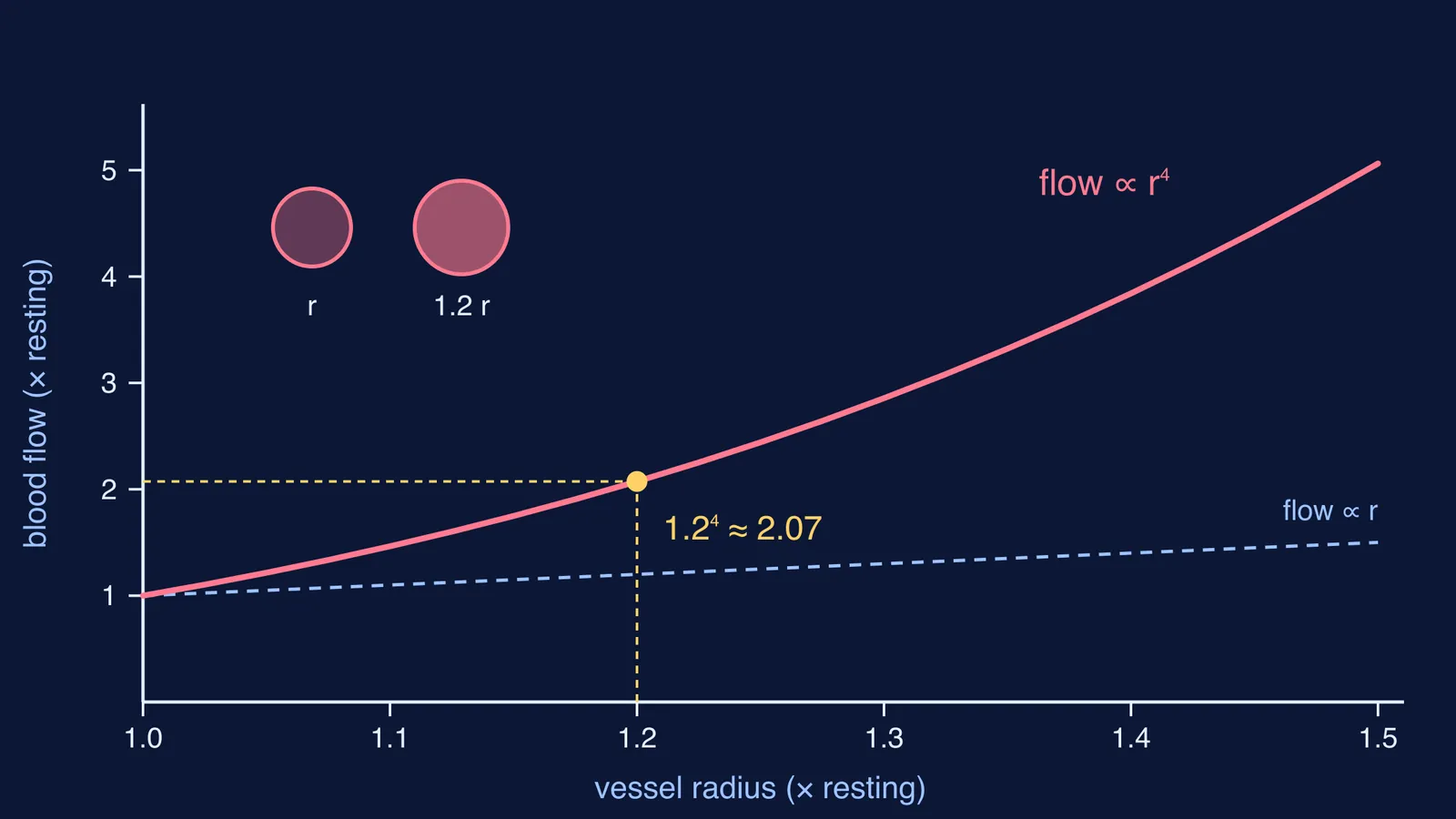
This is where biology meets Class 11 physics. OpenStax College Physics explains Poiseuille's law: at the same pressure, flow through a tube depends on the radius to the fourth power. Its own example: a blood vessel that is 5% narrower carries only about 0.81 of its original flow.
Now run it the other way, for a cheek vessel that widens:
Radius grows by 10%, so the new radius is 1.1 times the old one.
Flow scales as 1.1 to the power 4, which is 1.1 × 1.1 × 1.1 × 1.1 = 1.46.
That is about 46% more blood through the same vessel.
If the radius grows by 20%, flow scales as 1.2 to the power 4 = 2.07, roughly double.
Fourth-power curves are easier to see than to read. The Fermi Simulation Lab has interactive simulations for ideas like this. If the r⁴ term itself is shaky, the Fermi Concept Library has a lesson for each idea in physics and biology.
What can you do when you start blushing?
You cannot switch off a reflex, but you can plan for it. A plan for class or a viva:
Name it and keep going. Try: "I'm going a bit red, give me a second. My answer is..."
Remember that a mild blush may be less visible than it feels. In the 1990 study, observers reliably judged a face as blushing only at its point of strongest cheek colour.
Parents and teachers: do not point it out or joke about it. Move the conversation on.
Blushing is one small part of a bigger stress response. Next, read why your heart races when you are scared, or how Walter Cannon described the fight-or-flight response.


