

On this page
Your old phone's back panel has started to lift, or the screen bulges at one corner. That is usually the battery: the liquid that carries lithium ions has slowly been turning into gas, and the soft pouch has nowhere else to put it. Here is the chemistry, a worked example using Class 11 gas laws, and what to do tonight.
Why do old phone batteries swell up?
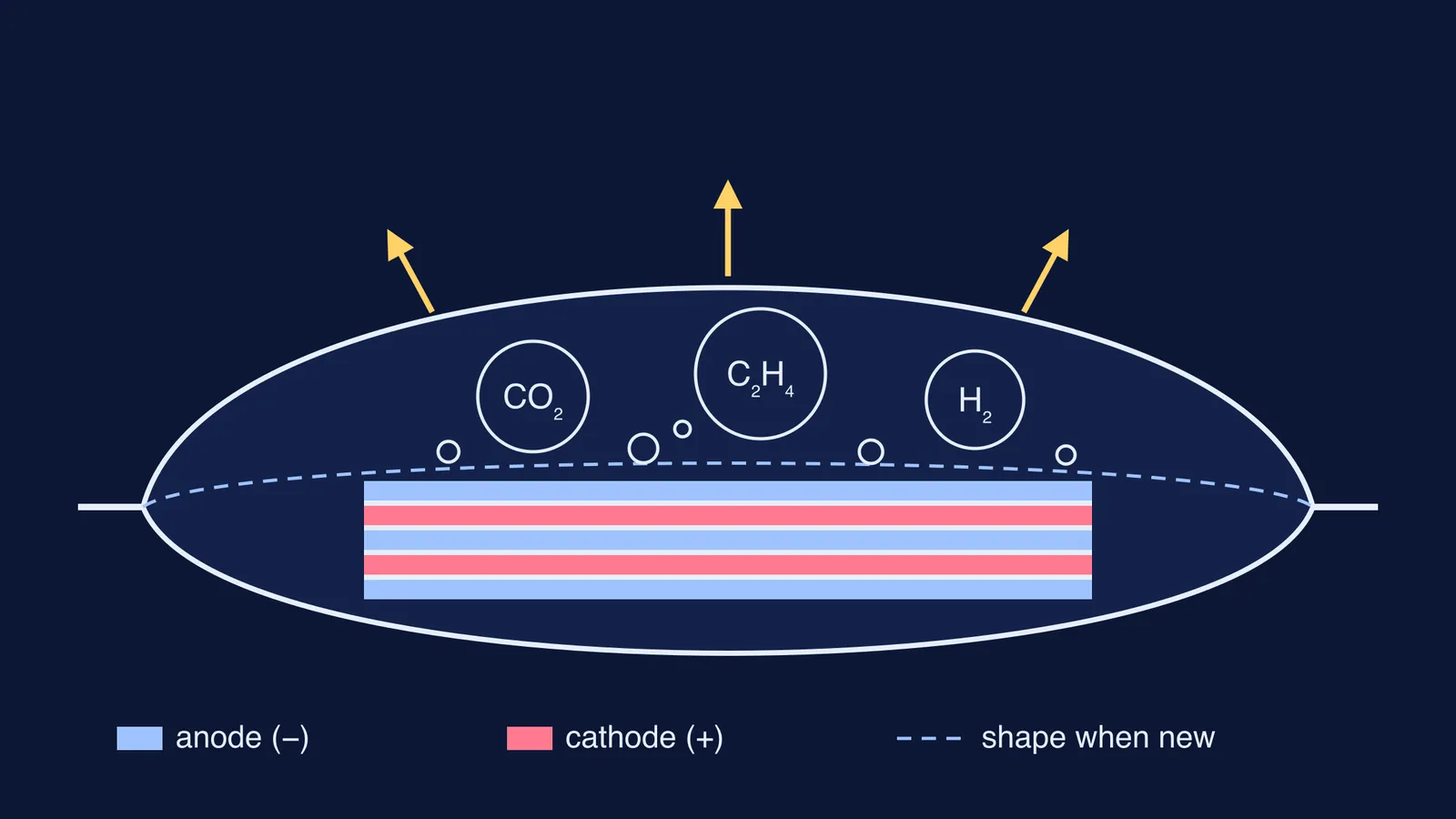
Phones use pouch cells: flat lithium-ion cells sealed in polymer-coated aluminium foil instead of a rigid metal can, which saves weight but lets the cell expand when gas forms inside, as a 2022 review by Aalund, Endreddy and Pecht in Frontiers in Chemical Engineering explains. The gases it lists include hydrogen, ethylene (C₂H₄), propylene, carbon dioxide, carbon monoxide and oxygen.
It is not just cosmetic: the Frontiers review cites a study in which swollen cells with a 278% increase in volume pressed on surrounding components at up to 28 N/mm², enough to deform or crack screens, trackpads and cases.
A 2025 review in Batteries discusses how swelling correlates with capacity fade and rising impedance (internal resistance), so a puffy battery is often a worn one.
What chemistry turns the electrolyte into gas?
This is syllabus electrochemistry: reduction at one electrode, oxidation at the other (refresh it with our explainer on batteries and fuel cells, from dry cells to lithium-ion).
At the graphite electrode, electrolyte solvent gains electrons. According to the Frontiers review, this builds a protective film called the solid electrolyte interphase (SEI) and releases ethylene from the solvent ethylene carbonate, along with CO or CO₂.
Traces of water are reduced to hydrogen gas at the same electrode.
At the positive electrode, the electrolyte is oxidised. For common NMC cathodes the review puts the onset of gassing at about 3.8 V, with the salt LiPF₆ breaking down above 4.2 V.
These side reactions continue slowly with use and heat, so gas can build up as the phone ages.
Worked example: how a drop of liquid puffs up a pouch
Gas takes far more room than the liquid it came from. Take ethylene carbonate (C₃H₄O₃, about 88 g per mole), a common electrolyte solvent with a density of about 1.32 g/cm³ near 40 °C, according to PubChem's data for ethylene carbonate.
One millimole of liquid ethylene carbonate weighs 0.088 g, so it fills 0.088 ÷ 1.32 ≈ 0.067 mL, about one small drop.
Suppose side reactions made 1 millimole of gas. With PV = nRT at 25 °C (298 K) and 1 atm (101,325 Pa): V = 0.001 × 8.314 × 298 ÷ 101,325 ≈ 2.4 × 10⁻⁵ m³, or about 24.5 mL.
The ratio is 24.5 ÷ 0.067 ≈ 370, so the same number of molecules takes roughly 370 times more space as a gas.
At 45 °C (318 K) that gas needs about 7% more volume (318 ÷ 298 ≈ 1.07).
Real reactions do not turn one solvent molecule into exactly one gas molecule, so treat this as an order-of-magnitude picture. Gas laws are easier to see than to read; the Fermi Simulation Lab offers interactive simulations for ideas like that.
Why do heat and full charge make it worse?
The Frontiers review says elevated temperature, overcharge and over-discharge can all cause rapid gas generation. Apple calls 16 to 22 °C the ideal comfort zone for its devices and warns that ambient temperatures above 35 °C can permanently damage battery capacity (Apple: maximizing battery performance). In an Indian summer, a phone left on a car dashboard can easily get hotter than that, and charging under a pillow traps heat. For how charging speed and heat interact, see how fast charging works in phones.
Is it safe to charge a swollen phone battery?
No. The US National Fire Protection Association tells people to stop using a device whose battery shows swelling, an unusual smell, excess heat, popping sounds or a change in colour (NFPA lithium-ion battery safety). Google's Pixel help page says swelling alone isn't a safety concern, yet still tells owners to leave the phone unused until it drains and never to press or pry it (Google Pixel help). The Frontiers review warns that a swollen lithium-ion battery may catch fire or explode and calls for extreme caution when removing one.
What to do tonight:
Unplug it and stop charging.
Do not press the bulge flat, pierce it or open the phone.
Leave it on a table or countertop, away from beds, curtains and school bags.
Take it to an authorised service centre for a battery replacement.
Never put a loose battery in household trash; the US EPA advises taping the terminals and bagging it before a battery or e-waste collection point.
If redox still feels like memorising arrows, the Fermi Concept Library gives every chemistry concept its own lesson, so you can revisit electrode reactions and gas laws one step at a time.


