

On this page
On a winter morning you wake up with a spot of blood on your pillow, or feel a trickle in the middle of a class. It is usually minor, and the reason is a mix of anatomy and the physics of air.
Why do noses bleed more in winter?
Most nosebleeds start at the front of the nose. The Merck Manual says most nasal bleeding is anterior, coming from a cluster of vessels on the lower front part of the septum called Kiesselbach's area. The septum is the wall between your two nostrils. Here the vessels sit just under a thin, moist lining, so a small crack is enough to open one.
That lining needs moisture to stay soft. The American Academy of Otolaryngology–Head and Neck Surgery Foundation explains on ENT Health that dry, heated indoor air in winter dries out the nasal membranes and makes the blood vessels more likely to burst. Merck lists drying of the lining, for example in cold weather, among the most common causes, next to nose blowing and picking.
The chain is simple. The lining dries and forms crusts, you rub or pick a crust, and the vessel underneath tears. It is the same drying that makes lips crack in winter. For a refresher on the vessels themselves, see how arteries, veins and capillaries differ.
Nosebleeds are common. A US clinical practice guideline (Tunkel et al., 2020) says they happen at some point to at least 60% of people in the United States, and only about 6% of people who get them seek medical attention.
Why does heated indoor air feel so dry?
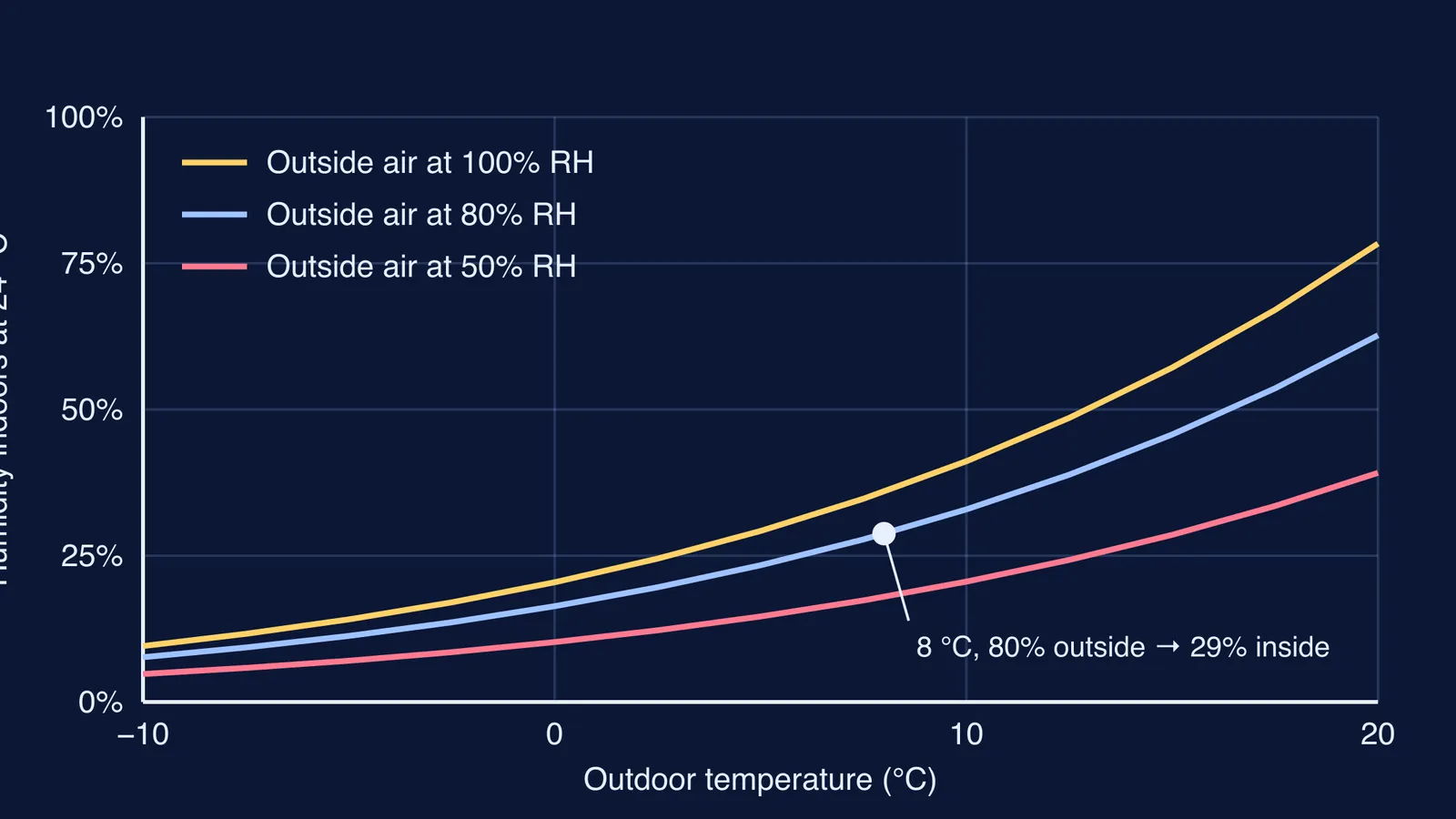
Relative humidity is how much water vapour the air holds compared with the most it could hold at that temperature (we explain it in what 80 percent humidity means on a weather app). Warm air can hold far more vapour than cold air. So when you heat winter air without adding water, its relative humidity falls.
Here is a worked example using the US National Weather Service formula for saturation vapour pressure, es = 6.11 × 10^(7.5T ÷ (237.3 + T)) hPa, with T in °C:
Outside it is 8 °C at 80% relative humidity. At 8 °C, es is about 10.7 hPa, so the air holds 0.80 × 10.7 = 8.6 hPa of water vapour.
A room heater warms that same air to 24 °C. At 24 °C, es is about 29.8 hPa.
The vapour is unchanged, so the new relative humidity is 8.6 ÷ 29.8, or about 29%.
No water was removed. The air simply has much more room for vapour, so it draws more moisture from the lining of your nose with every breath.
If relative humidity still feels abstract, the Fermi Simulation Lab has interactive simulations for ideas that are easier to see than to read.
Is it the cold or the dry air?
The research is mixed. A study at the Academic Hospital of Parma, Italy (Comelli et al., 2015) counted 5,404 nosebleed visits to the emergency department from 2003 to 2012. It found a strong winter peak and a strong link between more nosebleeds and lower daily temperature, with a weaker link to humidity only in some groups of patients.
In Alberta, Canada (Sowerby et al., 2014), a review of 4,315 adult emergency patients found that months with lower average temperatures brought more nosebleeds (r = −0.835). It found no link with humidity, and no clear seasonal pattern overall.
Both studies measured outdoor weather, not the air inside homes. The worked example shows why that matters: cold outdoor air becomes very dry indoor air once it is heated.
How do you stop a nosebleed?
The NHS gives these steps:
Sit down and lean forward, with your head tilted forward and your mouth open. Do not tip your head back.
Pinch your nose just above your nostrils for 10 to 15 minutes. Breathe through your mouth.
For 24 hours afterwards, avoid blowing or picking your nose, hot drinks, heavy lifting and lying flat.
The NHS advises emergency care if the bleeding lasts longer than 10 to 15 minutes, seems heavy, follows a blow to the head, or comes with feeling weak or dizzy or trouble breathing. It advises seeing a doctor if nosebleeds keep coming back or if you take medicine that stops blood clotting, such as warfarin.
How can you prevent winter nosebleeds?
The first three tips are from ENT Health:
Put a little saline gel or petroleum jelly just inside your nostrils.
Use a humidifier if a heater runs in your room for hours, especially overnight.
Keep nails short and leave crusts alone.
Blow your nose gently.
Note how often bleeds happen. If they are frequent, take that note to a doctor.


