

On this page
Chapped, cracked lips are a staple of cold weather, but they are not just a nuisance—they are a lesson in human biology and thermodynamics. The skin on your lips is structurally different from the skin on your cheeks, making it uniquely vulnerable to moisture loss when the temperature drops.
What is the anatomy of the lip?
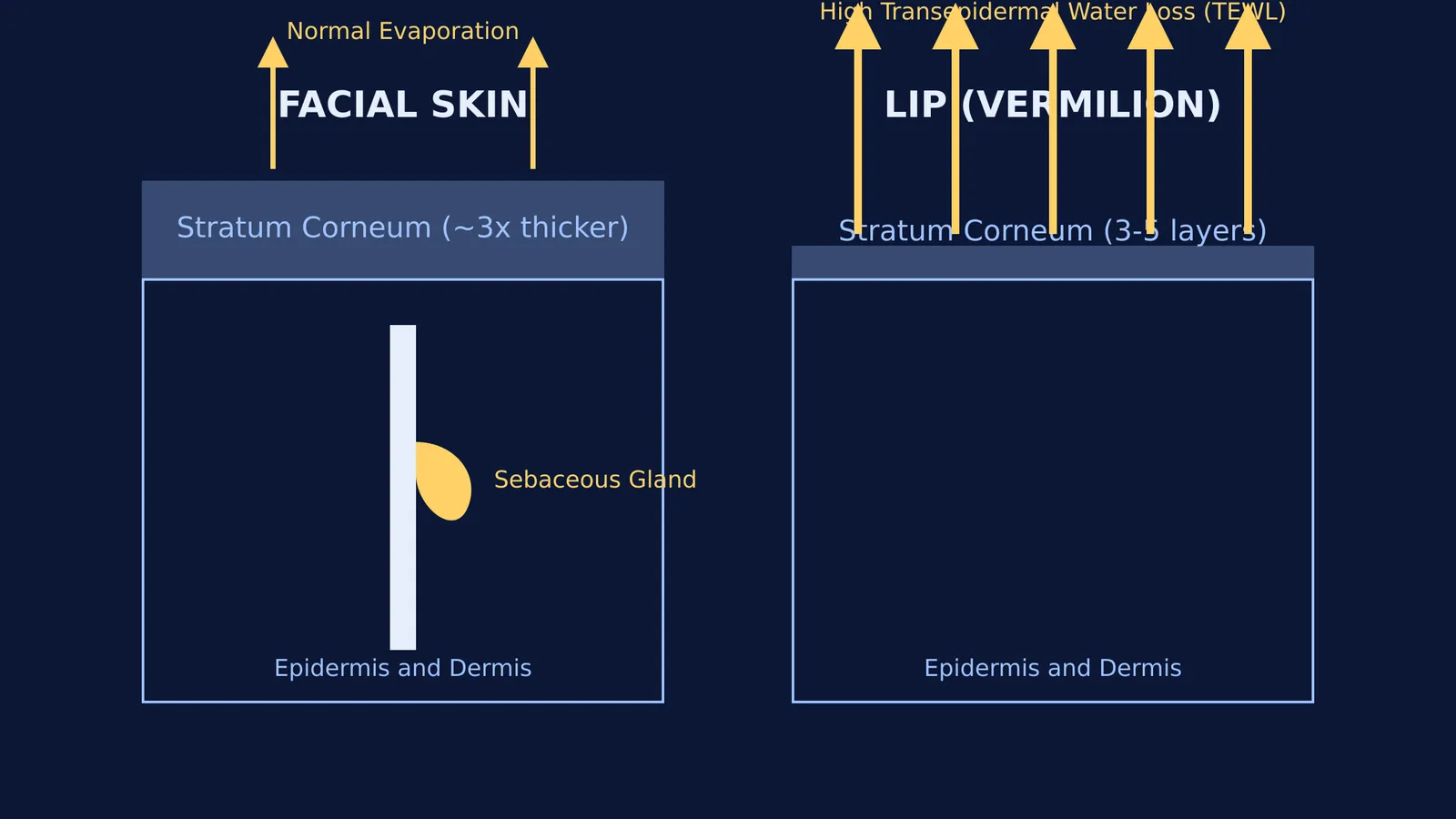
The outermost layer of your skin, the stratum corneum, acts as a waterproof barrier. The stratum corneum on the lips is exceptionally thin, consisting of only 3 to 5 cell layers—about a third of the thickness of facial skin (DiGirolamo et al., 2026). Because this layer is so thin, the underlying capillary network is more visible, giving the lips their red or pink colour.
Furthermore, lips are missing a crucial defence mechanism: sebaceous glands. These glands produce sebum, a natural oil that coats the skin and slows down water loss (Wang et al., 2022). Without sebaceous glands, the lips cannot self-moisturise or build a robust lipid barrier. They are left entirely dependent on internal hydration and external protection to stay supple.
How does cold winter air pull water from skin?
Why do lips suddenly crack when winter arrives? The answer lies in the vapour pressure gradient.
Cold air has a very low capacity to hold water vapour (a concept explored in our guide on the average molar mass of a gas mixture: worked air and vapour examples). Even if it is snowing or raining outside, the absolute humidity (the actual mass of water in the air) is extremely low. When you step outside, or when that cold air enters a building and is heated up, it becomes extremely dry. If you study gas laws, you might be familiar with converting PV, PT and VT graphs of ideal gas processes; similarly, warming up cold air at constant pressure drastically lowers its relative humidity.
Your internal tissues, meanwhile, are nearly saturated with water, creating a high vapour pressure at the skin's surface. This difference in vapour pressure creates a steep gradient that actively pulls water out of your cells through a process called transepidermal water loss (TEWL). Because your lips lack an oil barrier, water evaporates from them much faster than from the rest of your face.
In people suffering from chronic cheilitis (severe lip inflammation and chapping), this evaporation rate skyrockets. A clinical study recorded an average TEWL of 66.8 g/m²·h on the lips of these patients (Wang et al., 2022). This indicates a severely compromised barrier that is rapidly haemorrhaging moisture.
Visualising how a vapour pressure gradient drives evaporation is a classic thermodynamics problem. If you are struggling to picture the physics, the Fermi Simulation Lab has interactive simulations for the ideas that are easier to see than to read.
Why does licking your lips make it worse?
When your lips feel dry, the natural instinct is to lick them. But this creates a vicious cycle.
As the water in your saliva evaporates into the dry winter air, it follows the vapour pressure gradient and takes the lips' internal moisture with it. Saliva also contains digestive enzymes like amylase, which are designed to break down food. When applied repeatedly to the thin, unprotected skin of the lips, these enzymes act as irritants, breaking down the already fragile barrier and causing more peeling and cracking.
How can you protect your lips this winter?
Because the lips cannot protect themselves, you have to build the barrier for them. Here is a simple daily plan to stop the cracking:
Build a false barrier: Apply an occlusive lip balm (containing ingredients like petroleum jelly, beeswax, or shea butter) before going outside. This replaces the missing sebum and blocks the vapour pressure gradient.
Reapply after eating or drinking: The thin barrier easily wipes off. Keep it intact by reapplying whenever you wipe your mouth.
Humidify your room: If you wake up with cracked lips, the air in your bedroom is too dry. Use a humidifier to raise the absolute humidity and flatten the vapour pressure gradient while you sleep.
Stop the saliva cycle: If you catch yourself licking your lips, apply balm immediately instead.
Understanding the unique biology of your lips and the physics of the air around you explains why they crack—and why a simple physical barrier is all you need to keep them intact. If your lips remain severely cracked or painful despite these steps, consult a dermatologist for professional guidance.


