

On this page
If your family stores a season's rice or wheat in a drum, someone has probably dropped a handful of dried neem leaves on top. It looks like a superstition. It is really a small piece of chemistry and biology, and it has been tested in the lab.
What is in neem leaves that keeps insects away?
The neem tree, Azadirachta indica, makes a family of bitter compounds called limonoids. The best known is azadirachtin, which a review by Mordue and Nisbet describes as a tetranortriterpenoid limonoid from neem seeds and the main compound behind neem's toxic effects on insects (Mordue and Nisbet, 2000).
The same review describes three main ways azadirachtin works on insects (Mordue and Nisbet, 2000):
It stops feeding. Insects taste it and refuse to eat. Desert locusts stop feeding at 0.01 ppm, but beetles are much less sensitive: they reach up to complete antifeedancy only at 100 to 600 ppm.
It upsets moulting. It disrupts the release of moulting hormones (ecdysteroids), so young insects grow slowly, moult late or abnormally, and more of them die.
It cuts breeding. It blocks egg development in female locusts and lowered male fertility in tests on other insects.
One caveat: azadirachtin is found mainly in the seed kernels, while the leaves contain other active molecules but not high levels of azadirachtin (Mordue and Nisbet, 2000). So leaves are a milder, home-grown version of the treatment. They can help, but they are not a pesticide spray.
For more on neem's other compounds, see our post on the medicinal chemistry of tulsi and neem, and our profile of T. R. Govindachari and the chemistry of neem.
Do dried neem leaves really protect stored grain?
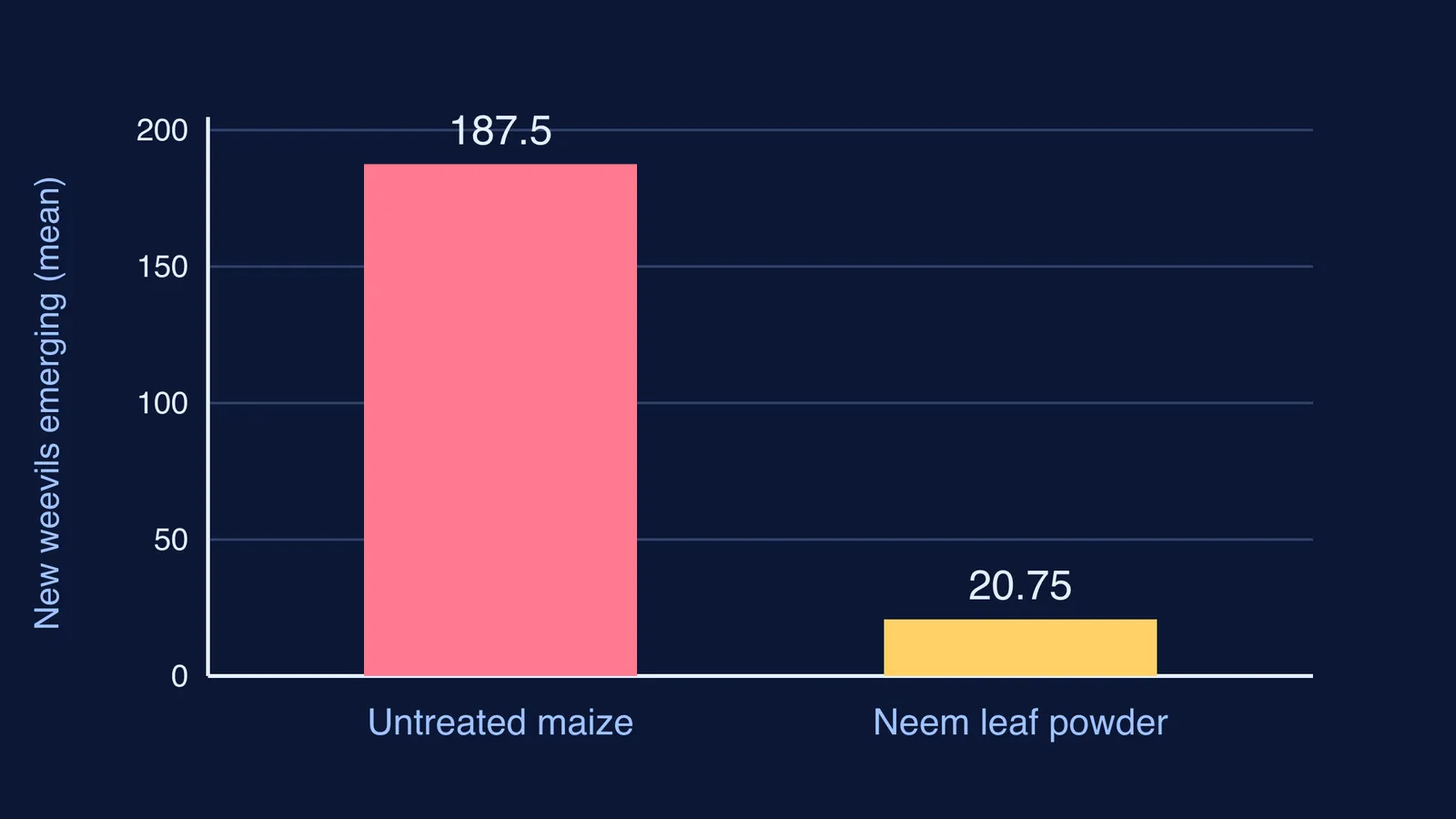
The evidence says yes, partly. In a trial at the University of Benin, maize treated with neem leaf powder was kept with maize weevils for 46 days. Untreated maize produced an average of 187.5 new weevils, while maize with the 10 g dose of leaf powder produced 20.75 (Ogedegbe and Evbuomwan, 2022). That is roughly nine times fewer. Adult deaths stayed low (a mean of 3.25 at the 10 g dose, against 0.25 untreated), so most of the gap came from fewer new weevils emerging. The trial used maize, so it is a guide for rice and wheat rather than proof.
Tamil Nadu Agricultural University's storage guidance states that neem leaf powder at 10 g per kg has been found effective against storage pests (TNAU Agritech Portal). The same page recommends neem seed kernel powder, 1 kg for every 100 kg of cereal or pulse.
A 1996 review of over 120 plants for the UK's Natural Resources Institute gave neem its own section because it had been studied more extensively than the others, and called for more rigorous, standardised testing (Dales, NRI Bulletin 65).
How should you store rice and wheat with neem leaves?
Neem is the last step, not the first. Follow the order below. The moisture and drying figures come from the TNAU storage guidance.
Dry the grain until its moisture is down to 12-13%. TNAU notes that short sun-drying spells (9 to 11 am, over about 8 days) also reduce insect infestation.
Clean it: remove dirt, stones, broken grains and any insects.
Clean the container. Brush out corners and cracks so fewer hidden insects and eggs remain.
Dry neem leaves in the shade until they crumble. Use them whole or as powder at about 10 g per kg of grain, which is roughly 250 g for a 25 kg drum.
Seal the lid and keep the drum off a damp floor.
Check every few weeks. Many families replace the leaves when they lose their smell.
Our post on how grains are stored safely from pests and moisture covers bins, godowns and fumigation.
Can you test neem leaves yourself?
Yes, and it makes a good school project. Take two identical jars with 200 g of the same rice each. Add 2 g of dried neem leaf powder to one, which matches the TNAU rate of 10 g per kg, and nothing to the other. Keep both in the same place and count live insects every week for two months.
If both jars stay clean, your rice was insect-free to begin with, which is itself a result: neem cannot keep away insects that were never there. Either way, it is a lesson in control groups, sample size and why one trial is not proof.
The real power of neem is not in killing adults but in shrinking the next generation. Cutting breeding by even a few times changes a population hugely over a few generations. If that is easier to see than to read, the Fermi Simulation Lab has interactive simulations for ideas like this.
Next time you see neem leaves on the rice, you will know what they are doing.


