On this page
On a night drive, highway trees flash past, the hills drift slowly, and the Moon seems to hang in the same spot, as if keeping pace with the car. The answer is parallax, and you can check it with a few lines of maths and one car window.
Why does the moon follow us when we travel?
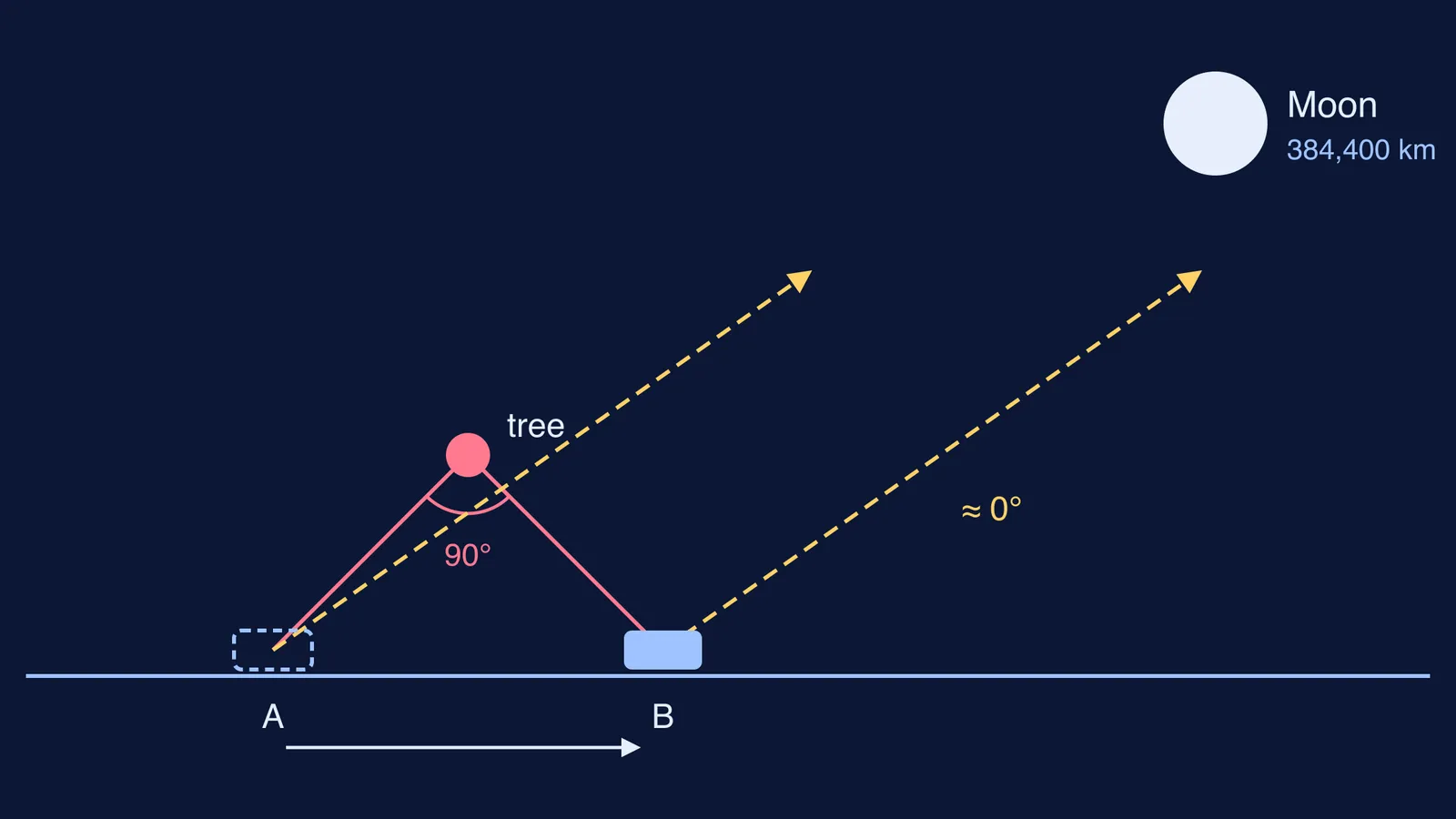
It doesn't. It just stays in almost the same direction because it is so far away. Parallax is "the apparent change in position of a nearby object caused by a change in the observer's point of view", as the Las Cumbres Observatory parallax activity defines it. The closer an object is, the more its direction changes when you move.
The Moon's mean distance from Earth is about 384,400 km, according to the NASA Moon fact sheet. As EarthSky's Deborah Byrd puts it, "Any distance you travel by car on Earth is very small in comparison."
A roadside tree swings from ahead of you to behind you in a couple of seconds; the Moon's direction hardly changes. Your brain expects things you pass to slide backwards, so an object that stays put seems to travel with you.
How much does the moon actually shift as you drive?
For small angles, the angle in radians is roughly the sideways distance you move divided by how far away the object is. If radians feel rusty, our post on radian measure and arc length covers the idea. Take a car at 60 km/h, which is about 16.7 metres every second, and use the 384,400 km Moon distance from the NASA fact sheet. Each figure assumes the object is off to your side, where its direction changes fastest.
A tree 20 m from the road, as you pass it: 16.7 / 20 = 0.83 radians per second, about 48 degrees every second. That is a blur.
The Moon: 16.7 / 384,400,000 = 0.000000043 radians per second, about 0.0000025 degrees every second.
The ratio is simply the ratio of distances: 384,400,000 m / 20 m, so the tree swings about 19 million times faster than the Moon.
Over a full hour (60 km): at most 60 / 384,400 = 0.00016 radians, about 0.009 degrees.
Now compare that with the Moon's size. NASA lists an equatorial radius of 1,738.1 km, so a diameter of about 3,476 km. Seen from 384,400 km, that diameter covers 3,476 / 384,400 = 0.009 radians, about 0.52 degrees. Your hour of driving moves the Moon by roughly one-sixtieth of its own width. To shift it by one full Moon-width, you would have to drive about 3,476 km sideways to it, the Moon's own diameter, on an imagined straight, flat road.
Does the moon move across the sky at all during the drive?
Yes, slowly, but not because of your car. Earth's spin carries the Moon across the sky through the night, just as it carries the Sun across the day. Everyone in your city sees that drift, driving or not. If you want to see how astronomers turned this same geometry into distances, read our story on Friedrich Bessel and the first star parallax.
How can you test parallax on your next car ride?
This is for passengers only. The driver keeps their eyes on the road.
Before you start, try the thumb test from the Las Cumbres activity: hold your thumb out, close one eye, then switch eyes. Your thumb jumps against the background. Bring it closer to your face and it jumps more.
In the car, rest your head against the headrest so your eye stays still relative to the window.
Line the Moon up with a fixed mark on the side window, such as a frame corner or a bit of tape.
Count to 30 and check the Moon against your mark. Repeat with a roadside pole and a distant hill.
Note what left the mark in under a second, what took a few seconds, and what barely moved.
You should find a ladder: near trees go first, hills next, and the Moon barely moves. You have ranked objects by distance using only angles, the same logic astronomers use. For a deeper look at how the shift turns into a measured distance, see measuring distance with a parallax simulation.
Want to see it without waiting for a night drive?
Parallax is easier to see than to read. The Fermi Simulation Lab has interactive simulations for ideas like this. If you get stuck on the radians step, Fermi's AI tutor notices where you are stuck and decides whether to explain, ask or show.
Next time someone in the back seat says the Moon is chasing the car, hand them the 19-million number and ask them to count to 30.