On this page
You pour milk into a plate, add a few drops of food colour, and touch the centre with a soapy cotton bud. The colours burst outward and keep swirling for a while. This kitchen trick, often called magic milk, lets you see two textbook ideas at once: surface tension and how soaps work.
What is surface tension, and how strong is it in water?
Surface tension is the force per unit length that pulls a liquid's surface tight, like a stretched sheet.
Pure water has a surface tension of 72.74 mN/m at 20 °C and 71.97 mN/m at 25 °C, according to the IAPWS release on the surface tension of ordinary water.
Milk is mostly water, but what is dissolved and floating in it changes that value. A 2014 study of buffalo milk found that skim milk had a higher surface tension than whole milk, and that surface tension rose as fat content fell (Awad, Hassan and Salama, International Journal of Dairy Science). Temperature matters too, as we explain in why surface tension falls as a liquid warms.
Why do food colours swirl in milk when soap is added?
Soap molecules are surfactants: one end is attracted to water and the other avoids it, so they crowd onto the surface. Where they land, surface tension drops sharply. In a 2019 lab study, solutions of the surfactant SDS above the critical micelle concentration started at about 37 mN/m (Iasella and colleagues, Journal of Colloid and Interface Science), roughly half the value for pure water.
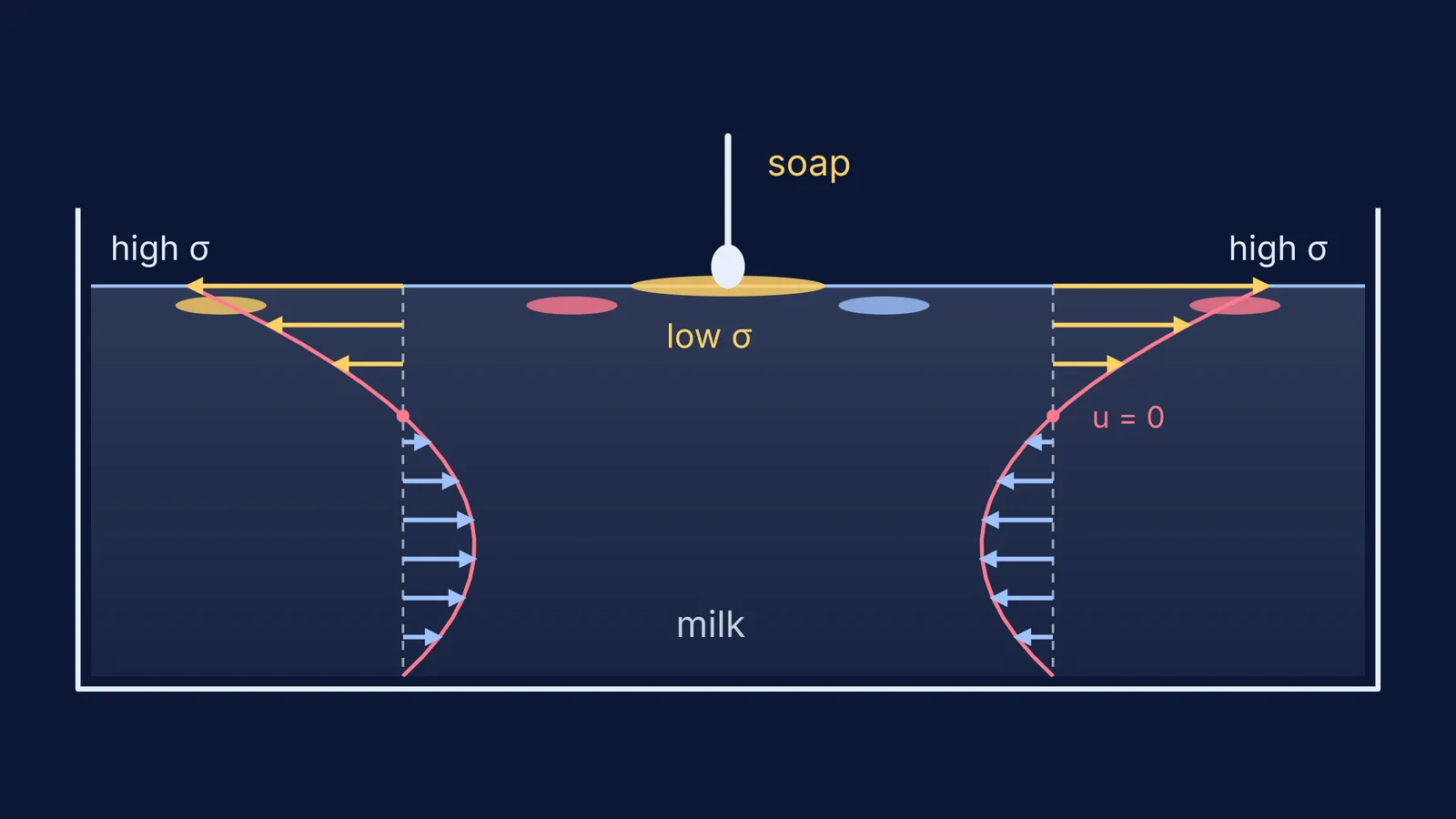
Now picture a tug-of-war on the surface. The soapy patch pulls weakly; the clean milk around it pulls strongly. The strong side wins, so the surface is dragged away from the soap, and the liquid just underneath goes with it. Flow driven by a difference in surface tension is called the Marangoni effect.
The same 2019 study shows this mechanism on thin layers of water: a drop of surfactant on one spot creates a surface tension gradient, which drives flow both at the surface and in the liquid below. Dye placed in the drop was carried about 6 cm across the surface, and the spreading front neared the rim of the 7 cm-radius dish within the first 233 milliseconds.
The food colour does not react with anything. It is a tracer that shows you where the liquid is going.
Where does the fat in milk come in?
A soap molecule has a water-loving head and a long oily tail. The tails tuck into fat droplets, and soap molecules cluster into micelles; a teaching activity from Carleton College's Science Education Resource Center describes these micelles spreading the fat through the milk (SERC MnSTEP activity). Soap lifts grease the same way, as our guide to soaps and micelles for Class 10 explains.
One common explanation is that as soap is pulled into fat droplets, it leaves some parts of the surface sooner than others, so uneven patches keep forming and new currents can start. You can test whether fat really makes the show last longer.
Why does it stop? Once soap has spread over the whole surface, there is no weak-versus-strong difference left, and without a gradient the flow dies down.
How can you test it like a scientist?
A fair test changes one thing at a time. Here is a plan:
Pour the same depth of liquid, about 1 cm, into four identical plates: full-cream milk, toned milk, skimmed milk and plain water. Let them reach room temperature.
Add four drops of food colour near the centre of each, in the same pattern.
Dip a fresh cotton bud in the same dish soap and touch the centre of each plate for two seconds.
Time how long visible movement lasts, and note how far the colour travels in the first five seconds.
Repeat three times and average your results.
Write your prediction first. Every plate should burst outward at the start, because each has a surface tension gap. If fat helps keep currents going, the full-cream plate should swirl longest and plain water should settle quickest.
For a second experiment, compare warm and cold milk. The IAPWS table shows water's surface tension falling from 74.23 mN/m at 10 °C to 69.59 mN/m at 40 °C, so a warmer liquid starts with a slightly weaker surface. Predict, then check, whether the colours move differently.
Soap's knack for weakening a water surface also explains why a floating needle sinks when soap is added.
How do you picture flow you cannot see?
The hard part is below the surface. The top layer races outward, but in a closed plate the liquid must come back, so deeper down it flows inward, as the diagram above shows. Ideas like this are easier to see than to read, which is what the Fermi Simulation Lab is built around: interactive simulations you can explore.
Next time the colours bloom, you will know what you are watching: a tug-of-war on the surface, and the soap just lost.