On this page
Many households in India have a story about the patila of milk that rose over the edge the moment someone looked away. A pan of water on the same flame just bubbles and steams. The difference: milk builds a lid on itself, and water does not.
What happens when you heat water?
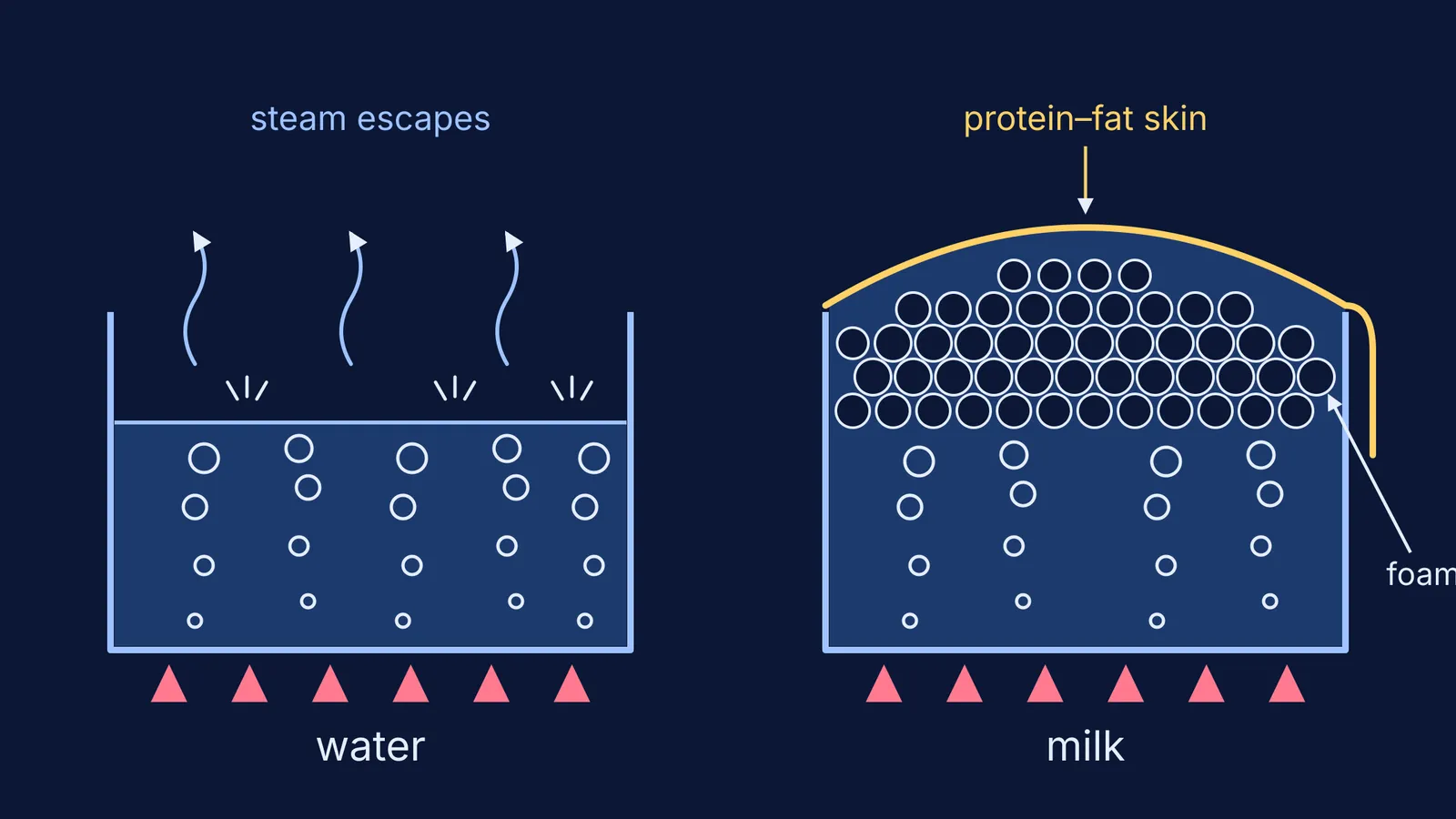
The water at the hot bottom of the pan turns to vapour first and forms steam bubbles, which rise because they are far less dense than the liquid. At the surface nothing holds them: the thin water wall breaks almost at once and the steam escapes. So boiling water churns, but its level stays roughly where it was, because bubbles leave as fast as they arrive. (The tiny bubbles you see long before boiling are something else, explained in why small bubbles appear in water before it boils.)
Why does milk form a skin when heated?
Milk is mostly water with proteins, fat and sugar in it. According to the FAO's page on milk composition, cow milk contains about 3.5 percent protein, about 5 percent lactose, and fat that varies by breed and can reach 5.5 percent in Bos indicus (zebu) cattle.
Some of those proteins, the whey proteins, are sensitive to heat. A 2022 paper in the journal Foods by Čurlej and colleagues notes that whey proteins start to denature above about 62 °C for alpha-lactalbumin and about 75 °C for beta-lactoglobulin, while casein is relatively heat-stable (Čurlej et al., 2022). Denaturing means the folded protein chains open up, which lets them stick to each other and to fat.
Evaporation at the surface also helps concentrate these proteins where milk meets air. The result is the skin, or malai. A study of milk skin in the journal Soft Matter describes it as a micron-thick hydrogel of denatured proteins and fat globules that forms at the air-water interface (Evans, Cheung, Nyberg and Rowat, 2017). We look at the cooking side of this in why a layer of malai forms on boiled milk.
Why does milk boil over but water does not?
Steam bubbles rise in milk just as in water, but at the top they meet a film that does not tear easily. America's Test Kitchen explains that steam bubbles rising from the bottom are forced through the protein-rich layer at the top, and the proteins stabilise the bubbles so they keep multiplying instead of bursting (America's Test Kitchen).
Each new bubble adds volume under the skin. The trapped steam becomes foam, the foam lifts the skin, and the level climbs fast. That is why milk seems calm one second and over the rim the next.
Fat is part of the skin, but it is not what makes the foam last. A review of milk foaming in the International Journal of Dairy Technology found that skim milk foams can be extremely stable, and that lipids can weaken milk foams rather than strengthen them (Huppertz, 2010). That review studied foams below boiling, but it fits why toned or skimmed milk still boils over: the proteins do the work.
How do you stop milk from boiling over?
Every fix works by doing one of three things: making fewer bubbles, breaking the film, or giving the foam room.
Give the foam room. America's Test Kitchen found that a spoon in the pot or butter on the rim only delayed boil-over, and recommends a big, wide pan instead: a 4-quart saucepan (about 3.8 litres) for a pint of milk (about half a litre) (America's Test Kitchen).
Make fewer bubbles. Turn the flame down as the milk nears boiling. Less heat means steam forms more slowly, so the foam has time to break.
Break the film. Stirring disturbs the skin before it becomes a strong lid, so trapped bubbles can escape.
A kitchen experiment you can run
Test the explanation with an adult nearby. Hot milk foam can scald, so keep your hands and face away from the pan.
Heat the same volume of water and milk in two identical small pans on the same flame setting.
Note when the first bubbles appear and whether a skin forms on each.
Repeat the milk in a much wider pan. Prediction: the foam spreads out and is less likely to reach the rim.
Repeat once more, stirring gently. Prediction: the foam rises later or not at all.
Write one sentence per pan explaining what you saw using three words: vapour, film, foam.
For an exam answer, use three steps: heat denatures milk proteins, which form a surface film with fat; steam bubbles are trapped under it as foam; the foam lifts the film over the rim, while water has no film, so its bubbles burst freely.
The Fermi Simulation Lab has interactive simulations for the ideas that are easier to see than to read.
Next time the milk starts to climb, turn the flame down, and you will know exactly which bubbles you are stopping.