

On this page
Why does a layer of malai form on boiled milk?
The formation of milk skin, or malai, is a masterclass in everyday chemistry, driven by heat, evaporation, and the unique properties of milk proteins. Milk is not a simple liquid; it is a complex emulsion containing about 87% water, along with suspended fat globules, sugars, and proteins.
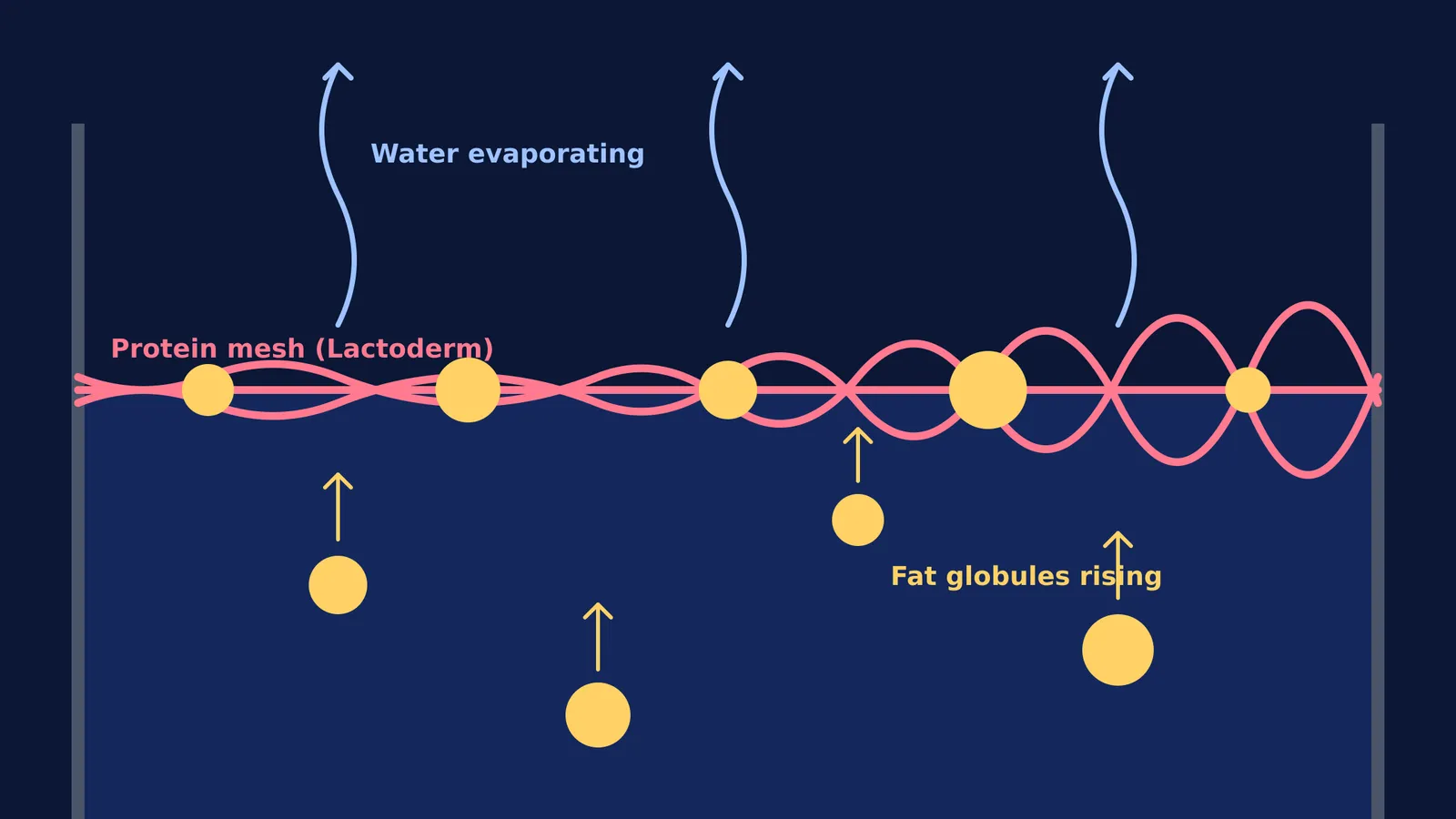
When you heat a pan of milk on the stove, two things happen simultaneously at the surface. First, the water molecules that are in direct contact with the air begin to evaporate rapidly. This evaporation leaves behind a highly concentrated zone of non-volatile components—primarily fats and proteins—at the very top of the liquid.
Second, the heat changes the structure of the milk proteins. The key player in this process is beta-lactoglobulin, the most abundant whey protein in cow's milk. According to the mechanics of milk skin, beta-lactoglobulin begins to denature, or unfold from its natural shape, when the temperature reaches approximately 70°C. As these proteins unspool, they expose hidden, sticky parts of their structure.
How do proteins and fat tangle together?
Once the beta-lactoglobulin molecules unfold, they do not just float harmlessly. They begin to bond with each other and with other proteins, such as casein, in a process called coagulation. They form a vast, interconnected mesh across the surface of the milk.
This protein net acts like a trap. As the milk heats up, lighter fat globules naturally rise toward the surface. When they hit the top, they become entangled in the sticky protein mesh. The combination of concentrated, denatured proteins and trapped fat creates a semi-solid, rubbery film. This structure is why whole milk forms a thick, rich malai, while skim milk—which lacks the fat to give the skin structure—forms a much thinner, fragile layer.
When studying physical chemistry, picturing how molecules bump, unfold, and link together is half the battle. The Fermi Simulation Lab provides interactive simulations for the ideas that are easier to see than to read. You can watch how temperature changes molecular movement and protein structures, just like the biological concepts covered in Protein structure from primary to quaternary, with worked numbers.
Why does boiling milk spill over?
The formation of malai is also the reason why boiling milk is so notoriously difficult to manage. Once the lactoderm layer forms, it acts as a physical lid on top of the pot. It is surprisingly tough and relatively impermeable.
As the milk at the bottom of the pan reaches its boiling point, it turns into steam. In a pot of boiling water, these steam bubbles simply rise to the surface and pop, releasing the pressure into the air. However, in a pot of milk, the steam bubbles rise and hit the rubbery ceiling of the milk skin. The steam cannot escape, so the pressure continues to build underneath the malai. Eventually, the pressure becomes so great that it lifts the entire layer of skin upward, bringing a wave of boiling milk with it and causing a sudden spill over the sides of the pan.
Understanding this process requires a grasp of how liquids change into gases and the forces involved, a topic explored deeply in Matter in our surroundings: states, evaporation and latent heat.
A simple checklist to prevent malai formation
If you want a cup of hot milk without the skin, you have to disrupt the chemistry that builds the lactoderm. You can achieve this by either breaking the protein network or stopping the surface evaporation.
Here is a practical checklist of methods to stop the skin from forming:
Stir constantly: Keeping the milk in motion breaks up the protein bonds before they can form a solid sheet, and it keeps the temperature even throughout the pan.
Cover the pot: Using a lid traps the steam. This raises the humidity right above the milk, significantly slowing down surface evaporation and preventing the proteins from concentrating.
Whip up some foam: If you froth the surface of the milk, you introduce hundreds of tiny air bubbles. This foam disrupts the flat air-liquid boundary, making it impossible for a continuous, solid film to form.
Whether you enjoy eating the malai or prefer to scrape it away, the skin on your milk is a perfect example of chemistry happening right in your kitchen. It is a daily demonstration of evaporation, protein denaturation, and the physical forces of fluids, much like the capillary action and viscosity discussed in Surface tension and viscosity: capillary rise to terminal velocity.


