On this page
Fly a plain diamond kite on a breezy afternoon and it may loop and crash. Tie ribbon to its bottom corner and the same kite often sits calmly in the sky. What changed is where the drag acts, and that is a torque problem from Class 11 physics.
What does a kite's tail actually do?
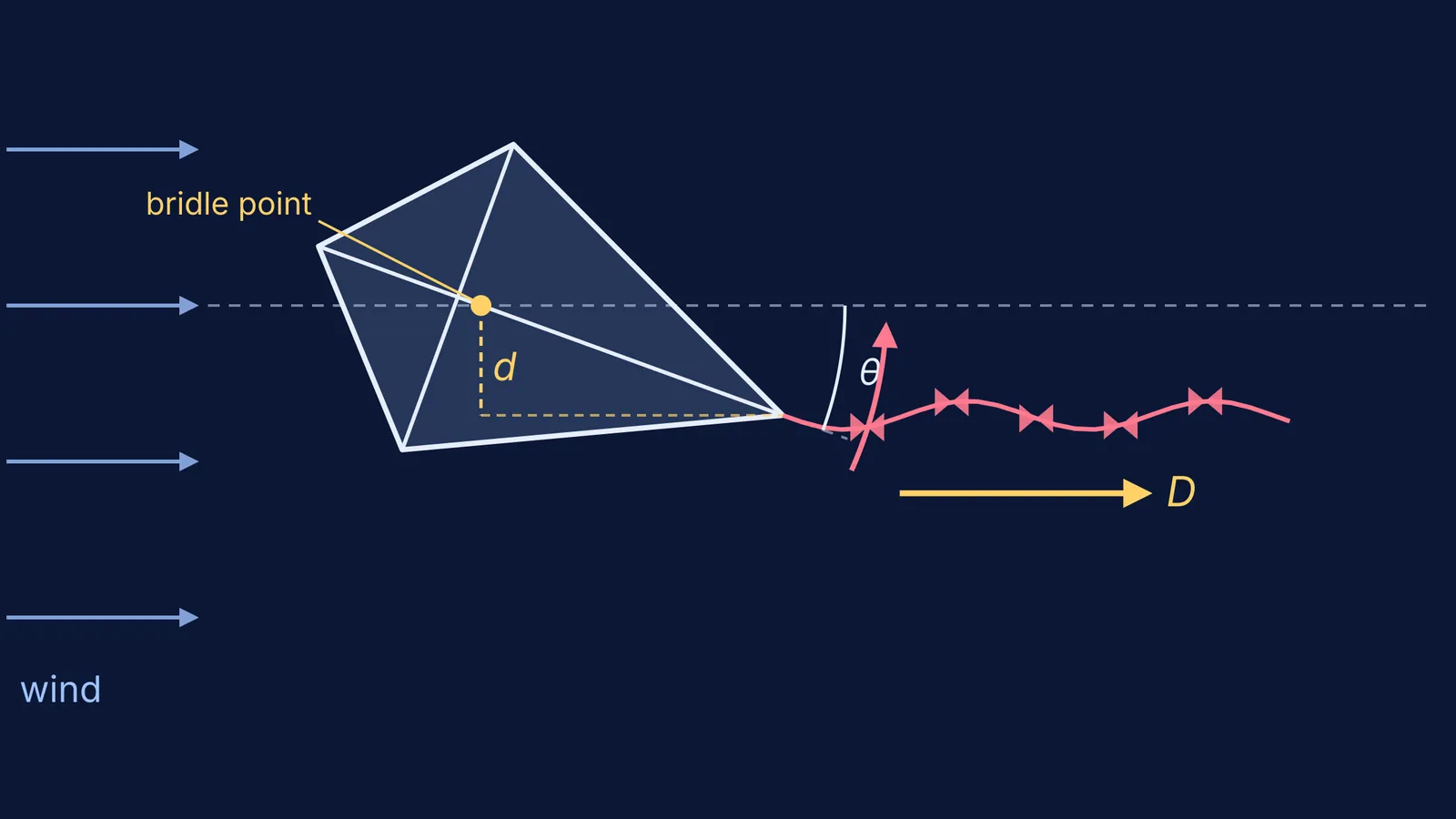
A kite in the air does not rotate about its middle. NASA's Glenn Research Center explains that the kite rotates about the bridle point, the knot where the flying line joins the bridle strings.
Drag is the resistance force of the air on the kite, and NASA notes that it always points in the direction of the wind (NASA, forces on a kite).
A tail adds drag a long way behind that pivot. A kite-flying guide from KiteSoar puts it simply: the tail adds drag behind and below the kite, like a weather vane's fin, and that drag makes it harder for the kite to rotate quickly.
Why does drag at the back stop a kite spinning?
In the diagram above, wind blows left to right and a gust has turned the kite's spine by an angle θ. The tail still streams downwind, and its drag D pulls that way. Here is the worked example.
Take moments about the bridle point, because that is the pivot.
The tail is attached a distance L behind the pivot, along the spine.
The drag acts parallel to the wind, so its lever arm is the perpendicular distance d = L sin θ.
The torque is τ = D × L sin θ, and it turns the tail back towards the wind line, which swings the nose back into the wind.
At θ = 20°, sin θ is about 0.34, so the lever arm is about a third of L. At θ = 0 the lever arm is zero, so once the kite points into the wind the tail stops turning it.
The further the kite strays, the larger the restoring torque. NASA uses the same test when it explains a kite's balance about the bridle point: a stable design is one where any change away from the balance point creates a torque that automatically returns the kite to balance (NASA, kite balance and stability).
Put the same drag in front of the pivot and the torque pushes the nose further from the wind, so every wobble grows into a spin.
Arrows use the same trick, which we explain in why arrows have feathers at the back.
Where do centre of mass and balance come in?
A tail has weight as well as drag. NASA treats a kite's weight as acting at a single point, the centre of gravity (NASA, forces on a kite). Adding a tail at the bottom moves that point down and back.
NASA's free KiteModeler program states that the length of the tail affects stability and trim by shifting the centre of gravity (NASA KiteModeler).
If you mix up centre of gravity and centre of mass, our explainer on centre of gravity vs centre of mass sorts that out.
More tail is not always better. KiteSoar warns that in light wind too much tail can stop a kite from climbing, and that the goal is enough stability with the least unnecessary drag.
Why do Indian patang kites fly without a tail?
If tails are so useful, why does the patang you fly on Makar Sankranti usually go without one? Because a fighter kite is meant to be unstable.
Most traditional fighter kites are small, unstable flat kites controlled by line tension alone, and in India they are called patang (Wikipedia, fighter kite). When the flyer lets out line, the kite starts to rock from side to side, or in extreme cases spin; when the flyer pulls the line taut again at the right moment, it moves in the direction the flyer wants. A tail would damp out exactly the turning the flyer relies on.
For how the kite stays up in the first place, read how a kite flies on Makar Sankranti.
How do you fix a kite that keeps spinning?
Treat it as an experiment. This plan follows the advice in the KiteSoar tail guide.
Fly the kite with no tail and note what it does: spins, darts or holds steady.
If it spins or darts, add tail length or use a tail with more drag, such as ribbon with bows.
If it struggles to climb, remove some tail or use a lighter material.
Change the tail in small steps and keep everything else, including the bridle, the same.
Before each flight, write a prediction using τ = D × L sin θ, then check it.
Torque is easier to feel when you can move the pivot and the force yourself. The Fermi Simulation Lab has interactive simulations for ideas that are easier to see than to read, and the Fermi Concept Library gives every physics concept, including torque and centre of mass, its own lesson.