

On this page
Most of us learned one tidy answer at school: the skate blade presses so hard that the ice melts, and the skater glides on water. It is a neat story, and it is mostly wrong. Physicists point to three effects, and pressure is the weakest of them. The same physics applies on a mall skating rink in Gurugram and a frozen pond in Ladakh.
Is ice slippery because pressure melts it?
Pressure does lower the melting point of ice, because ice takes up more space than the water it melts into. The idea that this explains skating goes back to James Thomson in 1849 and John Joly in 1886, as the Wikipedia article on premelting records.
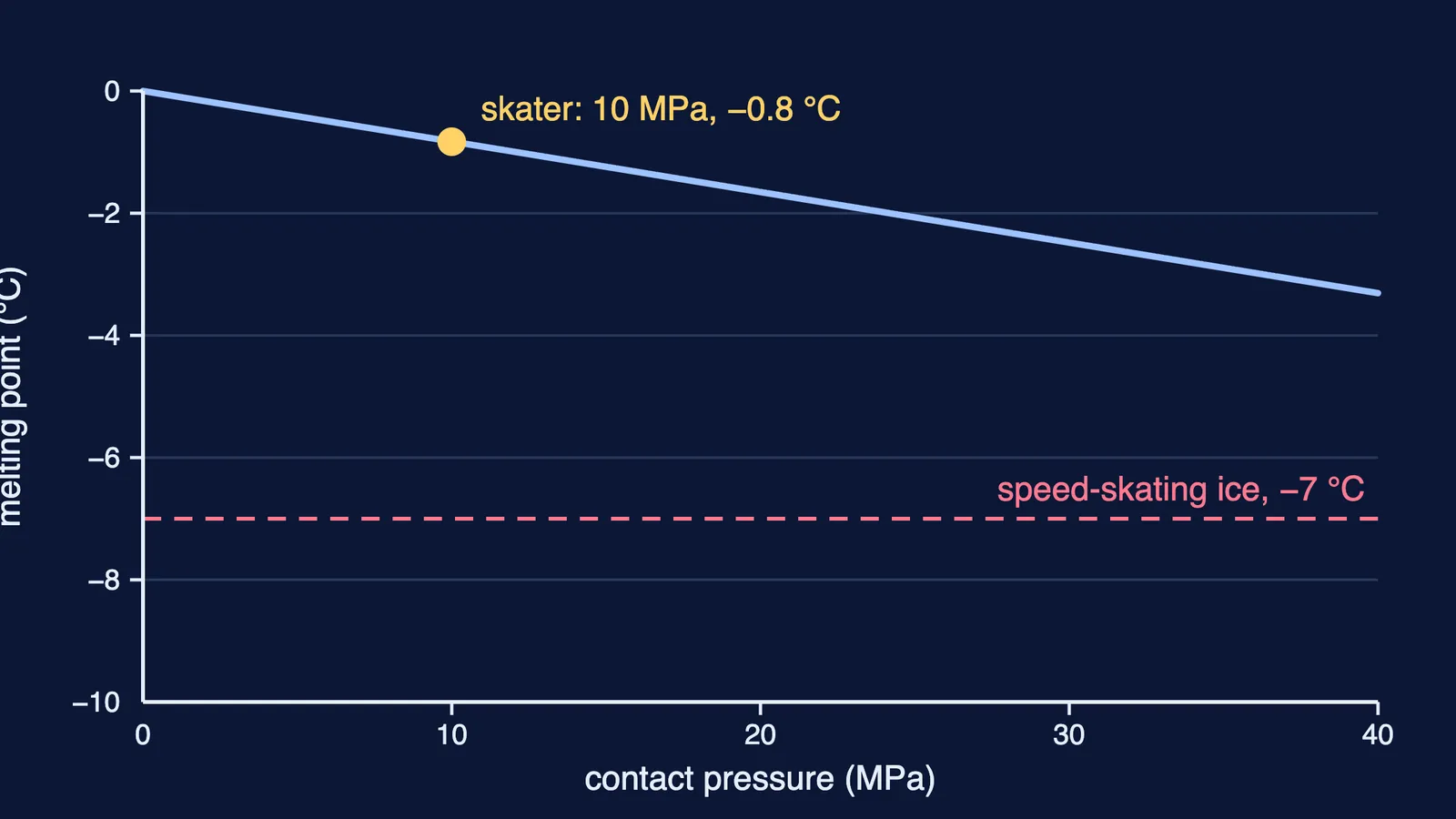
The trouble is the size of the effect. Physicist Joe Wolfe's UNSW Physclips estimate takes a skater weighing about 1 kN on a blade contact of about 100 mm², which gives a pressure of 10 MPa, or about 100 atmospheres. By the same page's working, that pressure lowers the melting point of ice by only about 1 °C.
If that were the whole story, skating would work only a degree or so below freezing, yet as the same page notes, people skate on much colder ice. At −20 °C, melting ice by pressure alone would take more than 100 MPa, according to the premelting article. Pressure melting is real, but it cannot carry the explanation.
Does friction heat melt the ice?
In 1939 Frank Bowden and T. P. Hughes at Cambridge set out to measure what was going on. Their paper, The mechanism of sliding on ice and snow, noted that a thin surface layer could be melted "either by pressure melting or by frictional heating". It also noted that few measurements had been made to support or disprove the pressure story.
The view that grew from that work is summed up in a 2018 phys.org report: the water under a moving slider is "not melted by pressure but by frictional heat produced during sliding".
That water film is thinner and stranger than you might picture. L. Canale, L. Bocquet and colleagues measured it under a millimetre-sized glass bead sliding on ice and found it was only hundreds of nanometres thick, with a viscosity up to 100 times that of ordinary water (Physical Review X, 2019).
What is the liquid-like layer on ice?
Even with nothing sliding on it, the surface of ice is not quite solid. In 1859 Michael Faraday proposed that a thin film of liquid covers ice even well below freezing, as Robert Rosenberg describes in Why is ice slippery? in Physics Today.
Premelting is a quasi-liquid film on the surface of a solid below its melting point, and its thickness depends on temperature (Wikipedia).
In 2018, Bart Weber, Yuki Nagata, Daniel Bonn and colleagues measured steel sliding on ice from −100 °C up to 0 °C. Friction was very high at −100 °C and fell steeply as the ice warmed (Journal of Physical Chemistry Letters). Their computer simulations showed weakly bonded water molecules rolling over the surface, with more of them, moving faster, as the temperature rose. The team concluded that these mobile surface molecules, rather than a thin layer of liquid water, make ice slippery (phys.org).
Why is ice most slippery at about −7 °C?
In the same experiments, friction was lowest at about −7 °C, the temperature used at speed-skating rinks (phys.org). Warmer than that, the ice turns softer and the slider digs in, so friction rises again.
How can you check the pressure-melting claim yourself?
You can redo the estimate with the Clausius-Clapeyron equation, dT/dP = TΔv/L, using the values on the UNSW Physclips page.
Pressure: a weight of 1 kN on 100 mm² (10⁻⁴ m²) gives 10⁷ Pa, which is 10 MPa.
Slope: T = 273 K, Δv ≈ 10⁻⁴ m³/kg (water is denser than ice) and L = 330 kJ/kg give dT/dP ≈ 8.3 × 10⁻⁸ K per pascal.
Multiply: 10⁷ Pa × 8.3 × 10⁻⁸ K/Pa ≈ 0.8 K. That is the "about 1 °C".
Reverse it: to reach −7 °C you need roughly 85 MPa, so about eight times the pressure, or a blade contact eight times smaller.
Use the same three questions on any explanation in a textbook:
Is the effect big enough? Put in real numbers.
Does it work at every temperature where you see the effect?
Could another mechanism explain the same observation?
Ice can also do the opposite and grip you, as in why ice sticks to wet fingers. For the friction laws behind all of this, read about Coulomb's laws of friction and whether a coefficient of friction can be greater than one.
If the Clausius-Clapeyron step feels shaky, the Fermi Concept Library has a lesson for every concept in physics and chemistry. Fermi's AI tutor works through problems alongside you and decides whether to explain, ask or show, so you can do an estimate like this one step by step.


