On this page
When a goalkeeper dives to catch a fast-moving soccer ball, they rely on a delicate balance of classical mechanics and material science. Modern goalkeeper gloves are not just thick fabric; they are highly engineered tools designed to manage friction and change momentum safely.
Why are goalkeeper gloves made of latex?
The primary job of a goalkeeper glove is to maximise grip. In physics terms, this means increasing the coefficient of static friction between the hands and the ball's synthetic leather casing. Static friction is the force that resists the initiation of sliding motion; a higher coefficient means the goalkeeper can hold onto the ball without it slipping through their fingers.
Latex is uniquely suited for this task because it is a soft, porous foam. Unlike rigid rubber or synthetic plastics, latex undergoes significant micro-deformation upon impact. It squashes and moulds itself into the microscopic texture of the ball. This deformation increases the actual contact area, allowing for mechanical interlocking and creating stronger temporary bonds between the surfaces, thereby providing exceptional grip.
How does latex reduce the force of a shot?
According to Real World Physics Problems, a powerful shot in professional soccer can reach speeds of 30 m/s (about 108 km/h). Under the official FIFA Laws of the Game, a size 5 soccer ball has a mass of up to 0.45 kg). Stopping this ball completely requires a substantial change in momentum of 13.5 kg m/s.
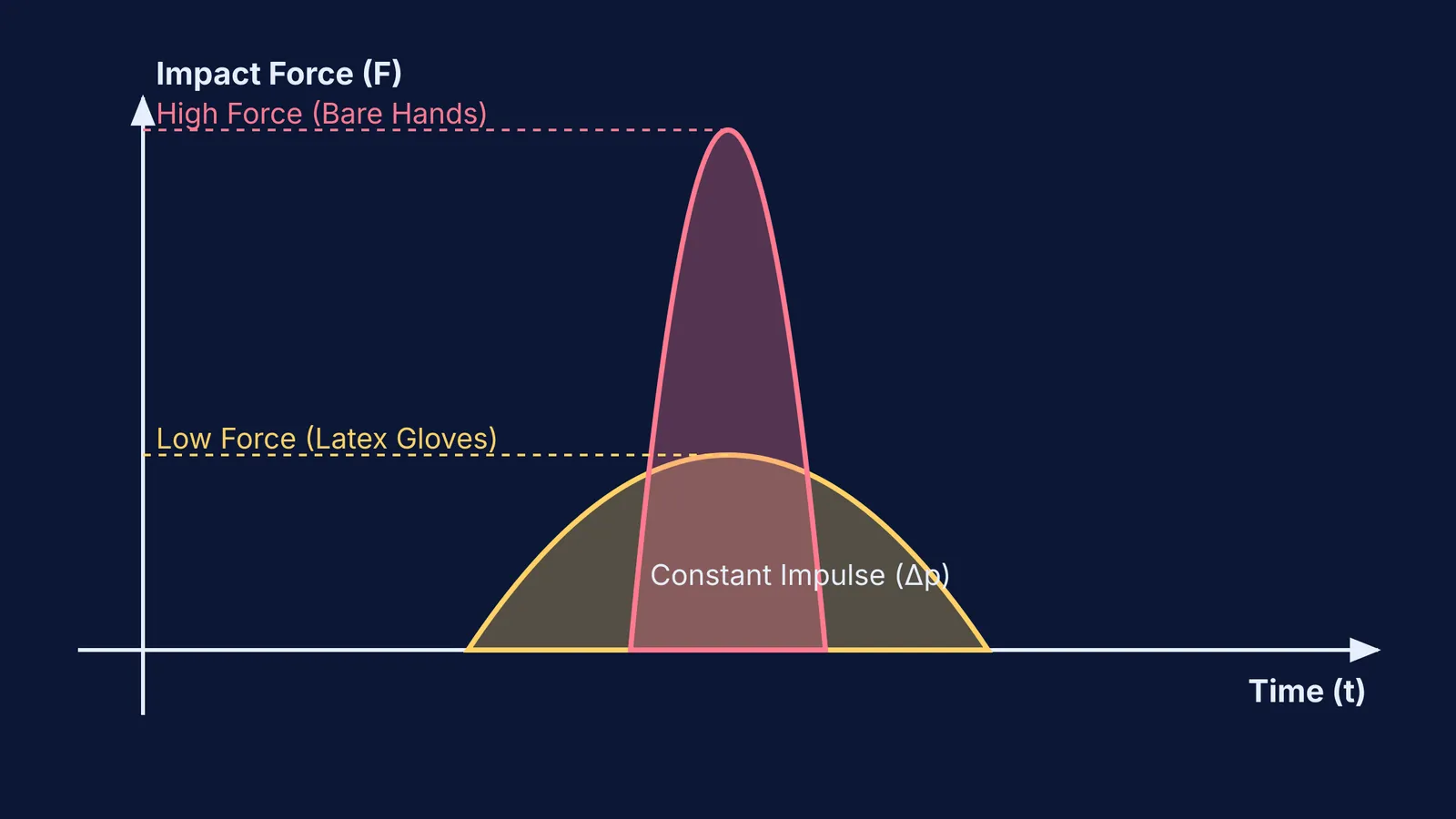
The physics of stopping the ball is governed by the impulse-momentum theorem (F × Δt = Δp). Because the change in momentum (Δp) is fixed by the ball's mass and incoming speed, the average force (F) applied to the goalkeeper's hands depends entirely on the time (Δt) it takes to bring the ball to a halt.
If a goalkeeper catches the ball with rigid hands, stopping it abruptly in just 0.01 seconds, the average force is a bone-jarring 1,350 Newtons. However, modern gloves feature a layer of latex bonded to a backing foam. This foam structure acts like a crumple zone in a car. By compressing upon impact, the latex extends the collision time by a few vital milliseconds. Even a small increase in this impact time lowers the peak force substantially, which is also why goalkeepers instinctively pull their arms back as they catch the ball.
Why does the grip wear out so quickly?
There is a catch to using extremely soft latex: an unavoidable engineering trade-off between grip and durability. The softer and more porous the foam is, the faster it wears down and tears when it scrapes against artificial turf, hard ground, or even the ball itself.
To keep the foam from becoming brittle and losing its adhesive properties, goalkeepers often keep their gloves slightly damp during a match. A tiny amount of moisture keeps the latex supple and maintains the micro-deformation that provides grip. It also clears away dust that might clog the pores. However, too much water will cause the ball to hydroplane, reducing friction drastically as a layer of liquid separates the glove from the ball. This phenomenon is similar to how a thin film of water affects a car's tires on a wet road, which is also why polarised sunglasses cut glare from roads and water.
Practising the physics of collisions
If you are studying for physics exams, impulse and momentum are everywhere in daily life.
Connecting the impulse-momentum theorem to sports makes the abstract concept stick in your memory. Next time you encounter a problem about force and time, draw a quick graph. As seen in the hero diagram, a wider time base means a lower peak force for the same total area (the impulse). This is a critical principle for answering assertion-reason questions accurately.
If you find these concepts hard to picture, try the Fermi Simulation Lab. You can test how different surfaces, masses, and impact times change the forces in a collision before you try the mathematical formulas. You can also explore the difference between elastic vs inelastic collisions in a simulation.
If you get stuck on the maths, the Fermi Problem Library will walk you through the reasoning step by step, rather than just giving you the final answer. You might even realise why a bulb glows instantly if drift velocity is so small relies on the same kind of hidden physical interactions you find in sports and everyday physics.