On this page
A magnet on the fridge door will hold a shopping list for years. Put the same magnet on a steel dabba and it slides straight off. Both are steel. The difference is not how much iron the metal contains but how its atoms are stacked.
Why does a magnet stick to the fridge door?
Refrigerator doors and side panels are mostly made from pre-painted steel sheet, according to the Indian coil-coating maker Manaksia Coated Metals. Even on fridges with a stainless-steel front, the sides are usually standard painted magnetic steel.
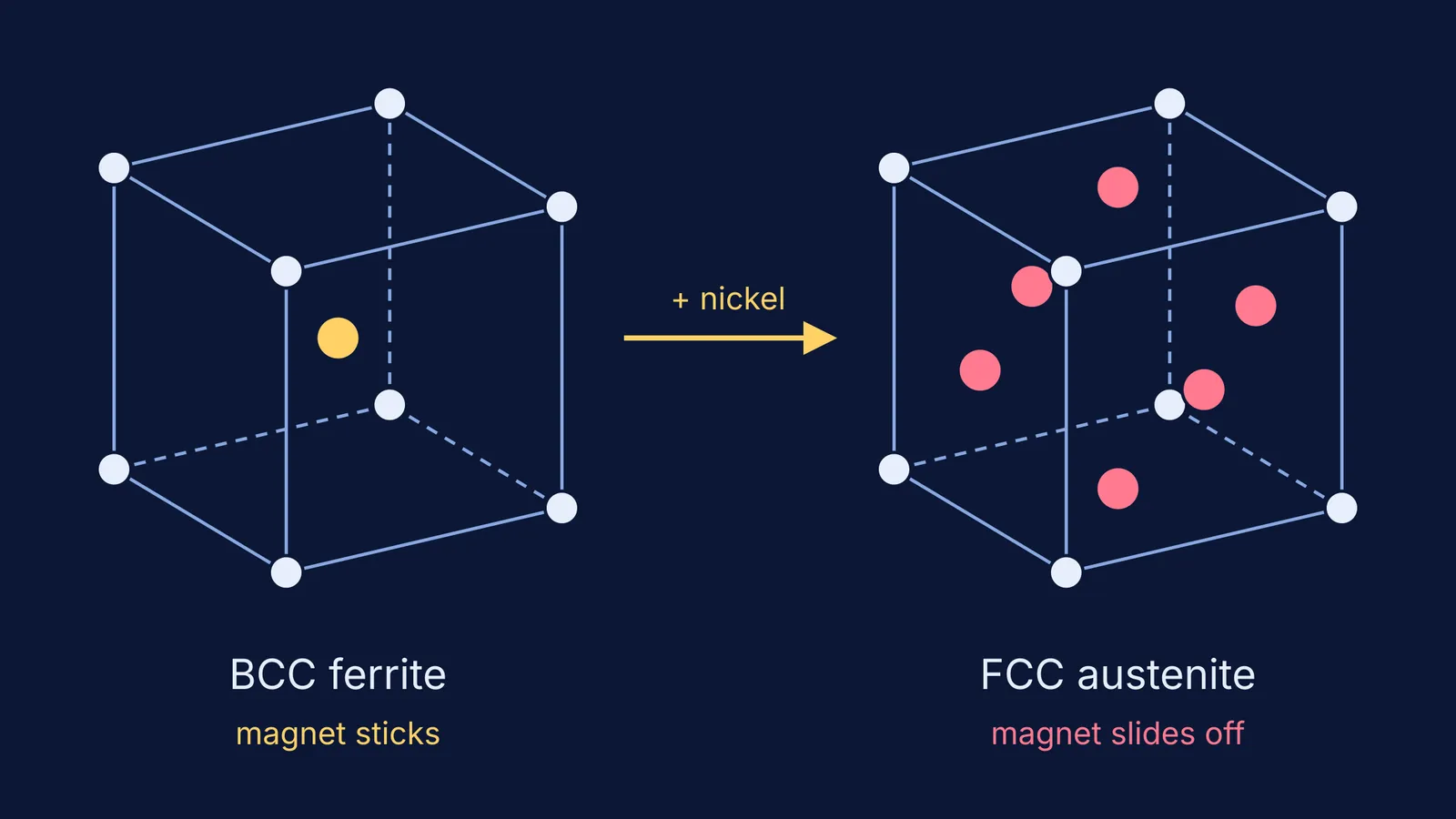
Ordinary steel is mostly iron in its alpha form. Below 912 °C iron has a body-centred cubic (BCC) crystal structure, and below its Curie temperature of 771 °C it is ferromagnetic (allotropes of iron). Ferromagnetic means tiny regions called domains line up with a nearby magnet's field, so the steel briefly becomes a magnet and pulls back.
A flexible fridge magnet is usually barium ferrite in a plastic binder, magnetised in strips of alternating poles about 5 mm apart, which almost doubles the field on the fridge side (refrigerator magnet). That field reaches only a short way, so it needs strongly magnetic steel right underneath.
Why don't magnets stick to stainless steel utensils?
Austenitic grades such as 304 and 316 are the stainless steels most commonly used in kitchen utensils and sinks. Their higher proportion of nickel creates a crystal structure in which the magnetic domains cannot align, making them practically non-magnetic, explains the Spanish stainless-steel association Cedinox.
That structure, austenite, is face-centred cubic (FCC): an atom at every corner of the cube and one in the centre of every face. The welding institute TWI states that FCC austenite is paramagnetic, in practice non-magnetic, while BCC ferrite is ferromagnetic, like mild steel.
Ferritic stainless steels have a magnetic permeability of around 700 to 1,000 or more, while austenitic steels sit close to 1, behaving almost like air (Cedinox). Fully annealed austenitic grades measure 1.003 to 1.005, according to the steelmaker Carpenter Technology.
Why do some steel spoons and pots stick to a magnet?
Not all stainless steel is austenitic. From the Cedinox technical sheet, there are three common reasons a kitchen item pulls on a magnet:
Ferritic grades. Ferritic and martensitic stainless steels are magnetic and are often used for cutlery and household appliances.
Induction bases. An induction hob needs magnetic steel to generate heat, so many utensils combine austenitic layers with a magnetic base.
Bent or pressed parts. Cold work such as bending or stamping turns part of the austenite into martensite, which is magnetic. Grade 304 becomes weakly ferromagnetic when heavily cold-worked (Carpenter Technology).
More nickel makes austenite more stable and harder to turn magnetic after processing (Cedinox). Grades with significantly more than 12% nickel, such as type 310, have a stable, fully austenitic structure and do not show the magnetism found in ordinary 300-series welds (TWI).
How can you test your own pots with a magnet?
Use a small, strong magnet if you have one. Before each step, write down your prediction and why, then test and explain any surprise.
Fridge door, front and side. Painted steel grips firmly. If the side holds but a stainless front does not, the front is probably austenitic.
Body of a steel tumbler or dabba. If the magnet slides off, the steel is most likely austenitic, FCC.
Rim or a sharp bend on the same vessel. A faint pull there may mean cold work has made some martensite.
Underside of an induction-ready pan. The magnetic base layer grips.
An iron tawa or kadhai. A strong grip: BCC iron.
A handful of spoons. Sort them into stick and no-stick piles; you may own both kinds.
A note for parents buying utensils: the test shows structure, not quality. Cedinox calls magnetism a design tool, far from being a quality indicator.
Where does this come up in physics and chemistry?
In physics, this is the difference between ferromagnetic and paramagnetic materials, and the Curie temperature of 771 °C for iron (allotropes of iron) is where one becomes the other. In chemistry, BCC and FCC are the cubic unit cells whose atoms you count in the solid state. Our list of magnetic and non-magnetic materials sorts everyday objects, and dia-, para- and ferromagnetism with hysteresis loops goes deeper. For your iron cookware, see whether cooking in an iron kadhai adds iron to food.
Unit cells and domains are hard to picture from a flat figure. The Fermi Simulation Lab has interactive simulations for ideas that are easier to see than to read, and the Fermi Concept Library gives each concept its own lesson and its place in the map.
Tonight, take a magnet round the kitchen and find out which side of the BCC and FCC line each vessel falls on.