On this page
Look up at an electric pole and you will see the wire is not tied straight to it. It sits on a ribbed white or glassy cup. That cup is an insulator, and it answers a basic electricity question: what stops current going where you don't want it?
What are the white cups on electric poles?
They are electrical insulators. Wikipedia's article on insulators) states that insulators for high-voltage power lines are made from glass, porcelain or composite polymer materials.
The white ones are porcelain: made from clay, quartz or alumina and feldspar, and covered with a smooth glaze to shed water, according to the same article.
The wire is live; the pole leads to the ground. The insulator holds the wire up while keeping the two electrically apart. A wooden pole cannot do this on its own: the resistivity article on Wikipedia notes that damp wood is a far worse insulator than oven-dry wood, and a pole in the monsoon is not oven-dry.
Why can't current flow through porcelain or glass?
Conductors such as copper have electrons free to move. Insulators such as glass hold theirs tightly, so a voltage moves almost no charge. For the deeper reason, our post on energy bands in conductors, semiconductors and insulators explains it with band gaps.
Wikipedia's resistivity table gives copper 1.68 × 10^-8 ohm-metres and glass 10^11 to 10^15 ohm-metres at 20 °C. Even at the low end, glass resists current about 6 × 10^18 times more than copper.
How much current leaks through a dry glass insulator?
Use R = ρL/A and take the worst case for glass from Wikipedia's resistivity table.
Resistivity: ρ = 10^11 ohm-metres (the lowest value given for glass).
Path through the glass: L = 0.2 m. Cross-section: A = 0.005 m², roughly a solid cylinder 8 cm across. These are round numbers we chose for the exercise.
Resistance: R = 10^11 × 0.2 ÷ 0.005 = 4 × 10^12 ohms.
Take a line at 11,000 volts and, to be generous, put the whole 11 kV across the insulator: I = V ÷ R = 11,000 ÷ (4 × 10^12) ≈ 3 × 10^-9 A, about 3 nanoamperes.
Compare copper of the same shape: R = 1.68 × 10^-8 × 0.2 ÷ 0.005 ≈ 7 × 10^-7 ohms. That is effectively a short circuit.
A clean, dry insulator lets almost nothing through its body.
Why do insulators have ridges like stacked cups?
The weak spot is the surface. Dust, salt and smoke settle on an insulator, and when they get wet they form a thin conducting film. Wikipedia) notes that the flashover voltage, at which a spark jumps across, can fall by more than 50% when an insulator is wet.
In a 2021 fog-chamber experiment published in Frontiers in Energy Research, Chunhua Fang and colleagues coated porcelain insulators with artificial pollution; at each of the three pollution levels tested, leakage current along the surface rose above 700 mA before flashover. The set-up differs from ours, but that is hundreds of millions of times our 3 nA estimate for the dry body.
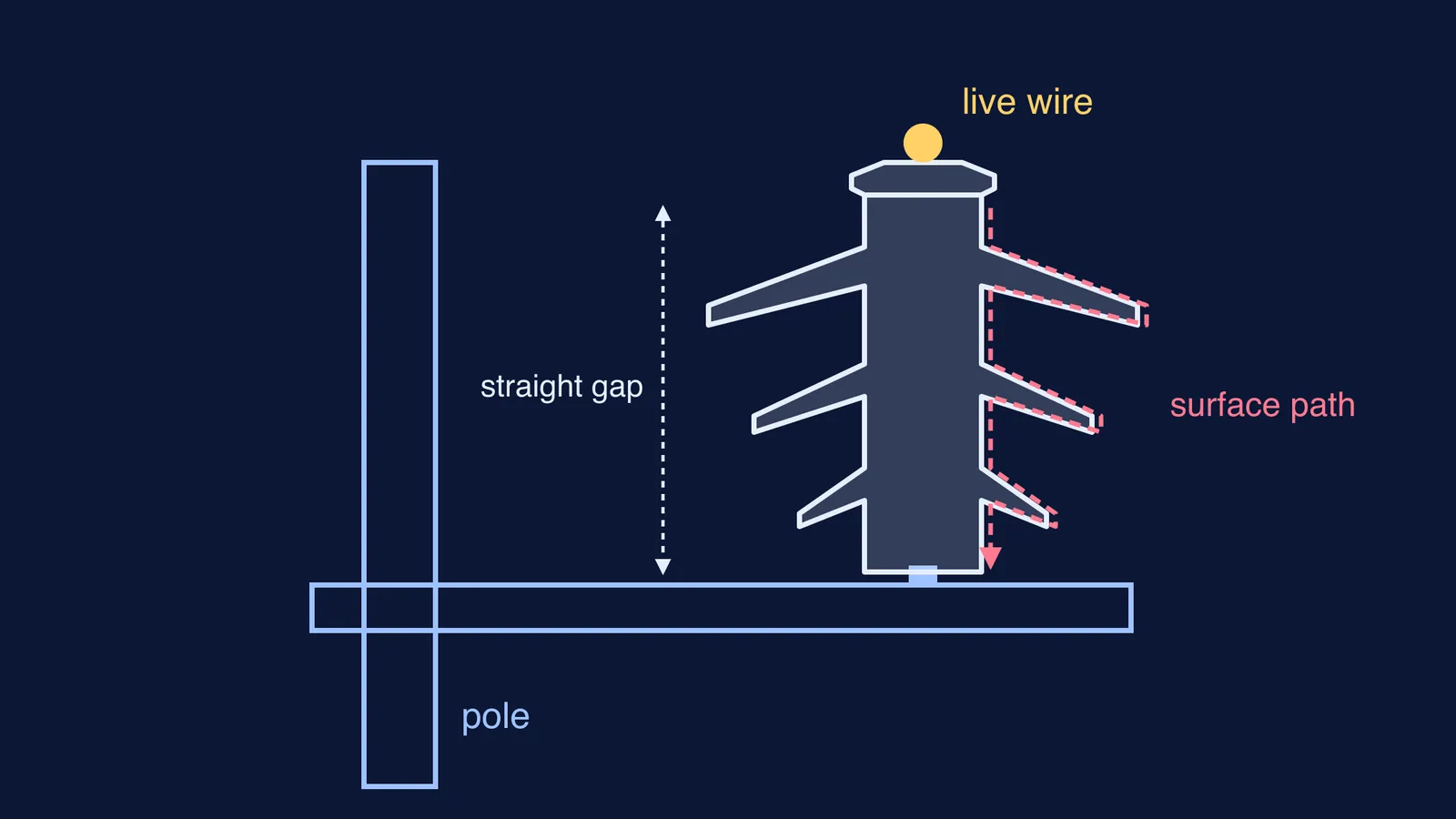
This is why the cups exist. Each ridge, called a shed, is a downward-facing cup that acts as an umbrella, so the part of the surface underneath stays dry in wet weather, as Wikipedia) describes. The sheds also lengthen the creepage distance, the path a leak must follow along the surface. The same source gives minimum creepage distances of 20 to 25 mm per kV, more near the sea or in polluted areas. As a rough estimate, an 11 kV insulator needs a surface path of 220 to 275 mm, folded over the sheds so the insulator stays short.
How do you read the insulators on your street?
Try this checklist on your next walk.
One cup on a pin, wire on top: a pin insulator. Wikipedia) says pin-type insulators are used up to 33 kV, so this is usually a local distribution line.
A hanging chain of discs: a suspension string, used on higher-voltage lines. Our post on why electricity is transmitted at high voltage works out why those lines run so high.
Glass discs instead of white porcelain: toughened glass. It is heat-treated to shatter when damaged, so a broken unit is easy to spot, according to Wikipedia) and Power Line magazine.
Then ask: where would current have to go to reach the ground, and what stops it? It pairs well with our explainer on why birds on a power line don't get an electric shock.
If creepage paths and leakage currents are hard to picture from a paragraph, the Fermi Simulation Lab has interactive simulations for ideas that are easier to see than to read. To practise more R = ρL/A problems like the one above, the Fermi Problem Library has a step-by-step solver that explains the reasoning rather than printing an answer.