On this page
Mud is a mixture of water and fine clay particles. When exposed to the sun or air, the water slowly evaporates.
This loss of water causes the volume of the mud to decrease. As the water leaves, capillary forces pull the tiny clay particles closer together. However, the top layer of the mud shrinks faster than the damp layers underneath. Because the top layer is anchored to the moist, unshrinkable mud below, it cannot contract freely. This tug-of-war builds up tensile stress—a stretching force pulling the surface apart.
Imagine pulling on a rubber band until it snaps. When the tensile stress exceeds the cohesive strength of the mud, a fracture opens to release the tension.
Why clothes take so long to dry in the monsoon
Why do initial cracks meet at 90 degrees?
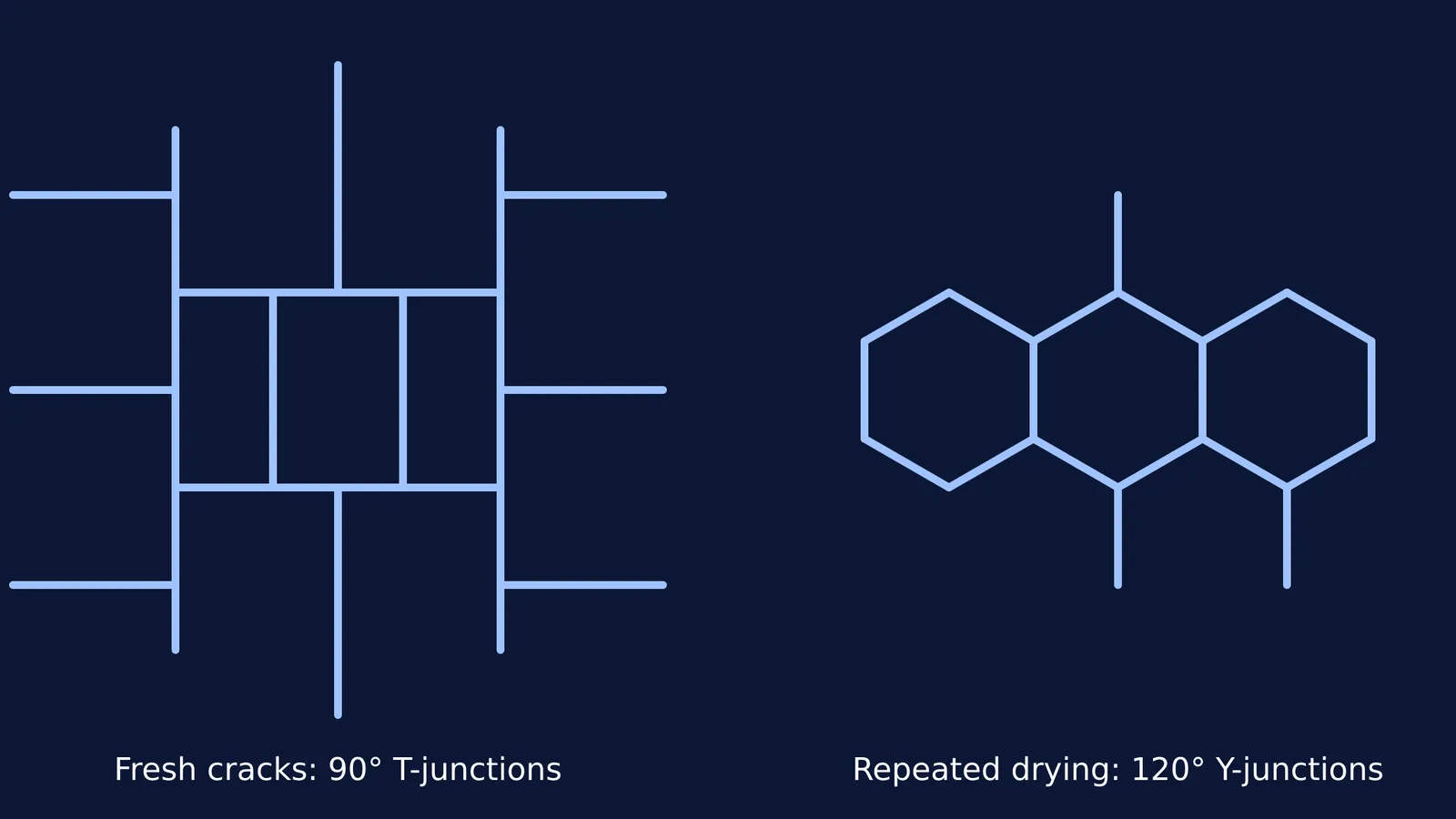
If you watch a fresh puddle dry for the first time, you will notice the cracks often form rectangles. This happens because the mud does not fracture all at once; the cracks form one by one.
When a primary crack opens, it completely relieves the tension pulling perpendicular to its length. However, the stress pulling parallel to the crack remains strong. As the mud continues to dry, a secondary crack will begin to grow towards the first one.
Because materials naturally tear perpendicular to the greatest pulling force, the new crack changes direction to run exactly perpendicular to the remaining parallel stress. This forces the new crack to meet the old one at exactly 90 degrees, forming a T-junction.
If you struggle to picture how invisible forces like tension and stress act in different directions, the Fermi Simulation Lab provides interactive simulations for ideas that are easier to see than to read.
How do cracks turn into hexagons?
While a single drying event creates right-angled blocks, older mud flats look like honeycombs made of hexagons. This structural evolution was explained in a 2010 study published in the journal *Soft Matter* by physicist Lucas Goehring and his colleagues.
The researchers found that when mud undergoes repeated cycles of wetting and drying—such as during alternating rain and sunshine—the cracks 'heal' slightly as the mud swells, and then reopen as it dries. Because the old cracks remain lines of structural weakness, the mud remembers where they were.
However, the exact order in which the cracks open changes slightly in each cycle. Over time, the junctions physically migrate through the mud to find a more stable, energy-efficient arrangement.
The study found that the cracks reach this stable state after approximately four to five generations of wetting and drying. At this point, the rigid T-junctions shift into Y-junctions where three cracks meet at 120-degree angles. This 120-degree geometry is the most efficient way to distribute stress evenly in all directions, minimising the energy required to maintain the crack network. Further research shows it is the same fundamental physics that makes soap bubbles and volcanic basalt columns hexagonal.
A field guide to reading mud cracks
You can use the geometry of mud cracks to understand the history of a landscape. The next time you see a dried puddle or a riverbed, use this checklist to read its history:
Look for T-junctions (90°): If the cracks form squares and rectangles, you are looking at a fresh crack network from a single, recent drying event.
Look for Y-junctions (120°): If the shapes are mostly hexagonal, the mud has been wetted and dried multiple times over weeks or months, reaching its most stable energy state.
Check the crack width: Wider cracks suggest a higher clay content or a longer period of severe dehydration.
Find the 'up' direction: Geologists use ancient, fossilised mud cracks to tell which way was up when the rock originally formed. Because the top of the mud dries first and shrinks the most, the resulting cracks are V-shaped, always tapering downwards.
Read more about everyday physics: Why does a glass of cold water get wet outside?