On this page
You walk past a park just after the mali has run the mower, and the air suddenly smells green. That smell is the grass reacting to being cut.
What chemical makes cut grass smell?
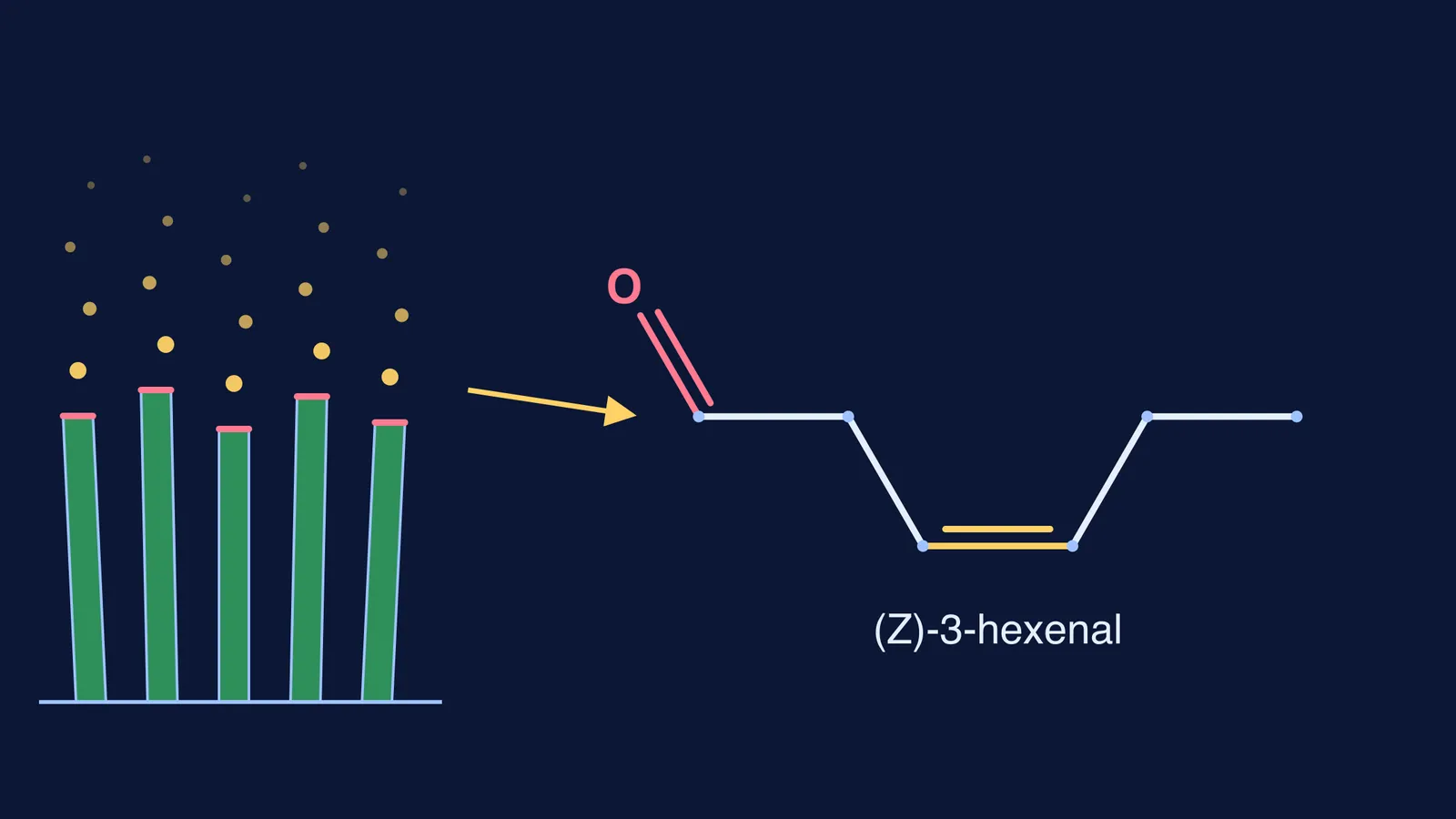
The smell comes from green leaf volatiles (GLVs), which a 2004 study in PNAS by Engelberth and colleagues describes as six-carbon aldehydes, alcohols and esters that plants commonly give off when they are mechanically damaged or eaten.
A 2013 review by Scala and colleagues in the International Journal of Molecular Sciences says the group takes its name from a fragrance that people perceive much like grass clippings, and that GLVs are made by almost all green plants.
The first one a wounded leaf makes is (Z)-3-hexenal, formula C6H10O, with a molar mass of 98.14 g/mol, according to PubChem. PubChem describes it as a colourless liquid with a "powerful grassy, apple-like" odour.
How does a cut leaf make the smell so fast?
The leaf does not store the smell. It makes it on the spot when cells break open, through the chain of steps set out in the Scala review:
Cutting breaks the cells, and enzymes called lipases free α-linolenic acid, a fatty acid, from membrane fats.
Enzymes called 13-lipoxygenases add oxygen to it, making a hydroperoxide.
A second enzyme, hydroperoxide lyase, cuts that molecule and gives (Z)-3-hexenal.
Some (Z)-3-hexenal changes into its isomer (E)-2-hexenal, and other enzymes turn some of it into alcohols and esters.
The same review reports that in wounded Arabidopsis leaves, (Z)-3-hexenal forms 30 to 45 seconds after damage, and the alcohol and acetate follow at about 5 minutes. In aspen, the review says (Z)-3-hexenal is given off within two seconds of wounding. That is why the smell reaches you almost as soon as the mower blade passes.
Is the smell a plant's distress signal?
Partly, and "may" is the honest word. Researchers have found several jobs for these chemicals, mostly in lab and greenhouse experiments:
Calling for help. The Scala review notes that a blind predatory mite depends on volatiles from attacked plants to find plants infested with its prey, spider mites.
Fighting microbes. (Z)-3-hexenal and (E)-2-hexenal have antimicrobial activity and can inhibit the growth of several strains of bacteria, the same review reports.
Warning neighbours. In the Engelberth study, corn seedlings that had been exposed to GLVs from neighbouring plants made significantly more jasmonic acid, a defence hormone, when they were later damaged and treated with caterpillar regurgitant. The gas primed them.
So "a chemical signal of injury" is fair. "The lawn is screaming" is not: the evidence comes from controlled experiments on plants such as corn and Arabidopsis, not lawns.
Why does the cut-grass smell fade?
First, these molecules are small and get into the air easily. You can only smell a chemical once some of it has reached your nose as a gas, and in open air that gas spreads out and gets diluted. The same idea of molecules escaping from a liquid explains why alcohol evaporates faster than water.
Second, the mixture keeps changing. As the Scala review describes, (Z)-3-hexenal turns into (E)-2-hexenal, alcohols and esters, so the smell shifts as well as fading.
The fade has been measured. Ian Galbally of CSIRO and Wayne Kirstine of Monash University sampled a grass paddock in Victoria, Australia, with a transparent chamber for two years. According to the CSIRO release reported by ScienceDaily, emissions rose about 100-fold after the grass was cut and took hours to fall back to normal. Even uncut grass gave off the most in warm weather around midday, and none at night. Their paper in the Journal of Geophysical Research found significantly higher emissions from freshly mown grass and clover, including (Z)-3-hexenal and (E)-2-hexenal.
If molecules escaping into the air are hard to picture, the Fermi Simulation Lab has interactive simulations for ideas that are easier to see than to read.
Try it: a 15-minute smell experiment
You need two blades of grass (or any soft green leaf), a watch and a notebook. Skip this if grass makes you sneeze or itch.
Hold a whole, uncut blade near your nose. Give the smell a score from 0 (nothing) to 3 (strong).
Tear and crush the second blade between your fingers. Score it straight away, then again after 1, 5 and 15 minutes.
Repeat with one blade warmed in the sun and one kept in the shade.
Predict before you smell, then check: does crushed beat whole, since the enzymes need broken cells? Does warm beat cool, since warmer molecules escape faster?
For a 3-mark board answer to "Why does freshly cut grass smell?", give three points: damaged cells release a fatty acid; enzymes turn it into volatile six-carbon compounds such as (Z)-3-hexenal; these get into the air easily and may act as an injury signal. For the earthy smell after a storm, which comes from different molecules and a different cause, read why the ground smells after the first rain.
If a step in the chain is unclear, the Fermi Concept Library has a lesson for every concept in chemistry and biology.