

On this page
Questions like "Which of these orbitals is not possible: 2p, 3f, 4d, 5s?" take ten seconds once you know a single inequality. Here is the rule, why it holds, and a quiz to check yourself.
What does the rule l ≤ n − 1 say?
An orbital label such as 3d packs in two quantum numbers. The number is the principal quantum number n, and the letter stands for the azimuthal quantum number l.
The principal quantum number n can be any positive integer: 1, 2, 3 and so on (OpenStax Chemistry 2e, section 6.3).
For a given n, l can take only the integer values 0, 1, 2, … , n − 1 (OpenStax Chemistry 2e, section 6.3).
The letters are codes for l: s means l = 0, p means l = 1, d means l = 2, f means l = 3 and g means l = 4 (OpenStax, same section). Put another way, each shell n has exactly n subshells (LibreTexts, Quantum Mechanics and Atomic Orbitals/06%3A_Electronic_Structure_of_Atoms/6.05%3A_Quantum_Mechanics_and_Atomic_Orbitals)).
Why do 2d and 3f orbitals not exist?
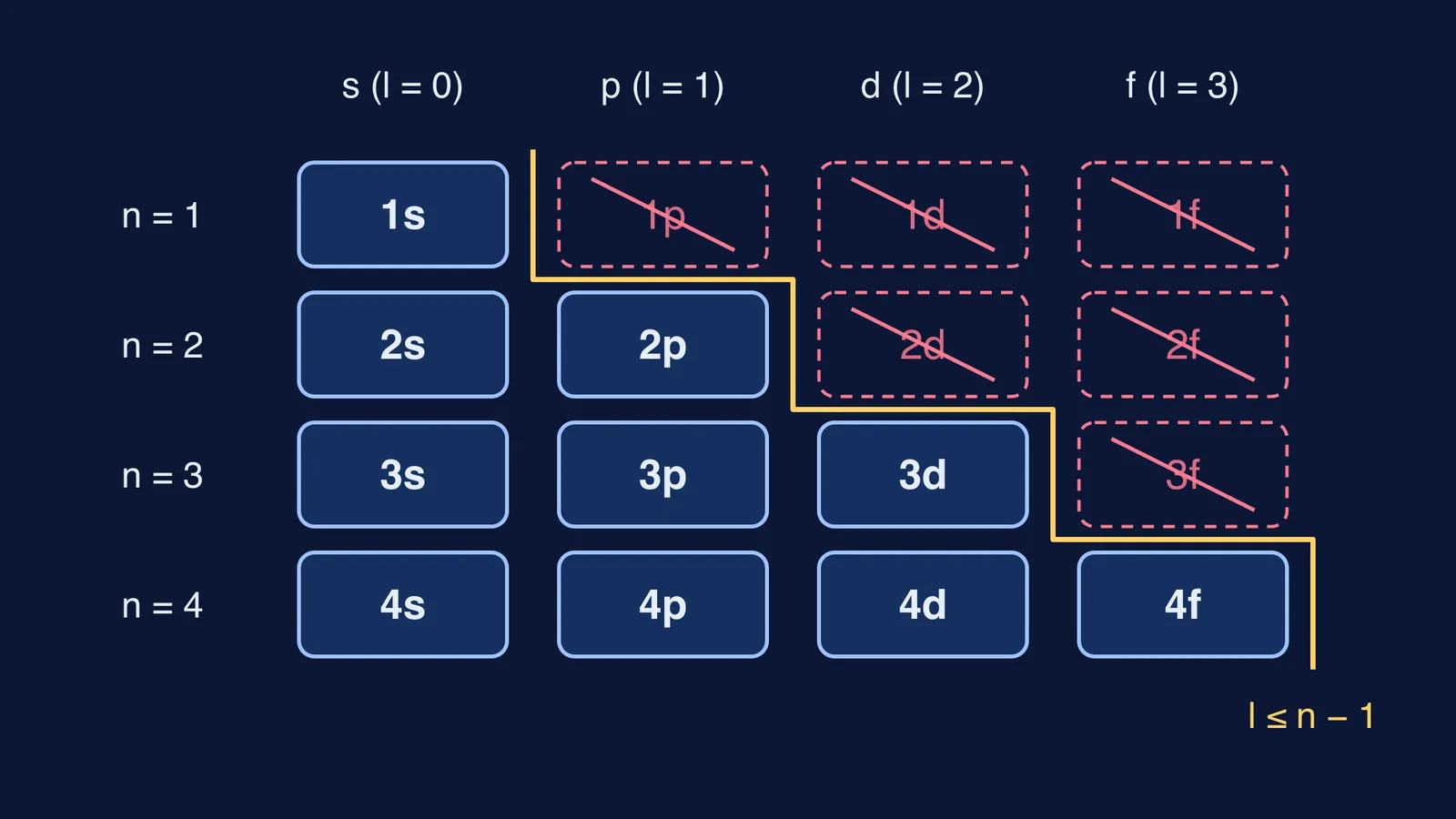
Take n = 2. The rule lets l be 0 or 1, so the second shell holds 2s and 2p and nothing else. A d orbital needs l = 2, which is bigger than n − 1 = 1, so 2d is ruled out. In the same way, n = 3 allows l = 0, 1 and 2 (3s, 3p, 3d), but an f orbital needs l = 3, so 3f cannot exist.
Counting nodes is a useful consistency check. An orbital has n − 1 nodes in total, l of them angular and n − l − 1 of them radial (LibreTexts, Radial Nodes/Quantum_Mechanics/09._The_Hydrogen_Atom/Radial_Nodes)). For a 2d orbital, that would mean 2 − 2 − 1 = −1 radial nodes. A negative node count makes no sense, which fits the rule: d shapes first appear at n = 3.
Which subshell labels are possible in each shell?
Working the rule shell by shell gives this list:
n = 1: only 1s. Impossible: 1p, 1d, 1f.
n = 2: 2s and 2p. Impossible: 2d, 2f.
n = 3: 3s, 3p and 3d. Impossible: 3f.
n = 4: 4s, 4p, 4d and 4f. Impossible: 4g.
n = 5: 5s up to 5g are all allowed by the rule.
A shortcut worth memorising is that each letter first appears at n = l + 1. So s starts at 1, p at 2, d at 3, f at 4 and g at 5. Any label whose number is smaller than that starting point is invalid. For more on counting how many subshells and orbitals each shell holds, see how many subshells and orbitals are in each shell n.
How do you spot an invalid set of quantum numbers?
Exam questions often give four numbers (n, l, ml, ms) instead of a label. Run these four checks in order and stop at the first failure:
Is n a positive integer (1, 2, 3 …)?
Is l between 0 and n − 1?
Is ml a whole number from −l to +l? There are 2l + 1 such values (OpenStax Chemistry 2e, section 6.3).
Is ms either +1/2 or −1/2?
Check 2 catches the 2d and 3f traps. Check 3 catches sets like l = 1, ml = −2. For more worked sets, read which set of quantum numbers is not possible. To work backwards from an element, see how to find the quantum numbers of the last electron.
Quiz: can you spot the impossible orbitals?
Mark each item as possible or impossible, then check the answers below.
3f
4d
1p
n = 2, l = 2, ml = 0, ms = +1/2
n = 3, l = 1, ml = −2, ms = −1/2
n = 4, l = 3, ml = −3, ms = −1/2
n = 3, l = 0, ml = 0, ms = 0
5g
Answers:
Impossible: f means l = 3, but n = 3 allows l up to 2.
Possible: d means l = 2, and n = 4 allows l up to 3.
Impossible: p means l = 1, but n = 1 allows only l = 0.
Impossible: this is a 2d electron, and l = 2 fails check 2.
Impossible: with l = 1, ml can only be −1, 0 or +1.
Possible: a 4f electron, and every check passes.
Impossible: ms must be +1/2 or −1/2.
Possible by the rule: g means l = 4, and n = 5 allows l up to 4.
If you got items 4 or 5 wrong, revisit how ml depends on l. The Fermi Concept Library gives each concept its own lesson and its place in the map. For practice, the Fermi Problem Library has worked problems with a step-by-step solver that explains the reasoning rather than printing an answer.


