

On this page
When evaluating quantum numbers, a single broken rule makes the entire set impossible. In multiple-choice questions, examiners rely on predictable tricks to test whether you know the mathematical limits of the principal (n), azimuthal (l), magnetic (m_l), and spin (m_s) quantum numbers.
According to the OpenStax *Chemistry 2e* textbook, no two electrons in an atom can have the exact same set of four coordinates. But before electrons even fill an orbital, the coordinates themselves must be valid.
What are the rules for allowed quantum numbers?
To determine if a set of quantum numbers is possible, you must check it against four fundamental rules:
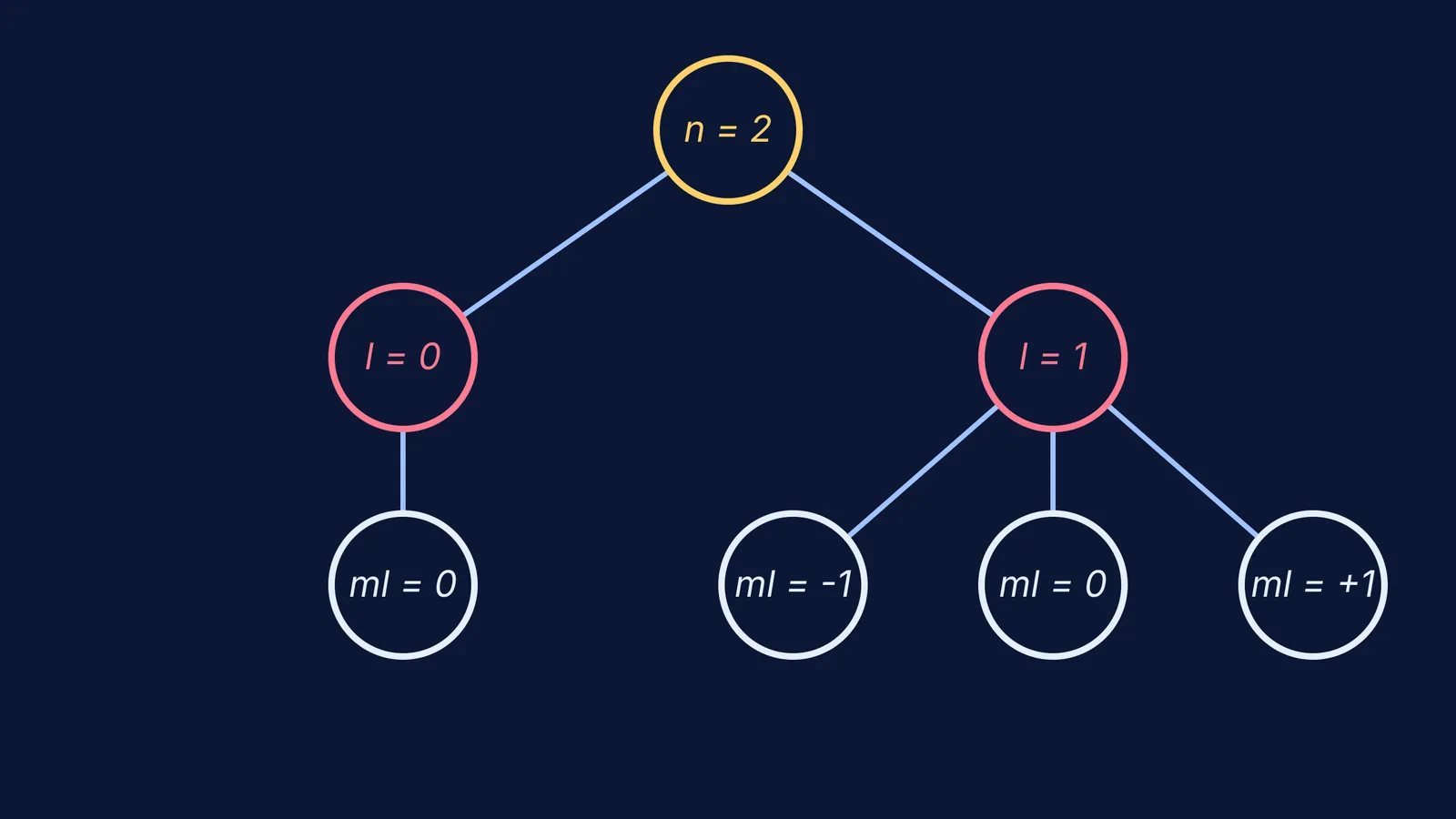
Principal Quantum Number (n): This defines the energy level or shell. It must be a positive integer (1, 2, 3, …). It can never be zero or negative.
Azimuthal Quantum Number (l): This defines the shape of the subshell. Its value must be an integer ranging from 0 to n - 1. This means l must always be strictly less than n.
Magnetic Quantum Number (m_l): This defines the orientation of the orbital in space. It must be an integer between -l and +l, including zero.
Spin Quantum Number (m_s): This describes the intrinsic spin of the electron. It is restricted to only two possible values: +1/2 or -1/2.
If you want to trace how these numbers govern the periodic table and fill atomic orbitals step by step, the Fermi Concept Library has every concept in physics, chemistry, biology, mathematics and computing, each with its own lesson and its place in the map.
Which set of quantum numbers is not possible?
When you face an exam question asking you to identify the impossible set, you do not need to memorise combinations. Instead, look for three common violations.
Violation 1: l is equal to or greater than n
Look at the set n = 3, l = 3, m_l = -1, m_s = +1/2. This fails because l cannot equal n. For n = 3, allowed values for l are 0, 1, or 2 (s, p, or d subshells).
Violation 2: m_l exceeds the bounds of l
Consider n = 2, l = 1, m_l = +2, m_s = -1/2. This fails because |m_l| is larger than l. For l = 1 (a p orbital), permitted m_l values are -1, 0, and +1.
Violation 3: Incorrect spin values
A set like n = 4, l = 0, m_l = 0, m_s = 0 is invalid because m_s must be exactly +1/2 or -1/2.
How do you spot the wrong set in an exam?
Let us apply these rules to a standard worked example. Identify which of the following four sets of quantum numbers is not possible:
n = 4, l = 2, m_l = -1, m_s = +1/2
n = 3, l = 2, m_l = -3, m_s = -1/2
n = 5, l = 3, m_l = 0, m_s = +1/2
n = 2, l = 0, m_l = 0, m_s = -1/2
For the first set, n = 4 and l = 2 (a 4d subshell). The magnetic number m_l = -1 falls between -2 and +2, and the spin m_s is +1/2. This set is fully valid.
For the second set, n = 3 and l = 2. The azimuthal rule is met, but m_l must be between -2 and +2. The given value of -3 falls outside this range, making it the impossible set.
The remaining options follow the rules. In the third set (n = 5, l = 3), m_l = 0 is permitted. In the fourth set (n = 2, l = 0), m_l must be 0.
What is a quick checklist for multiple-choice questions?
To save time and avoid careless mistakes during a test, run each given set (n, l, m_l, m_s) through this mental checklist:
Is n a positive integer of 1 or higher?
Is the second number (l) strictly smaller than the first number (n)?
Is the magnitude of the third number (|m_l|) less than or equal to the second number (l)?
Is the fourth number (m_s) exactly +1/2 or -1/2?
The moment you answer "no" to any of these questions, you have found the impossible set. By checking n first, then comparing l to n, and finally comparing m_l to l, you guarantee you will catch the error without having to guess. If you get stuck on problems that mix these rules with complex atomic structures, the Fermi Problem Library has worked problems with a step-by-step solver that explains the reasoning rather than printing an answer.
For further reading on how these mathematical bounds arise from physical principles, you can explore the history of Erwin Schrodinger and the wave equation behind atomic orbitals or read about the electron configuration of ions like Fe³⁺ and Cu⁺: which go first. If you want to review foundational definitions, our guide on quantum numbers and electron configuration, rule by rule explains each atomic coordinate in detail.


